

Content
- What is the India-New Zealand Free Trade Agreement?
- Mega AI summit
- Indian Navy’s stitched sailing vessel INSV Kaundinya sets off for Oman
- Karen and Arakan (Rakhine) Regions
- The importance of being a hill
Explained -What is the India-New Zealand Free Trade Agreement?
Why in News ?
- India and New Zealand have concluded a Free Trade Agreement (FTA) in December 2025 — hailed as the fastest-negotiated FTA (nine months) — providing zero-duty access for 100% of India’s exports to New Zealand and targeting $20 billion FDI inflows by 2030.
- The deal is positioned as a gateway to Oceania and Pacific Island value chains, aims to double bilateral trade (~$1.3 bn) in five years, and is notable for being negotiated by an entirely women-led team.
- Strategically, it marks India’s push toward trade diversification, supply-chain resilience, and deeper integration into global value chains (GVCs) amid tariff headwinds and slowing progress on the Indo-U.S. trade track.
Relevance
GS-III | Economy, Trade, Infrastructure
- Trade diversification, export competitiveness, supply-chain resilience.
- Global Value Chains (GVCs), FDI inflows, manufacturing & services linkages.
- MSMEs, labour-intensive sectors, tariff policy, rules-of-origin safeguards.
GS-II | International Relations & Economic Diplomacy
- Bilateral engagement, strategic partnerships, market access diplomacy.
- Geopolitics of FTAs, diversification beyond U.S./EU/China.
From Basics — Strategic Context
- Trade diversification push
- Shift away from over-dependence on U.S., EU, and China-centric markets.
- New FTAs → U.K., Oman, Russia (ongoing), Pacific & West Asia partners.
- GVC positioning
- FTAs aligned with Make in India, PLI, technology transfer, and manufacturing integration.
- Objective → move from market access dependence to value-chain participation.
Key Features of the India–New Zealand FTA
- Market Access
- Zero-duty access for all Indian exports.
- India to liberalise 95% of imports, 57% duty-free from Day-1 (calibrated list).
- FDI Commitment
- $20 bn over 15 years with clawback safeguards.
- Focus → skills, services, mobility, 118 sectors.
- Services & Mobility Gains
- Easier movement for students, professionals, youth.
- Opportunities → IT, healthcare, education, construction, chefs, yoga & music instructors.
- Cultural & Soft Power Linkages
- Indian diaspora ~5% of NZ population (~3 lakh) strengthens people-to-people ties.
- Traditional Knowledge Access
- First-time facilitation of Ayurveda, yoga, traditional medicine services.
Sensitive-Sector Safeguards
- Agriculture & Dairy kept outside FTA
- No concessions on milk, butter, cheese, yogurt, oils, sugar, spices, rubber, onions.
- Protects farmers, SMEs and cooperatives against a major global dairy exporter.
- Cooperation without Market Opening
- NZ to assist India’s fruit & honey productivity, supply chains, quality standards, centres of excellence.
Relevance to Global Value Chains (GVCs)
- Moves India up the value ladder
- Encourages manufacturing collaboration, skill-linked services exports, MSME participation.
- Gateway to Oceania & Pacific supply networks
- Expands market reach, logistics corridors, export diversification.
- Investor-friendly framework
- Predictable rules → supports value-chain anchoring and cross-border co-production.
Strategic Significance
- Geo-economic diplomacy
- FTAs as instruments for long-term trade alliances, not transactional access.
- Resilience against tariff shocks
- U.S. tariff tightening + slow bilateral progress → push for alternate market footholds.
- Employment & skills pathway
- Labour-intensive sectors gain → textiles, leather, gems & jewellery, engineering goods, processed food.
Criticisms & Risks
- In New Zealand
- Criticised for excluding dairy & agriculture — called “not fair or free” by political partners.
- In India
- Concerns over trade deficits and asymmetric gains from past FTAs.
- Success depends on implementation, monitoring, rules-of-origin discipline, anti-dumping enforcement.
Way Forward
- Strengthen domestic competitiveness
- Quality standards, productivity, export capability, MSME upgrading for GVC participation.
- Enforce safeguards
- Robust ROO checks, supply-chain traceability, anti-dumping provisions.
- Invest in R&D & capability building
- Move from market-access gains → value-addition positioning.
- Leverage services + manufacturing synergy
- Skill mobility + production partnerships → GVC embedding, not shallow trade growth.
Mega AI summit
Why in News ?
- India is set to host the AI Impact Summit 2026, positioned at a global scale comparable to the 2023 G-20 Summit, with participation expected from 15–20 heads of state and around 1,00,000 delegates at the main event.
- The summit is part of the annual multilateral AI governance track that began at Bletchley Park (U.K., 2023) and continued through Seoul (2024) and Paris (2025), where India was handed the mandate to host the 2026 edition.
- The event seeks to shape global discourse on AI safety, trust, governance, and economic transformation, while strengthening India’s role as a leader of the Global South in AI policy coordination.
Relevance
GS-III | Science & Technology, Innovation, Economy
- AI governance, frontier-AI safety, digital public infrastructure.
- Future of work, skills, innovation diplomacy, technology leadership.
Evolution of the Global AI Summit Process
- Bletchley Park Declaration (2023) → 27 participating countries; focus on frontier AI safety risks.
- Subsequent editions expanded participation to 100+ countries, signalling widening consensus-building on AI governance.
- India’s mandate for 2026 reflects growing geopolitical relevance in digital diplomacy & tech governance.
Summit Scale & Stakeholders
- Participation
- Heads of State (15–20), ministers, regulators, and multilateral institutions.
- Top AI labs & firms — Anthropic, Google DeepMind, and other global leaders (tentative confirmations).
- Significant presence from Global South countries.
- Engagement Format
- Large ecosystem mobilisation through multiple pre-summit events in India and abroad.
Core Themes for Deliberation
- AI & the Future of Work — productivity, labour-market transitions, skills & inclusion.
- Trust, Safety & Governance Protocols — frontier model safeguards, accountability, evaluation frameworks.
- Sectoral AI Applications — health, finance, manufacturing, public services, climate, education.
- Global Coordination Architecture — cooperation between governments, research labs, and industry.
Strategic Significance for India
- Positions India as a rule-shaper in emerging AI governance, not just a technology user.
- Strengthens Global South leadership in debates on access, equity, capacity-building, and responsible innovation.
- Enhances innovation diplomacy — collaboration with major AI firms & research institutions.
- Supports domestic AI agenda — investments in compute, skills, and industry-research linkages.
Opportunities & Challenges
- Opportunities
- Platform to push risk-based governance + innovation-friendly frameworks.
- Chance to secure partnerships, funding, and technology collaboration.
- Framework for inclusive global AI standards reflecting developing-country needs.
- Challenges
- Translating declarations into implementation & institutional mechanisms.
- Balancing safety norms with growth and market innovation.
- Avoiding over-securitised or firm-dominated governance structures.
Indian Navy’s stitched sailing vessel INSV Kaundinya sets off for Oman
Why in News ?
- INSV Kaundinya, the Indian Navy’s indigenously built traditional stitched sailing vessel, has embarked on its maiden overseas voyage from Porbandar (Gujarat) to Muscat (Oman).
- The expedition aims to revive and celebrate India’s ancient maritime heritage, retracing historic sea routes that fostered trade, cultural exchange, and civilisational linkages between India and Oman across the Indian Ocean.
Relevance
GS-I | Culture & Heritage
- Maritime heritage, indigenous shipbuilding traditions, historical trade routes.
GS-II | International Relations
- Maritime diplomacy, India–Oman ties, IOR cultural linkages, SAGAR vision.
What is a Stitched Sailing Vessel?
- Construction technique
- Hull planks are stitched together using natural fibre cords, instead of metal nails or rivets.
- Historical use
- Practised for centuries along India’s western coast — Gujarat, Konkan, Kerala.
- Enabled long-distance Indian Ocean navigation, monsoon sailing, and coastal trade.
- Civilisational significance
- Symbol of indigenous shipbuilding, seamanship, and navigation traditions rooted in maritime archaeology and textual references.

Voyage & Mission Highlights
- Route: Porbandar → Muscat (retracing ancient trade corridors).
- Crew: 4 officers + 13 sailors;
- Symbolism: Re-affirmation of Gujarat-Oman historical maritime ties and people-to-people connect.
Overview
1) Heritage Revival (Cultural & Historical Lens)
- Recreates living maritime traditions rather than museum-based remembrance.
- Strengthens awareness of India’s pre-modern oceanic trade networks and cultural interchanges in the Arabian Sea littoral.
2) Maritime Diplomacy (Strategic & Soft-Power Lens)
- Functions as heritage-led diplomacy, deepening relations with Oman and the wider Gulf & Indian Ocean Region (IOR).
- Supports India’s SAGAR vision (Security and Growth for All in the Region).
3) Naval Identity & Institutional Learning
- Reinforces the Navy’s evolution from colonial maritime narratives to indigenous seafaring identity.
- Provides a practical learning platform for seamanship, traditional navigation, and endurance sailing.
4) Cultural Economy & Tourism Linkages
- Potential to develop maritime heritage tourism, coastal craft revival, skill preservation, and community livelihoods along the western seaboard.
5) Geopolitical & Civilisational Signalling (Advanced Context)
- Positions India as a civilisational maritime power with deep historical roots in the IOR.
- Complements contemporary naval engagements with symbolic soft-power projection and people-centric diplomacy.
Strategic Significance for India–Oman Relations
- Reinforces trust, friendship, and historic connectivity between the two nations.
- Adds cultural depth to an already strong partnership in defence, energy, diaspora ties, and logistics cooperation.
Karen and Arakan (Rakhine) Regions
Why in News ?
Elections are underway in Myanmar (three-phase polling from Dec 28, 2025 to Jan 2026), and rebel groups from the Karen and Arakan/Rakhine regions have expressed dissatisfaction with India’s response, urging stronger pressure on the junta for an inclusive process.
Relevance
GS-II | International Relations — Neighbourhood First
- India–Myanmar relations, border security, refugee flows, democratic processes.
- China factor, ethnic armed groups, diplomatic signalling.
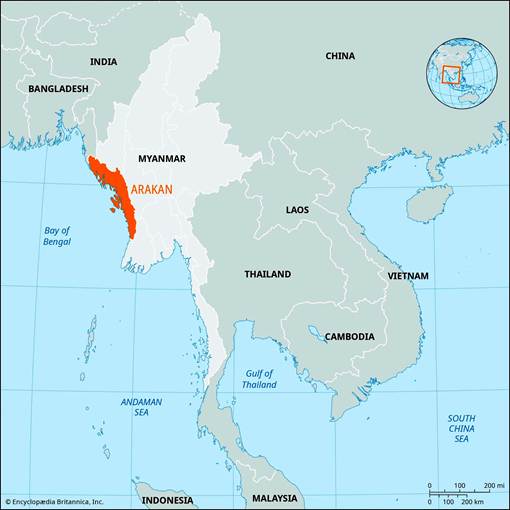
Where are Karen & Arakan (Rakhine) Regions?
- Karen (Kayin) State
- Location: Southeastern Myanmar, bordering Thailand; mountainous–forest terrain.
- People: Predominantly Karen ethnic minority.
- Capital: Hpa-An.
- Arakan / Rakhine State
- Location: Western Myanmar, along the Bay of Bengal, bordering Bangladesh.
- Capital: Sittwe.
- Known for ethnic contestations, including Rakhine groups and Rohingya communities.
The importance of being a hill
Why in News ?
- The article reflects on the ecological, cultural, historical, and civilisational importance of hills and hill ranges in India, in the backdrop of the Supreme Court’s November 20, 2025 judgment on the Aravalli range, which critics fear could dilute protections and enable destructive land-use changes.
- Using examples such as Pavagadh, the Vindhyas, Satpuras, Eastern Ghats, and the Aravallis, it argues that hills are not minor landforms, but critical ecosystems, strategic landscapes, and heritage spaces essential to human history and environmental stability.
Relevance
GS-III | Environment, Ecology, Biodiversity
- Ecosystem services of hill ranges — watersheds, climate buffers, carbon sinks.
- Conservation vs land-use change, sustainable hill governance.
GS-I | Geography & Culture
- Physiography of Indian hill ranges; civilisational, archaeological significance.
What is a Hill and Why It Matters ?a
- Hills vs Mountains
- Mountains are typically higher and steeper; hills are smaller but geologically, ecologically, and culturally significant.
- Global significance
- Hills and mountains cover ~25% of Earth’s land area and support ~40% of the world’s population (Ecological Indicators, 2024).
- Core ecosystem services
- Water storage & watershed protection
- Flood moderation & climate regulation
- Carbon sequestration & oxygen production
- Natural barriers & wind / desert-sand buffers (e.g., Aravallis)
Historical & Civilisational Importance — Key Illustrations
1) Pavagadh Hill (Gujarat) — Culture, Power & Settlement
- Part of Deccan Traps / Aravalli-extension zone; strategic height fostered urban settlement & dynastic control.
- Capital of Mahmud Begada’s Champaner (1484) — a symbol of trade control, political authority, and architectural legacy.
2) Vindhya Range — Boundary, Watershed, Culture
- Acts as a civilisational and geographic divide between Indo-Gangetic plains & Deccan Plateau.
- Major river systems arise here (Betwa, Ken, Son, Parbati, Kali Sindh).
- Hosts rich teak–sal–bamboo ecosystems and megafauna.
3) Satpura Range — Biodiversity Corridor & “Faunal Bridge”
- Satpura Tiger Reserve → rare & endemic flora (bryophytes, pteridophytes).
- Satpura Hypothesis → corridor enabling faunal dispersal between Himalayas & Western Ghats.
4) Eastern Ghats — Tribal Landscapes & Seed Diversity
- Home to ancient tribal communities and 454 endemic plant species.
- Jeypore Tract → secondary centre of origin of cultivated rice (high agro-biodiversity value).
5) Archaeological & Anthropological Significance
- Rock shelters like Bhimbetka → evidence of early human habitation, art, and evolution.
Why Hills Are Irreplaceablec?
- Ecological buffers → regulate rainfall, microclimates, groundwater recharge.
- Cultural geographies → pilgrimage, heritage landscapes, identity spaces.
- Strategic terrain → control over trade routes, defence vantage, settlement evolution.
- Human–nature continuity → habitats supporting communities, wildlife, livelihoods.
The critique warns that reducing hills to narrow legal/technical definitions risks legitimising mining, real-estate expansion, and ecological fragmentation, undermining their multidimensional value.
Key Takeaway
- Hills are not expendable minor elevations; they are living ecosystems, historical archives, climate stabilisers, and cultural anchors.
- Any policy or judicial framework must treat them with ecological sensitivity, historical awareness, and long-term sustainability, rather than purely economic or land-use lenses.