
Published on Jan 8, 2026
Daily Editorials Analysis
Editorials/Opinions Analysis For UPSC 08 January 2026

Content
- Natgrid’, the search engine of digital authoritarianism
- Fine-tune this signal to sharpen India’s AMR battle
‘Natgrid’, the search engine of digital authoritarianism
Context & Background
- 26/11 Mumbai terror attacks (2008):
- Over 160 lives lost
- Exposed serious intelligence coordination failures
- Core problem identified:
- Intelligence inputs existed
- Failure lay in fragmentation, poor aggregation, and weak institutional response
- Example:
- David Headley’s travel, visas, hotel stays created data trails
- No system stitched these into a preventive warning
Relevance
GS-III (Internal Security & Technology)
- Counter-terrorism architecture post-26/11
- Use of big data, AI, analytics in internal security
- Limits of techno-solutionism in intelligence failures
- Shift from targeted intelligence to mass surveillance
- Institutional capacity vs technological capacity
Practice Question
Q1.“Security without accountability erodes democracy.”Critically examine this statement in the context of the expansion of NATGRID in India.(250 Words)
Birth of NATGRID: The Original Rationale
- Psychological and political aftermath of 26/11 led to:
- Expansion of intelligence architecture
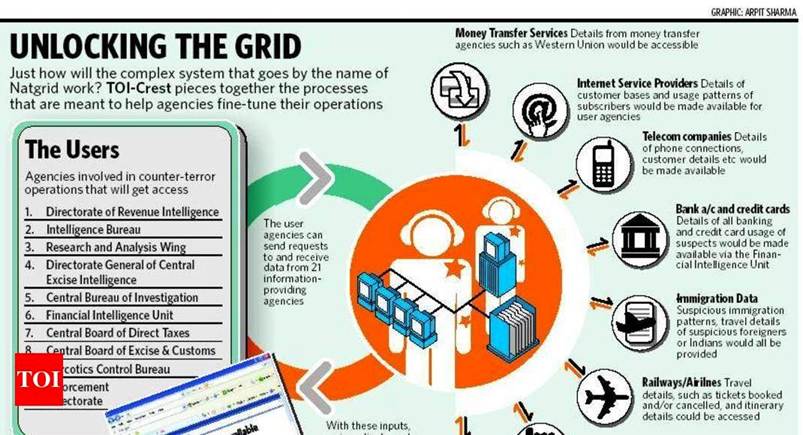
- Emergence of National Intelligence Grid (NATGRID) as the technological solution
- Core idea:
- A middleware platform
- Enables selected agencies to query multiple databases in real time
- Objective:
- Prevent future terror attacks through data integration
Design & Scope of NATGRID
- Access:
- Initially 11 central intelligence and investigative agencies
- Data sources (21 categories):
- Identity records
- Travel & immigration
- Financial transactions
- Telecom metadata
- Property & asset databases
- Function:
- Acts as a search-and-correlation layer, not a data owner
Constitutional & Legal Concerns
- Key constitutional question:
- Can a mass surveillance system function without:
- Parliamentary law
- Independent oversight?
- Can a mass surveillance system function without:
- Timeline:
- 2009: Public announcement
- 2010: Cabinet concerns on safeguards and privacy
- 2012: Cleared by executive order + CCS, not Parliament
- Funding:
- ₹1,002.97 crore (Horizon–I)
- Core issue:
- No statutory framework
- No oversight mechanism
From ‘Vaporware’ to Reality
- Long delays created belief NATGRID was symbolic
- Situation changed in 2025:
- ~45,000 queries per month
- Usage expanded to:
- State police forces
- Officers down to Superintendent of Police rank
- Shift:
- From elite intelligence tool → routine policing infrastructure
Integration with NPR: A Structural Turning Point
- NATGRID reportedly integrated with National Population Register (NPR)
- NPR contains:
- Data of ~1.19 billion residents
- Household, lineage and demographic linkages
- Why this is critical:
- Moves from event-based intelligence
- To population-wide surveillance
- Political sensitivity:
- NPR closely linked with NRC debates
- Result:
- Intelligence grid becomes a citizen-mapping platform
Technological Escalation: From Search to Inference
- Deployment of advanced analytics tools (e.g. “entity resolution” engines)
- Capabilities:
- Merge fragmented records into a single identity
- Link faces, telecom KYC, driving licences, travel data
- Transformation:
- From “search bar” → predictive inference system
- Risk:
- Algorithms infer intent, not just retrieve facts
Two Qualitative Dangers
1. Algorithmic Bias
- Algorithms reflect:
- Biases embedded in data
- Prejudices of policing practices
- Likely outcomes:
- Reinforcement of caste, religious, regional profiling
- Disparate impact:
- Affluent citizens → inconvenience
- Marginalised individuals → detention, harassment, violence
2. Tyranny of Scale
- Tens of thousands of queries monthly
- Safeguards claimed:
- Logging
- Sensitivity classification
- Problem:
- Without independent audit, safeguards become ritualistic
- No parliamentary or judicial supervision
Core Fallacy: Data ≠ Intelligence
- Intelligence failures are rarely due to:
- Lack of data alone
- Real causes:
- Institutional decay
- Poor training
- Lack of accountability
- 26/11 example:
- Local police lacked even basic firearms training
- NATGRID does not fix:
- Human competence
- Organisational incentives
- Political interference
Judicial & Democratic Deficit
- Supreme Court recognised right to privacy (Puttaswamy, 2017)
- Yet:
- Surveillance systems continue expanding
- No final adjudication on legality of NATGRID
- Pending issues:
- Absence of enabling law
- Absence of proportionality tests
- Absence of remedies for citizens
Security Narrative vs Accountability
- Public discourse shaped by:
- Political rhetoric
- Cultural normalisation of surveillance
- Questioning intelligence agencies seen as:
- Anti-national
- Consequence:
- Silence on accountability
- Even after fresh terror attacks (e.g. Delhi, Nov 2025)
Overall Assessment
- NATGRID has drifted from:
- Counter-terrorism tool
- To everyday surveillance infrastructure
- Without:
- Parliamentary oversight
- Judicial scrutiny
- Transparency
- It risks becoming:
- An architecture of suspicion
- A pillar of digital authoritarianism
Way Forward
- Genuine prevention requires:
- Professional, well-trained investigation
- Clear statutory backing for intelligence tools
- Parliamentary and judicial oversight
- Transparency about failures, not just data accumulation
- Core message:
- Security without accountability erodes democracy
- Technology cannot substitute institutional integrity
Fine-tune this signal to sharpen India’s AMR battle
Context & Trigger
- In the 129th edition of Mann Ki Baat (Dec 28, 2025), Prime Minister Narendra Modi explicitly flagged Antimicrobial Resistance (AMR) as a national concern.
- He cited national data from Indian Council of Medical Research (ICMR) showing:
- Declining effectiveness of antibiotics against pneumonia and urinary tract infections.
- Central message:
- Indiscriminate and self-medicated antibiotic use is at the core of India’s AMR crisis.
- This is seen as a possible anagnorisis (moment of realisation) capable of catalysing mass behavioural change.
Relevance
GS III – Health Security & Sustainable Development
- Antimicrobial Resistance as a non-traditional security threat
- Surveillance gaps and data-driven policymaking
- One Health approach (human–animal–environment interface)
- Global health governance (WHO, GLASS)
- Long-term economic costs of health crises
Practice Question
Q1.Antimicrobial Resistance is increasingly being viewed as a silent pandemic.Discuss the reasons for its rapid spread in India and evaluate the adequacy of existing policy responses.(250 Words)
What is AMR?
- Antimicrobial Resistance (AMR):
- Occurs when bacteria, viruses, fungi or parasites evolve to resist medicines.
- Consequence:
- Common infections become harder or impossible to treat.
- Increased mortality, longer hospital stays, higher health costs.
- Global recognition:
- WHO classifies AMR as one of the top global public health threats.
Why AMR is a Serious Problem in India
- India is:
- One of the largest consumers of antibiotics globally.
- Structural drivers:
- Over-the-counter antibiotic sales
- Self-medication culture
- Incomplete treatment courses
- Poor regulation of private healthcare
- Core contributor :
- Irrational use / misuse / overuse of antibiotics.
Significance of PM’s Intervention
- AMR had remained:
- Confined to hospitals, laboratories, experts, and policy documents.
- PM’s speech:
- Mainstreams AMR as a public behavioural issue.
- Translates technical warnings into citizen-level responsibility.
- Why this matters:
- Previous policy tools (National Action Plan on AMR, drug bans) had limited mass impact.
- A direct appeal from the head of government can alter social norms.
Behavioural Change as a Policy Tool
- Message delivered:
- Antibiotics are not casual medicines.
- Self-medication is dangerous.
- Strength:
- Targets the broadest base of the pyramid.
- Limitation:
- Awareness alone is necessary but not sufficient at India’s current AMR stage.
The One Health Imperative
- AMR is a multi-sectoral problem:
- Human health
- Animal health
- Environment
- One Health approach:
- Recognises interlinkages between:
- Antibiotic use in humans
- Antibiotics as growth promoters in animals
- Environmental contamination
- Recognises interlinkages between:
- Without this integrated approach:
- AMR behaves like a hydra-headed problem, regenerating across sectors.
Surveillance: The Weakest Link
- Effective AMR control requires:
- Accurate, representative, nationwide data.
- Present limitation:
- Surveillance heavily skewed towards:
- Urban areas
- Tertiary care hospitals
- Surveillance heavily skewed towards:
- Risk:
- Overestimation or distortion of national AMR trends.
- Community-level AMR remains under-reported.
India’s AMR Surveillance Architecture
NARS-Net
- National AMR Surveillance Network (NARS-Net):
- Established in 2013.
- Provides data to WHO’s Global Antimicrobial Resistance and Use Surveillance System (GLASS).
- Current status:
- ~60 sentinel medical college laboratories.
- Latest GLASS report (2023 data):
- Inputs from 41 sites across 31 States/UTs.
- Scope:
- Surveillance of 9 priority bacterial pathogens
- Some fungal pathogens.
Critical Gaps Highlighted
- Non-urban India largely absent from datasets.
- Primary and secondary care centres excluded.
- Private hospitals not systematically integrated.
- Result:
- National AMR picture is incomplete and potentially misleading.
Expert Viewpoint
- Dr. Abdul Ghafur (Chennai Declaration on AMR):
- Calls for true national representation.
- Advocates inclusion of:
- Primary healthcare
- Secondary hospitals
- Private sector facilities
- Rationale:
- Balanced, realistic estimation of resistance patterns.
- Evidence-based policy design.
Global Framework Reference
- WHO Global Action Plan on AMR (2015) outlines five pillars:
- Improve awareness and understanding
- Strengthen surveillance and research
- Reduce infection incidence
- Optimise antimicrobial use
- Ensure sustainable investment in new drugs, diagnostics, vaccines
- PM’s speech:
- Strongly advances Pillar 1 (awareness).
- Missing acceleration:
- Pillar 2 (surveillance expansion)
- Pillar 4 (enforcement and regulation)
What Still Needs Political Will ?
- Expanding surveillance sites nationwide
- Integrating private healthcare data
- Regulatory enforcement on antibiotic sales
- Investment in diagnostics and infection prevention
- Monitoring, accountability and inter-ministerial coordination
Overall Assessment
- PM’s statement is a necessary inflection point, not a complete solution.
- Awareness can:
- Slow misuse
- Change social behaviour
- But without:
- Robust surveillance
- One Health governance
- Regulatory enforcement
- AMR will continue to rise silently.
Way Forward
- India needs:
- Mass awareness + structural reform
- Surveillance that reflects community reality
- Integration of human, animal and environmental health
- Core takeaway:
- AMR is not just a medical issue; it is a governance and behavioural crisis.