
Published on Jan 9, 2026
Daily Editorials Analysis
Editorials/Opinions Analysis For UPSC 09 January 2026

Content
- Central Tax Devolution & GSDP Debate
- Top Court’s Green Governance & Regulatory Uncertainty
Central Tax Devolution & GSDP Debate
Why in News ?
- Recommendations of the 16th Finance Commission are yet to be tabled in Parliament.
- Renewed debate on fairness of Centre–State fiscal transfers, especially by high-performing States.
- Rising concerns over GST-induced fiscal centralisation, cesses/surcharges, and skewed devolution outcomes.
Relevance
- GS II – Polity & Governance
- Finance Commission and fiscal federalism
- Centre–State relations; cooperative vs competitive federalism
- GST and constitutional rebalancing of taxing powers
- GS III – Economy
- Public finance, tax devolution, inter-governmental transfers
- Efficiency vs equity in resource allocation
- Regional disparities and inclusive growth
Practice Question
- “Tax collection does not necessarily reflect tax contribution of States.”
Examine this statement in the context of the debate on using GSDP as a criterion for tax devolution. (250 words)
Background: India’s Fiscal Transfer Architecture
- Central transfers to States occur via:
- Tax Devolution (as per Finance Commission recommendations)
- Grants-in-Aid
- Centrally Sponsored Schemes (CSS)
- 15th Finance Commission:
- Recommended 41% devolution of gross tax revenue to States (2020–25).
- Implemented fully; 16th FC awaited.
Core Issues in the Current System
- Erosion of State Fiscal Autonomy
- GST subsumed major State taxes → reduced independent revenue handles.
- GST rate cuts → revenue uncertainty.
- Rise of Non-shareable Revenues
- Increasing use of cesses and surcharges by Centre (not devolved).
- CSS Dominance
- Tied transfers constrain State-level expenditure priorities.
- Equity vs Efficiency Bias
- Heavy reliance on:
- Income distance
- Population (often outdated base years)
- Frequent changes in weights → unpredictability.
- Heavy reliance on:
- Regional Disparities Persist
- Wide variation in fiscal capacity and expenditure needs across States.
Tax Contribution vs Tax Collection: The Controversy
- High-income States (Maharashtra, Tamil Nadu, Karnataka):
- Argue high contribution but low devolution.
- Counter-argument:
- Direct tax collection is location-biased:
- Based on PAN/registered office, not place of income generation.
- Direct tax collection is location-biased:
- Distortions arise due to:
- Multi-State firms
- Migrant labour
- Centralised corporate registrations
- Absence of granular inter-State transaction data
Why GSDP is a Better Proxy ?
- Gross State Domestic Product (GSDP) reflects:
- Actual economic activity
- Underlying tax base in a State
- Assumptions (largely valid):
- Similar tax administration efficiency across States
- Stable direct tax-to-GSDP ratios
- Empirical evidence (2023–24):
- Correlation:
- GSDP vs Direct Taxes: 0.75
- GSDP vs GST: 0.91
- Correlation:
- GST being destination-based → relatively uncontroversial attribution.
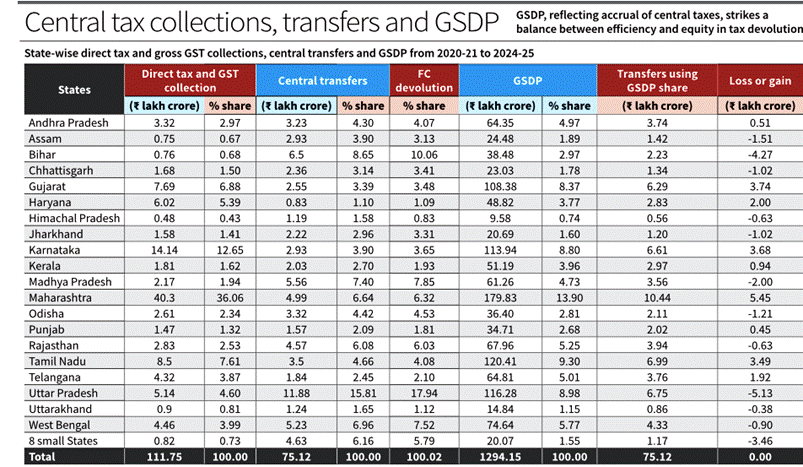
Devolution Outcomes (2020–25): Key Data Insights
- Total transfers: ₹75.12 lakh crore
- Major recipients:
- Uttar Pradesh: 15.81%
- Bihar: 8.65%
- West Bengal: 6.96%
- Their tax contribution (Direct + GST):
- UP: 4.6%
- Bihar: 0.67%
- WB: 3.99%
- Major contributors:
- Maharashtra: 40.3% contribution, 6.64% transfers
- Karnataka: 12.65% contribution, 3.9% transfers
- Tamil Nadu: 7.61% contribution, 4.66% transfers
Correlation Analysis
- 15th FC devolution share vs actual transfers: 0.99
- Devolution share vs tax collections: 0.24 (very weak)
- GSDP share vs tax collections: 0.81
- GSDP share vs devolution: 0.58
Inference: - GSDP balances efficiency (contribution) and equity (redistribution) better than current criteria.
State-wise Anomalies Explained
- Haryana, Karnataka, Maharashtra:
- Tax collection > GSDP share → HQ concentration effect.
- Tamil Nadu:
- GSDP share > tax collection → production without tax booking.
Winners & Losers under GSDP-based Devolution
- Gainers:
- Maharashtra
- Gujarat
- Karnataka
- Tamil Nadu
- Losers:
- Uttar Pradesh
- Bihar
- Madhya Pradesh
- Adjustments are moderate, not disruptive.
Policy Implications
- Higher weight to GSDP would:
- Reflect true tax accrual
- Recognise States’ contribution to national income
- Improve perceived fairness
- Strengthen credibility of India’s fiscal federalism
- Relevant for:
- 16th Finance Commission deliberations
- GST reform debates
- Centre–State trust deficit
Top Court’s Green Governance & Regulatory Uncertainty
Why in News ?
- Increasing judicial intervention by the Supreme Court in environmental governance over the last decade.
- Concerns over regulatory uncertainty, role confusion, and policy instability arising from court-driven environmental management.
- Renewed debate on limits of judicial review vs executive regulation, especially in climate, pollution, and environmental clearances.
Relevance
- GS II – Polity & Governance
- Judicial review vs separation of powers
- Role of judiciary in policy-making
- Accountability of regulatory institutions
- GS III – Environment
- Environmental governance and regulatory capacity
- Pollution control, environmental clearances
- Sustainable development vs precautionary principle
Practice Question
- “Judicial intervention in environmental governance is often a response to regulatory failure but can itself become a source of uncertainty.”
Critically examine. (250 words)
Core Argument of the Article
- The Supreme Court has shifted from reviewing legality of administrative action to micro-managing environmental governance.
- This shift has:
- Weakened statutory regulators
- Increased uncertainty for States, industry, and citizens
- Blurred separation of powers
Key Trends Identified
- From Regulator-Corrector to Regulator-Substitute
- Court increasingly issues continuing mandamus.
- Replaces regulator discretion with judicial directions.
- Managerial Role of Judiciary
- Court supervises implementation rather than correcting errors.
- Results in ad hoc governance rather than rule-based regulation.
Illustrative Judicial Shifts
- Eco-Sensitive Zones (ESZs):
- 2022: Mandatory 1 km ESZ around protected areas.
- 2023: Partial dilution due to implementation challenges.
- Vehicle Pollution (NCR):
- 2015: Blanket diesel vehicle ban.
- 2016: Ban lifted, replaced with pollution charge.
- Later: Coercive scrappage rules, then narrowed to BS-IV vehicles.
- Firecrackers & Air Pollution:
- Near-total bans → festival-specific relaxations.
- Result: Frequent litigation, exemptions, confusion.
Structural Cause: Regulatory Failure
- Weak enforcement
- Delayed notifications
- Poor monitoring
- Arbitrary exemptions
→ Invites judicial intervention, even if sub-optimal.
Doctrinal Inconsistency
- Court often:
- Justifies intervention using consequentialist reasoning.
- Later retreats due to implementation backlash.
- Example:
- Vanshakti v Union of India (2025):
- Post-facto environmental clearances invalidated.
- Later reconsideration acknowledging disruption.
- Vanshakti v Union of India (2025):
Problem of Expertise
- Courts rely on:
- Expert committees
- Ad hoc definitions (e.g., “Aravalli hills”)
- Issues:
- Experts compensate for technical gaps but lack institutional continuity.
- Rapid constitution and dissolution of committees → policy flip-flops.
- Uniform judicial rules ignore ecological diversity across regions.
Consequences of Judicial Overreach
- Uncertainty for Regulated Actors
- Industries face shifting compliance rules.
- State Capacity Erosion
- Regulators hesitate, anticipating judicial override.
- Finality Without Process
- Court rulings often bypass statutory sequencing.
- Distorted Accountability
- Regulators answer to courts, not legislatures or citizens.
Institutional Cost
- Projects stalled before statutory clearance process concludes.
- Litigation becomes first resort, not last.
- Courts reshape:
- Who decides
- What evidence counts
- How policies evolve
Suggested Corrective Approach
- Judicial Restraint with Regulatory Discipline
- Court should:
- Enforce statutory duties
- Avoid substituting policy judgment
- Court should:
- Threshold-Based Intervention
- Clear criteria for when court will intervene.
- Process-Oriented Oversight
- Insist on:
- Transparency
- Timelines
- Accountability
- Insist on:
- Predictability
- Avoid sweeping bans.
- Specify evidentiary and implementation standards in advance.
Broader Governance Lesson
- Environmental protection is best achieved by:
- Strong regulators
- Clear rules
- Stable enforcement
- Not by continuous judicial management.