
Published on Feb 13, 2026
Daily Editorials Analysis
Editorials/Opinions Analysis For UPSC 13 February 2026

Content:
- Farmers’ pulse
Farmers’ pulse
Source : The Hindu
Basics and context
What are pulses?
- Pulses = edible dried seeds of leguminous crops (family Fabaceae), harvested for grain; distinct from oilseeds (soybean, groundnut) and green vegetable legumes (beans, peas consumed fresh).
- FAO definition: crops harvested solely for dry grain, naturally high in protein (18–25%), fibre, micronutrients, and capable of biological nitrogen fixation.
Nutritional and strategic importance
- Pulses supply about 25% of India’s non-cereal protein, provide essential amino acids, and support dietary diversity for millions, making them central to nutrition security in a cereal-dominated food system.
- As nitrogen-fixing legumes, pulses reduce fertiliser use, improve soil health, and fit climate-smart agriculture, especially in semi-arid regions where water and input constraints limit cereal sustainability.
Demand–supply realities
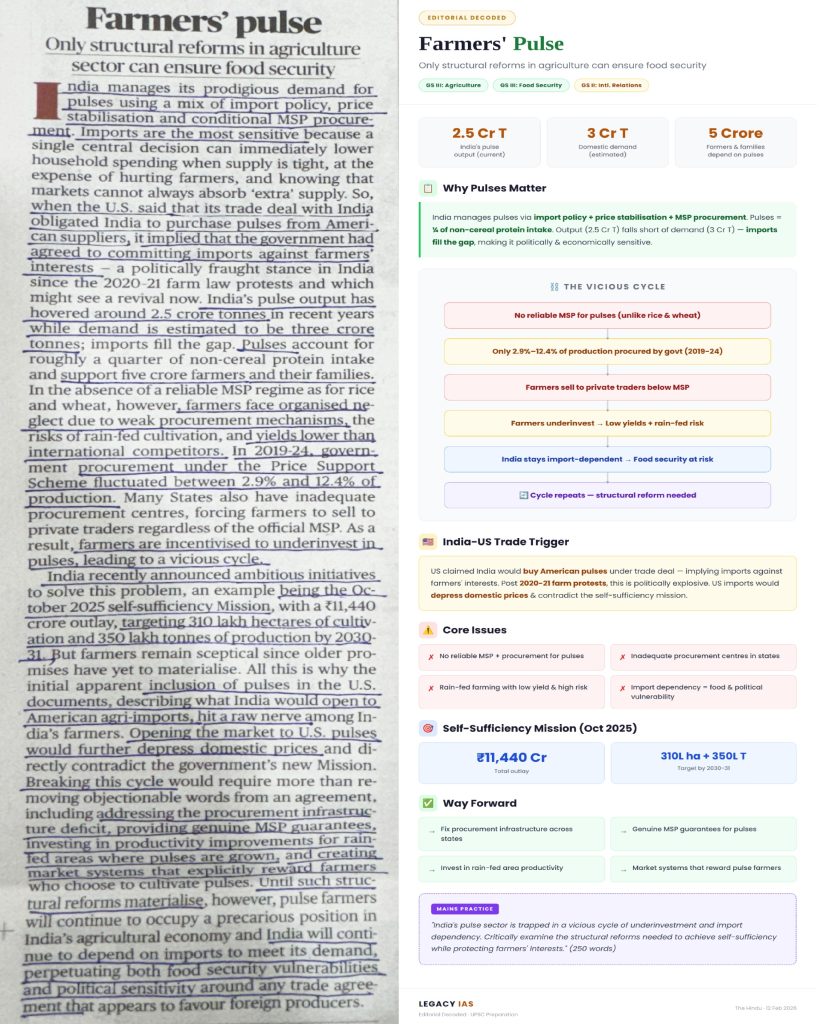
- India’s pulse production remains around 2.5 crore tonnes annually, while demand is near 3 crore tonnes, creating a 4–5 million tonne structural deficit routinely bridged through calibrated imports.
- Over 70% pulse area is rain-fed, making output highly sensitive to monsoon variability, yield shocks, and climate stress, unlike irrigated rice-wheat systems enjoying stronger procurement and policy backing.
Relevance
GS III – Agriculture & Economy
- Food & nutrition security
- Cropping pattern & diversification
- MSP, procurement, price policy
- Agri trade & import dependence
- Climate-resilient agriculture
Practice Question
- “India’s pulse policy must balance farmer income and consumer prices.” Discuss.(250 Words)
Why in news ?
Trade sensitivity and farmer concerns
- Indications of U.S. pulse exports to India raised alarms because assured imports during harvest season depress mandi prices, directly affecting incomes of nearly five crore pulse-growing farmers and families.
- After the 2020–21 farm law protests, farmers view trade-linked agricultural commitments cautiously, fearing policy bias toward cheap imports and consumers rather than remunerative and stable domestic farm-gate prices.
New self-sufficiency push
- The 2025 Pulse Self-Sufficiency Mission allocates ₹11,440 crore, targeting 310 lakh hectares and 350 lakh tonnes production by 2030-31, signalling a major scale-up in state support for pulses.
- However, past missions delivered mixed results due to weak procurement, delayed payments, and limited extension, creating scepticism among farmers about whether announced targets will translate into reliable incomes.
Governance and policy architecture
MSP and procurement gaps
- Although MSPs are declared for major pulses annually, actual procurement under the Price Support Scheme ranged only 2.9%–12.4% of production during 2019-24, limiting real price support impact.
- Many States lack adequate procurement centres, storage, and assaying facilities, forcing farmers into distress sales to private traders below MSP, weakening credibility of official price assurances and diversification incentives.
Policy dualism
- Government frequently uses imports and tariff changes to cool prices for consumers, but repeated interventions create uncertainty, discouraging farmers from investing in productivity, quality seeds, and better agronomic practices.
Economic, social and environmental relevance
Farm economics and diversification
- Pulse yields in India remain below several global benchmarks due to limited irrigation, input use, and R&D diffusion, reducing profitability compared to cereals backed by assured procurement and input subsidies.
- Weak returns push farmers toward rice, wheat, or cash crops, undermining diversification, increasing water stress, and perpetuating import dependence that exposes India to global price and supply fluctuations.
Nutrition and equity
- Pulses are the cheapest protein source for large vegetarian and low-income populations; unstable availability or high prices worsen protein deficiency, directly affecting child nutrition and public health outcomes.
- Ensuring affordable pulses supports nutrition equity, linking agricultural policy with human development goals, mid-day meals, and food-based welfare programmes targeting vulnerable populations.
Environmental sustainability
- Pulses enhance soil fertility through biological nitrogen fixation, reduce chemical fertiliser demand, and lower greenhouse gas footprints relative to fertiliser-intensive cereals, supporting sustainable intensification strategies.
- Yet, heavy concentration in marginal rain-fed areas exposes pulse farmers to climate risks, making resilience investments in seeds, water management, and advisories crucial for stable production.
Challenges and way forward
Structural challenges
- Import reliance and price crashes: Large tur imports in 2016–17 after domestic output recovery led to mandi prices falling below MSP in Maharashtra and Karnataka, discouraging farmers from expanding pulse acreage next seasons.
- Low procurement credibility: With PSS procurement only 2.9%–12.4% of output (2019–24), many farmers in MP and Rajasthan report selling chana and masur below MSP due to absent or delayed procurement operations.
- Policy unpredictability: Frequent tariff changes and stock limits under the Essential Commodities framework for pulses like tur and urad create uncertainty, making farmers risk-averse about allocating land to pulses.
- Seed and R&D gaps: Adoption of improved varieties such as Pusa-372 (chickpea) or IPM-02-3 (moong) remains uneven because certified seed distribution and last-mile extension are weak in major pulse belts.
- Weak extension example: Rain-fed pulse farmers in Bundelkhand and Vidarbha often rely on traditional practices due to limited agri-advisory reach, leading to yields significantly below research-station potential.
Reform priorities
- Decentralised MSP procurement: States like Madhya Pradesh under Bhavantar-type price support showed that price deficiency payments and local procurement can reduce distress sales when implemented transparently and on time.
- Digital and localised systems: Expanding e-NAM linked procurement and FPO-led aggregation, as seen in parts of Karnataka, can improve farmer access to MSP operations and reduce trader intermediation.
- Trade aligned to crop cycles: Imposing or raising duties on tur during peak arrivals, as India has periodically done, helps prevent import-led price crashes and stabilises domestic markets.
- Productivity-led model: Success of short-duration moong in rice fallows in Andhra Pradesh and Odisha shows how improved varieties and advisories can raise pulse output without expanding net sown area.
- Irrigation and advisories: Micro-irrigation support under PMKSY (irrigation) in pulse belts of Gujarat and Telangana has demonstrated higher and more stable yields compared to purely rain-fed plots.
- Seed systems strengthening: Scaling breeder–foundation–certified seed chains through ICAR and State Agricultural Universities can replicate successes seen in wheat and rice seed replacement gains.
Major pulses in India
| Pulse (Common name) | Season | Key Producing States | Key Facts (Data & Static Points) |
| Chana (Chickpea/Bengal gram) | Rabi | MP, Maharashtra, Rajasthan, UP | ~40–45% of India’s pulse output; Desi & Kabuli types; 20–22% protein; thrives in cool, dry winters |
| Tur/Arhar (Pigeon pea) | Kharif | Maharashtra, Karnataka, MP, Gujarat | Long duration (160–200 days); deep-rooted, drought tolerant; major source of dal in India |
| Urad (Black gram) | Kharif/Zaid | UP, MP, Tamil Nadu, AP | Short duration (70–90 days); used in idli/dosa batter; suitable for intercropping |
| Moong (Green gram) | Kharif/Zaid | Rajasthan, Maharashtra, AP, Karnataka | Very short duration (60–70 days); ideal for rice-fallow cultivation; highly digestible protein |
| Masur (Lentil) | Rabi | UP, MP, Bihar, WB | Rich in iron and protein; fits well in rice–lentil systems; cool-season crop |
| Field pea (Matar) | Rabi | UP, Punjab, Haryana, MP | Dual use (vegetable + pulse); used in mixed cropping with wheat |