
Published on Apr 1, 2026
Daily PIB Summaries
PIB Summaries 01 April 2026

Content
- Digital Push Deepens in Rural India: eGramSwaraj Records Over ₹3 Lakh Crores in Online Payments; SabhaSaar Expands to 23 Languages
- India emerges as Global Leader in issuing Compliance Certificates under Nagoya Protocol
Digital Push Deepens in Rural India: eGramSwaraj Records Over ₹3 Lakh Crores in Online Payments; SabhaSaar Expands to 23 Languages
Why in News?
- PIB (31 March 2026) reported over ₹3 lakh crore cumulative transactions through eGramSwaraj, marking deepening digital financial governance at grassroots level.
- SabhaSaar AI tool expanded to 23 Indian languages, enhancing inclusivity and accessibility in Gram Sabha proceedings across diverse linguistic regions.
- Reflects transition from basic digitisation to full-scale digital governance integrating finance, participation, and decision-making in Panchayati Raj Institutions.
Relevance
GS II (Polity & Governance)
- Panchayati Raj Institutions – 73rd Constitutional Amendment (Part IX)
- Decentralisation & grassroots governance
- Gram Sabha & participatory democracy (Article 243A)
- E-governance: transparency, accountability, auditability
GS III (Science & Technology + Economy)
- Digital India & Digital Public Infrastructure (DPI)
- Artificial Intelligence in governance (SabhaSaar)
- Financial inclusion & rural digital economy
- Cybersecurity, data protection, digital divide
Practice Question
Q1. Digital platforms like eGramSwaraj are redefining fiscal and administrative transparency at the grassroots level.Discuss their impact on decentralised governance in India. (250 words)
Context
- Panchayati Raj Institutions historically suffered from fragmented accounting systems, delayed payments, weak documentation, and limited citizen participation in Gram Sabha processes.
- Government initiatives aim to ensure real-time financial tracking, improved transparency, and digitised participatory governance at grassroots level.
- Represents convergence of Digital India, decentralisation reforms, and AI-based governance tools for strengthening local democracy.
Static Background
Panchayati Raj System
- Established through 73rd Constitutional Amendment Act, 1992, granting constitutional status to local self-government institutions in rural India.
- Part IX of Constitution (Articles 243–243O) defines structure, powers, elections, and financial provisions for Panchayats.
- Gram Sabha under Article 243A acts as foundation of direct democracy, enabling participatory decision-making at village level.
- Eleventh Schedule lists 29 subjects including agriculture, health, and education, devolved to Panchayats for local governance.
e-Panchayat Mission Mode Project
- Launched under Digital India Programme to digitise entire lifecycle of Panchayat functioning, including planning, budgeting, implementation, and monitoring.
- Aims to enhance transparency, accountability, and efficiency through integrated digital platforms such as eGramSwaraj and AuditOnline.
Public Financial Management System (PFMS)
- Developed by Controller General of Accounts to ensure real-time tracking of funds and direct digital payments across government schemes.
- Enables end-to-end financial visibility from Centre to last-mile implementing agencies, reducing leakages and delays.
Key Features & Achievements
eGramSwaraj
- Integrated digital platform enabling planning, accounting, budgeting, and real-time online payments for Panchayati Raj Institutions.
- Replaces traditional paper-based records and cash transactions with digital workflows ensuring transparency and accountability in governance processes.
Data & Evidence
- Over ₹3 lakh crore cumulative transactions demonstrate massive scale of digital financial operations at grassroots governance level.
- ₹53,342 crore transferred during FY 2025–26 alone, indicating rapid adoption and increasing reliance on digital payment systems.
- 2,59,798 PRIs onboarded on platform, ensuring near-universal coverage of Panchayati Raj institutions across India.
- 2,50,807 PRIs actively making online payments, reflecting operational integration of digital systems into daily governance.
- 2,55,254 Gram Panchayats uploaded development plans, improving planning transparency and accountability in resource allocation.
- 1,60,79,737 vendors registered on platform, expanding rural economic ecosystem and enabling direct vendor payments.
Outcomes
- Ensures complete digital audit trail of financial transactions, reducing scope for corruption, leakages, and discretionary misuse of funds.
- Enables real-time payments directly to vendors and service providers, improving efficiency and reducing administrative delays.
- Facilitates better monitoring and evaluation by higher authorities through real-time dashboards and data analytics.
SabhaSaar (AI Tool)
- AI-powered voice-to-text tool launched in August 2025 to automate recording and summarisation of Gram Sabha meetings.
- Generates structured outputs including minutes, attendance, resolutions, and actionable points, improving documentation quality and consistency.
Features
- Uses speech recognition technology to capture discussions in local languages, enhancing accessibility and inclusivity in governance processes.
- Expanded from 13 to 23 languages, covering major linguistic diversity and aligning with constitutional recognition of languages.
Data
- Adopted by 1,11,486 Gram Panchayats, indicating growing trust and usage of AI tools in grassroots governance processes.
- Received national recognition through awards in AI and social impact categories, validating technological innovation in governance.
Outcomes
- Enhances participatory democracy by enabling citizens to engage in their native languages without linguistic barriers.
- Improves transparency through accurate and accessible documentation of Gram Sabha proceedings and decisions.
- Builds institutional memory, enabling continuity and accountability in local governance decisions over time.
Significance
- Strengthens financial governance through real-time tracking of public expenditure and elimination of manual, opaque financial processes.
- Enhances administrative efficiency by standardising procedures, reducing delays, and enabling faster decision-making across Panchayati Raj Institutions.
- Deepens democratic participation by documenting Gram Sabha proceedings and making them accessible for public scrutiny and engagement.
- Promotes social inclusion by enabling multilingual participation and reducing barriers for marginalised and non-literate populations.
- Supports rural economic formalisation by integrating large vendor ecosystem into digital payment networks and formal financial systems.
- Demonstrates application of advanced technologies like AI and digital public infrastructure in grassroots governance contexts.
Challenges
- Persistent digital divide due to uneven internet connectivity, particularly in remote, tribal, and geographically difficult regions.E.g,While India crossed the 1 billion internet connections mark in 2025, active internet penetration in rural areas stands at approximately 55-57%. This means nearly 45% of rural India remains offline or “under-connected.”
- Limited digital literacy among Panchayat officials and citizens, affecting effective utilisation of digital governance platforms.E.g,Even with 63.9 million people certified under PMGDISHA, a 2025 impact study found that 72% of rural users still rely on Common Service Centers (CSCs) or “village computer points” for basic tasks like checking land records or filing PM-Kisan applications.
- Incomplete devolution of funds, functions, and functionaries restricts full potential of digital tools in decentralised governance.
- Technological limitations in AI tools, especially regarding dialect recognition and accuracy in noisy rural environments.
- Cybersecurity risks and lack of robust data protection frameworks at local governance level raise concerns of data misuse.
- Risk of procedural compliance replacing genuine participation, where digital records exist without meaningful deliberation in Gram Sabhas.
Way Forward
- Strengthen last-mile digital infrastructure through accelerated BharatNet rollout and ensuring reliable electricity supply in rural areas.
- Implement continuous capacity-building programmes for Panchayat officials focusing on digital skills and governance applications.
- Improve AI tools with enhanced dialect recognition, real-time translation, and contextual understanding of local languages.
- Ensure effective devolution of funds, functions, and functionaries to complement digital governance with institutional empowerment.
- Integrate digital platforms with social audit mechanisms to enhance accountability and citizen oversight in governance processes.
- Develop robust cybersecurity and data protection frameworks tailored for Panchayati Raj Institutions and local governance systems.
- Promote Gram Sabha participation through awareness campaigns and incentives, ensuring technology complements rather than replaces deliberation.
- Converge with schemes like MGNREGA, SVAMITVA, and SDG localisation initiatives for holistic rural development planning.
Data & Facts for Answers
- ₹3 lakh crore cumulative digital transactions through eGramSwaraj highlight scale of grassroots financial digitisation in India.
- Over 2.59 lakh PRIs onboarded indicate near-universal institutional coverage under digital governance framework.
- SabhaSaar’s expansion to 23 languages demonstrates commitment to inclusive and multilingual governance practices.
- More than 1.6 crore vendors integrated into system reflects significant formalisation of rural economic transactions.
Prelims Pointers
- eGramSwaraj is part of e-Panchayat Mission Mode Project under Digital India Programme for Panchayat-level governance digitisation.
- PFMS enables real-time fund tracking and direct payments, reducing leakages and improving financial transparency.
- SabhaSaar is an AI-based voice-to-text tool used for recording and summarising Gram Sabha proceedings.
- Panchayati Raj system derives constitutional status from 73rd Amendment Act, 1992, under Part IX of Constitution.
India emerges as Global Leader in issuing Compliance Certificates under Nagoya Protocol
Why in News?
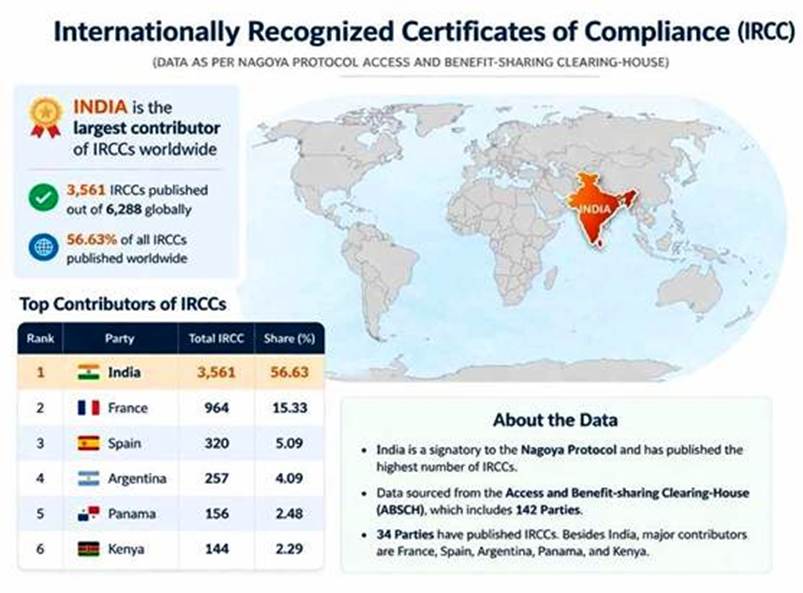
- India emerged as the global leader in issuing Internationally Recognized Certificates of Compliance (IRCCs), accounting for more than 56 percent of total certificates issued worldwide.
- Latest ABS Clearing-House data shows India issued 3,561 IRCCs out of global 6,311, significantly outperforming all other participating countries.
- Demonstrates India’s strong implementation of Access and Benefit Sharing (ABS) provisions under Nagoya Protocol and leadership in biodiversity governance.
Relevance
GS III (Environment & Ecology)
- Biodiversity conservation under Convention on Biological Diversity (CBD)
- Access and Benefit Sharing (ABS) framework
- Sustainable use of genetic resources
- Bio-economy & ecological governance
GS II (International Relations)
- India’s leadership in global environmental governance
- Multilateral environmental agreements (Nagoya Protocol)
- Equity, climate justice, and North-South cooperation
Practice Question
Q1. India’s leadership in issuing Internationally Recognized Certificates of Compliance reflects its strong implementation of the Nagoya Protocol.Analyse its significance for biodiversity governance. (250 words)
Context
- Nagoya Protocol operationalises fair and equitable sharing of benefits arising from utilisation of genetic resources and associated traditional knowledge.
- IRCCs serve as globally recognised legal instruments ensuring compliance with Prior Informed Consent and Mutually Agreed Terms between users and providers.
- Increasing global demand for biological resources in pharmaceuticals, biotechnology, and agriculture has intensified importance of ABS frameworks.
Static Background
Convention on Biological Diversity (CBD)
- International treaty adopted in 1992 with objectives of biodiversity conservation, sustainable use, and fair sharing of benefits from genetic resources.
- Provides overarching legal framework for biodiversity governance, under which Nagoya Protocol was later adopted as supplementary agreement.
Nagoya Protocol on ABS (2010)
- Supplementary agreement to CBD focusing specifically on Access and Benefit Sharing of genetic resources and associated traditional knowledge.
- Mandates obtaining Prior Informed Consent and establishing Mutually Agreed Terms before accessing biological resources.
- Entered into force in 2014 and aims to ensure provider countries and communities receive fair compensation.
ABS Clearing-House
- Global online platform under CBD for transparency, information sharing, and monitoring of ABS implementation by member countries.
- Maintains database of IRCCs, national laws, and compliance measures to ensure accountability in resource utilisation.
India’s Legal Framework
- Biological Diversity Act, 2002 provides statutory basis for ABS implementation and regulation of access to biological resources.
- Institutional structure includes National Biodiversity Authority, State Biodiversity Boards, and Biodiversity Management Committees at local level.
- Ensures decentralised governance and involvement of local communities in benefit-sharing mechanisms.
Key Highlights & Data
- India issued 3,561 IRCCs, representing over 56 percent of total global certificates, establishing clear dominance in ABS compliance mechanisms.
- Globally, only 34 out of 142 registered countries on ABS Clearing-House have issued IRCCs, highlighting India’s exceptional implementation performance.
- Other countries lag significantly behind, including France with 964 certificates, Spain with 320, and Argentina with 257 IRCCs.
- IRCCs act as legal proof that access to genetic resources followed due procedures of consent and benefit-sharing agreements.
Significance
- Establishes India as a global leader in biodiversity governance and implementation of international environmental agreements under CBD framework.
- Strengthens protection of traditional knowledge and ensures local communities receive fair economic benefits from resource utilisation.
- Enhances transparency and traceability in utilisation of genetic resources, from research stages to commercial applications.
- Boosts India’s credibility in international negotiations on biodiversity, climate change, and sustainable development frameworks.
- Supports bio-economy growth by creating a regulated and predictable framework for accessing biological resources.
- Reinforces India’s commitment towards Sustainable Development Goals, particularly SDG 15 (Life on Land) and SDG 12 (Responsible Consumption).
Challenges
- Implementation gaps persist at grassroots level due to limited awareness among local communities about their rights under ABS framework.
- Administrative delays and procedural complexities may discourage research institutions and private sector participation in accessing resources legally.
- Monitoring end-use of genetic resources globally remains difficult, especially in cases of digital sequence information and biotechnology innovations.
- Limited capacity of Biodiversity Management Committees affects effective documentation of People’s Biodiversity Registers and local knowledge systems.
- Concerns of biopiracy and misappropriation of traditional knowledge continue due to weak international enforcement mechanisms.
- Balancing conservation objectives with economic utilisation of resources remains a key policy challenge in biodiversity governance.
Way Forward
- Strengthen awareness campaigns at local level to ensure communities understand rights related to benefit-sharing and protection of traditional knowledge.
- Simplify regulatory procedures and ensure time-bound approvals to promote research, innovation, and sustainable utilisation of biological resources.
- Enhance capacity of Biodiversity Management Committees through training, funding, and digital tools for better documentation and monitoring.
- Develop robust mechanisms for tracking utilisation of genetic resources, including digital sequence information and cross-border applications.
- Promote international cooperation for preventing biopiracy and ensuring enforcement of ABS obligations across jurisdictions.
- Integrate ABS framework with bio-economy policies to balance conservation with sustainable economic development.
Data & Facts for Answers
- India issued 3,561 IRCCs out of global total of 6,311, accounting for over 56 percent share worldwide.
- Only 34 out of 142 countries registered on ABS Clearing-House have issued IRCCs, highlighting low global compliance levels.
- India’s ABS framework implemented through three-tier institutional structure involving national, state, and local biodiversity bodies.
Prelims Pointers
- Nagoya Protocol deals with Access and Benefit Sharing of genetic resources under Convention on Biological Diversity framework.
- IRCCs are issued as proof of Prior Informed Consent and Mutually Agreed Terms between resource providers and users.
- Biological Diversity Act, 2002 governs biodiversity conservation and ABS implementation in India.
- ABS Clearing-House is global platform for transparency and monitoring of compliance under Nagoya Protocol.