
Published on Feb 2, 2026
Daily PIB Summaries
PIB Summaries 02 February 2026
Content
- Budget push to make India a Global Bio pharma Hub(Union Budget 2026–27)
- Summary of Union Budget 2026–27
Budget push to make India a Global Biopharma Hub (Union Budget 2026–27)
Context & Significance
- Union Budget 2026–27 positions biopharma as a strategic growth sector, aligning healthcare security with industrial policy, export competitiveness, employment generation, and Atmanirbhar Bharat in high-value pharmaceutical value chains.
- Global biologics market exceeds USD 450 billion and growing faster than small-molecule drugs; India’s timely policy push targets leadership in biosimilars, vaccines, cell-gene therapies, and complex biologics manufacturing.
Relevance
GS-2 (Polity & Governance):
- Public health policy, regulatory reforms (CDSCO), ethical clinical trials, Article 21.
GS-3 (Economy):
- Pharma exports, high-value manufacturing, Atmanirbhar Bharat, industrial policy.
Key Budget Announcements
Biopharma SHAKTI Scheme
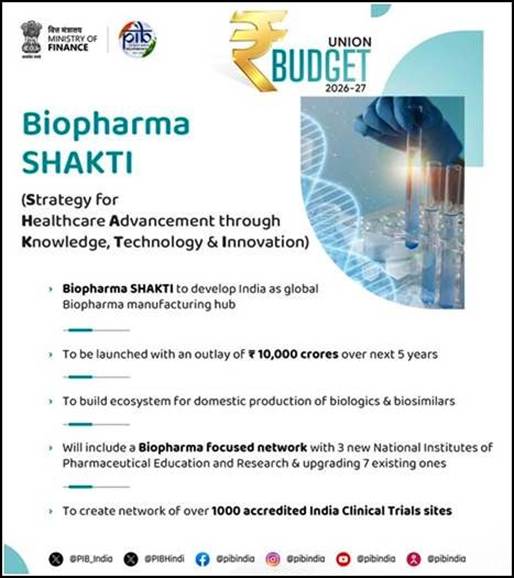
- Biopharma SHAKTI with ₹10,000 crore outlay over five years aims building domestic biologics and biosimilars ecosystem, strengthening upstream research, downstream processing, and integrated biomanufacturing clusters reducing import dependence.
- Scheme focuses on knowledge, technology, and innovation-led manufacturing, supporting pilot-scale facilities, translational research platforms, and industry partnerships, enabling Indian firms to move from generics dominance toward complex biologics leadership.
- Import substitution in monoclonal antibodies, recombinant proteins, and advanced biologics improves health security, reduces forex outgo, and stabilizes supply chains exposed during pandemics and geopolitical disruptions.
Clinical Trial Ecosystem Expansion
- Creation of 1,000+ accredited clinical trial sites expands India’s research geography beyond metros, improves participant diversity, strengthens data reliability, and enhances India’s attractiveness for global multicentric trials.
- Faster recruitment, lower trial costs, and large treatment-naïve populations position India competitively against Eastern Europe, Latin America, and Southeast Asia in global clinical research outsourcing markets.
- Strengthened CDSCO with scientific review cadre targets globally comparable approval timelines, regulatory predictability, and compliance with ICH-GCP norms, improving investor confidence and international trial acceptability.
NIPER Expansion
- Establishment of three new NIPERs and upgradation of seven existing institutes expands high-end pharmaceutical education capacity, fostering specialized talent in bioprocessing, pharmacovigilance, regulatory sciences, and biologics analytics.
- Industry–academia linkages through NIPERs support translational research, patent generation, and startup incubation, strengthening India’s innovation pipeline beyond contract manufacturing toward original biologic product development.
Constitutional / Legal Dimension
- Advances Article 21 by improving access to life-saving biologics, and supports Directive Principles Articles 39(e), 41, 47 promoting public health, scientific advancement, and state responsibility toward healthcare improvement.
- Regulatory strengthening aligns with Drugs and Cosmetics Act framework and evolving bio-regulatory regimes, ensuring safety, efficacy, and ethical compliance in clinical trials and biologics manufacturing.
Governance / Administrative Dimension
- Multi-ministerial coordination among Health, Pharmaceuticals, Biotechnology, and Commerce ministries required for cluster development, harmonized regulations, and faster clearances for biologics facilities and clinical research infrastructure.
- Accreditation-based trial ecosystem improves standardization, reduces ethical violations, and strengthens institutional review boards, addressing past criticisms regarding informed consent and participant protection.
Economic Dimension
- Indian pharma industry already USD 50+ billion; moving into biologics with higher margins can boost exports, reduce reliance on low-margin generics, and support aspiration of USD 130 billion pharma market by 2030.
- Biologics manufacturing generates high-skilled employment in R&D, quality control, cold chain logistics, and regulatory affairs, creating knowledge-intensive jobs aligned with demographic dividend utilization.
Social / Ethical Dimension
- Domestic biologics production can lower treatment costs for cancer, autoimmune, and rare diseases, improving affordability and equity in access, particularly where biologics currently remain prohibitively expensive.
- Strong ethical oversight needed for trials to protect vulnerable populations, ensure informed consent, fair compensation, and transparency, preventing exploitation concerns historically associated with clinical research outsourcing.
Science–Tech / Security Dimension
- Investment in advanced biomanufacturing enhances strategic autonomy in vaccines, pandemic response, and biosecurity preparedness, reducing vulnerability to export restrictions or supply disruptions during global health emergencies.
- Promotes frontier technologies like cell-gene therapy, mRNA platforms, and precision biologics, positioning India within global innovation networks rather than remaining peripheral manufacturing base.
Data & Evidence
- India supplies around 20% of global generics and 60% of global vaccines by volume, yet share in global biologics market remains limited, indicating significant untapped potential for value addition.
- Clinical trial costs in India estimated 30–50% lower than developed countries, offering cost advantage if regulatory credibility and ethical standards remain robust and internationally trusted.
Challenges / Gaps / Criticisms
- Biologics require high capital investment, stringent quality systems, and cold-chain infrastructure; MSME pharma firms may struggle without targeted financing and technology transfer mechanisms.
- Regulatory capacity constraints, potential approval delays, and variability in ethics committee quality can undermine credibility if expansion of trials outpaces regulatory and monitoring capabilities.
- IPR complexities and patent thickets in biologics may restrict market entry; balancing TRIPS compliance with public health needs remains persistent policy challenge.
Way Forward
- Develop dedicated biologics parks with shared facilities, plug-and-play infrastructure, and fiscal incentives, reducing entry barriers and achieving economies of scale in complex biomanufacturing.
- Strengthen regulatory science training, digitalize approval processes, and adopt risk-based inspections to ensure speed with safety, matching USFDA and EMA benchmarks.
- Promote public-funded translational research, sovereign biotech funds, and global collaborations to support indigenous innovation while integrating into global biologics value chains.
Summary of Union Budget 2026–27
Context & Vision
- Union Budget 2026–27 framed around “Yuva Shakti” and three Kartavya pillars, balancing growth, inclusion, and capacity-building amid global trade fragmentation, supply-chain risks, and technology-driven economic restructuring.
- Budget situates India’s macro-strategy within Viksit Bharat trajectory, emphasizing competitiveness, resilience, and social justice, while integrating domestic reforms with deeper global market participation and long-term capital attraction.
Relevance
GS-3 (Economy):
- Fiscal deficit, public capex, MSMEs, manufacturing, logistics.
GS-3 (Agriculture):
- AgriStack + AI, farmer advisory, risk reduction.
Philosophical Framework – Three Kartavya
Kartavya 1 – Accelerate & Sustain Growth
- Focus on productivity, competitiveness, and resilience through manufacturing scale-up, infrastructure push, energy security, MSME strengthening, and city economic regions leveraging agglomeration economies and cluster-based development models.
Kartavya 2 – Fulfil Aspirations & Build Capacity
- Emphasis on human capital formation through education, skills, sports, tourism, and creative industries, recognizing demographic dividend requires employability, innovation capacity, and social mobility enhancement.
Kartavya 3 – Sabka Sath, Sabka Vikas
- Targets inclusive development ensuring access to opportunities for regions, communities, farmers, women, Divyangjan, and vulnerable groups, aligning fiscal policy with distributive justice and cooperative federalism principles.
Macroeconomic & Fiscal Architecture
- Fiscal deficit pegged at 4.3% of GDP (BE 2026–27), continuing consolidation path, signalling credibility to investors while attempting balance between fiscal prudence and growth-supportive expenditure.
- Debt-to-GDP ratio estimated 55.6%, marginally declining, indicating gradual debt sustainability strategy to reduce interest burden and create fiscal space for social and capital expenditure.
- Non-debt receipts estimated ₹36.5 lakh crore and total expenditure ₹53.5 lakh crore, reflecting expansionary yet calibrated fiscal stance prioritizing capital formation and growth multipliers.
Public Capex & Infrastructure Push
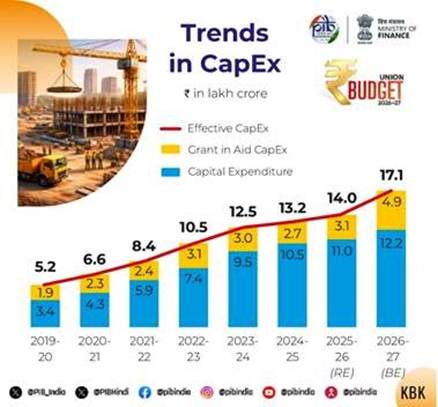
- Public capex increased to ₹12.2 lakh crore from ₹11.2 lakh crore, reinforcing government’s capex-led growth model, crowding-in private investment and strengthening infrastructure-led multiplier effects.
- Seven high-speed rail corridors and dedicated freight corridors promote green mobility, logistics efficiency, and regional integration, reducing logistics cost—currently ~13–14% of GDP versus global benchmark ~8%.
- Operationalising 20 new National Waterways supports multimodal logistics, mineral evacuation, and low-carbon transport, complementing PM Gati Shakti and National Logistics Policy objectives.
Manufacturing & Industrial Policy
- Scaling manufacturing in seven frontier sectors aligns with PLI logic, targeting value-chain integration, technology absorption, and export competitiveness amid global reconfiguration of supply chains.
- City Economic Regions (₹5,000 crore per CER over five years) institutionalize place-based development, encouraging metropolitan growth engines and coordinated urban-industrial planning.
MSME & Enterprise Ecosystem
- ₹10,000 crore SME Growth Fund aims creating “Champion MSMEs,” supporting scaling, technology adoption, and export readiness, addressing MSMEs’ chronic credit and competitiveness constraints.
- Customs and e-commerce export reforms, including removal of ₹10 lakh courier export cap, integrate MSMEs into global digital trade ecosystems and cross-border value chains.
Sectoral Growth Drivers
Biopharma & Health
- ₹10,000 crore Biopharma SHAKTI, 3 new NIPERs, and 1,000+ clinical trial sites target biologics leadership, health security, and high-value pharma exports beyond generics dominance.
- Five Regional Medical Hubs and medical value tourism strengthen healthcare services exports, employment generation, and India’s positioning as global medical tourism hub.
Textiles
- Integrated textile programme covering fibres, cluster modernization, sustainability, and skilling supports labour-intensive employment and export revival in a sector employing over 45 million people.
Creative & AVGC Economy
- AVGC labs in 15,000 schools and 500 colleges build pipeline for sector projected to require 2 million professionals by 2030, supporting digital economy diversification.
Sports Economy
- Khelo India Mission institutionalizes sports ecosystem with science, coaching, and leagues, linking sports with health outcomes, youth engagement, and global sporting competitiveness.
Agriculture & Rural Transformation
- Bharat-VISTAAR AI integrates AgriStack and ICAR advisories, enabling precision agriculture, risk reduction, and data-driven farm decisions, supporting income stability and climate-smart agriculture.
- SHE Marts strengthen SHG-led rural enterprises, promoting women-led local value chains and inclusive rural non-farm growth.
Social Sector & Inclusion
- Girls’ hostel in every district addresses gendered barriers in STEM education, improving female labour force participation and educational continuity.
- NIMHANS-2 and regional mental health institutes signal mainstreaming of mental health within public health architecture, addressing rising psychosocial stress burdens.
- Focus on Purvodaya and North-East through corridors, tourism, and e-buses promotes regional equity and balanced development.
Direct Tax Reforms
- New Income Tax Act 2025 effective April 2026 simplifies compliance, reduces litigation, and improves taxpayer experience through redesigned forms and automated processes.
- Rationalization of penalty and prosecution, decriminalisation of minor defaults, and integrated assessment orders reflect trust-based tax administration shift.
- Reduced TCS on overseas tours and LRS education/medical remittances eases middle-class burdens and improves global mobility affordability.
Corporate & International Tax
- Safe harbour margin 15.5% for IT services and higher threshold (₹2,000 crore) reduce transfer pricing disputes and enhance predictability for major export sector.
- Tax holiday for foreign cloud providers till 2047 and MAT exemption for presumptive non-residents aim positioning India as global data centre and digital services hub.
Indirect Taxes & Customs
- Customs rationalisation supports domestic manufacturing, critical minerals processing, energy transition, aviation manufacturing, and nuclear sector development.
- Duty exemptions on lithium-ion, solar inputs, and critical minerals align with clean energy transition and strategic resource security.
- Tariff reduction on personal imports from 20% to 10% improves ease of living and reduces compliance burden for individuals.
Ease of Doing Business
- Single digital window for cargo approvals, Customs Integrated System, AI-based risk assessment, and full container scanning reduce dwell time and logistics uncertainty.
- Warehouse operator-centric model with self-declarations and risk-based audits signals shift from control-based to trust-and-verify regulatory philosophy.
Constitutional / Governance Lens
- Aligns with Directive Principles—Articles 38, 39, 41, 43, 47—promoting welfare state, livelihood, health, and equitable resource distribution through fiscal policy.
- Cooperative federalism reflected in state-supported hubs, CERs, and sectoral schemes requiring Centre–State convergence.
Challenges / Criticisms
- High capex requires strong state capacity and timely project execution; historical delays can dilute multiplier effects and strain fiscal math.
- Tax incentives risk revenue foregone without guaranteed investment inflows; sunset clauses and outcome monitoring critical.
- Implementation complexity across multiple schemes may lead to fragmentation without strong coordination mechanisms.
Way Forward
- Strengthen outcome-based budgeting, independent evaluation, and real-time dashboards to track scheme effectiveness and fiscal efficiency.
- Enhance state-level capacity and urban governance reforms to realize benefits of CERs, logistics corridors, and infrastructure investments.
- Balance tax incentives with revenue stability and ensure predictable policy regime to maintain investor confidence.