
Published on Mar 3, 2026
Daily PIB Summaries
PIB Summaries 03 March 2026
Content
- Advancing Self-Reliance and Export Resilience: India’s Growing Global Footprint
- Seva Sankalp Resolution – Department of Drinking Water and Sanitation (DDWS)
Advancing Self-Reliance and Export Resilience: India’s Growing Global Footprint
Why in News?
- PIB release reported cumulative exports of USD 720.76 billion (Apr–Jan FY26), registering 6.15% YoY growth, highlighting resilience amid global trade uncertainty and geopolitical fragmentation.
- Services exports reached USD 354.13 billion (Apr–Jan FY26), growing 10.57% YoY, reaffirming India’s structural strength in IT, BPM, fintech, consulting, and knowledge-intensive services sectors.
- Union Budget 2026-27 emphasised strategic manufacturing expansion, semiconductor ecosystem strengthening, rare earth corridors, and logistics reforms to enhance competitiveness and reduce critical import dependencies.
- Rising UNCTAD Trade Policy Uncertainty Index (2025) and global supply chain realignments have intensified India’s calibrated push for resilient supply chains and diversified export partnerships.
Relevance
GS II – Governance & International Relations
- Trade diplomacy & FTAs (38 countries; ~70% global GDP access).
- WTO compatibility (MFN, national treatment).
- Districts as Export Hubs – cooperative federalism in trade.
- Strategic supply chain diversification amid geopolitical fragmentation.
GS III – Economy
- Exports: USD 720.76 bn (Apr–Jan FY26), 6.15% YoY growth.
- Services exports: USD 354.13 bn (Apr–Jan FY26), 10.57% YoY growth.
- Manufacturing push: PLI, ISM (₹76,000 cr), defence corridors.
- Defence exports: ₹23,622 cr (FY25).
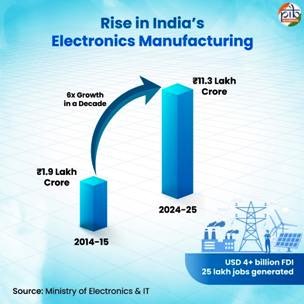
- Electronics expansion: ₹1.9 lakh cr → ₹11.3 lakh cr (2014–25).
Practice Question
- “Self-reliance in the 21st century must coexist with global integration.” Examine in the context of India’s industrial strategy. (250 Words)
Evolution of India’s Industrial Strategy
- Post-independence India adopted Import Substitution Industrialisation (ISI) under the Mahalanobis strategy, emphasising heavy industries, high tariffs, and domestic capacity creation to conserve foreign exchange.
- The 1991 Liberalisation reforms shifted India toward export-led growth, tariff rationalisation, deregulation, and integration with global markets under WTO-compatible frameworks.
- Since 2014, policies like Make in India, Atmanirbhar Bharat, and PLI schemes have combined strategic import substitution with outward-oriented manufacturing competitiveness.
- The contemporary approach seeks self-reliance without protectionism, promoting domestic value addition while embedding firms into Global Value Chains (GVCs).
Macroeconomic Context
- The Economic Survey 2025-26 highlighted India among the fastest-growing major economies, supported by a healthy banking sector, strong credit growth, and robust macroeconomic fundamentals.
- India maintains comfortable foreign exchange reserves and manageable current account dynamics, enabling resilience against external volatility and commodity price shocks.
- Export diversification and services trade surplus have reduced vulnerability to demand contraction in specific geographies, particularly during global slowdown cycles.
Sectoral Transformation
Electronics Manufacturing
- Electronics production expanded from ₹1.9 lakh crore (2014-15) to ₹11.3 lakh crore (2024-25), reflecting nearly six-fold growth driven by PLI incentives and large-scale domestic assembly operations.
- Mobile manufacturing surged from ₹18,000 crore to ₹5.45 lakh crore, making India the world’s second-largest mobile manufacturer with over 300 operational manufacturing units.
- India attracted over USD 4 billion FDI in electronics since 2020-21, demonstrating investor confidence in policy stability and domestic market scale.
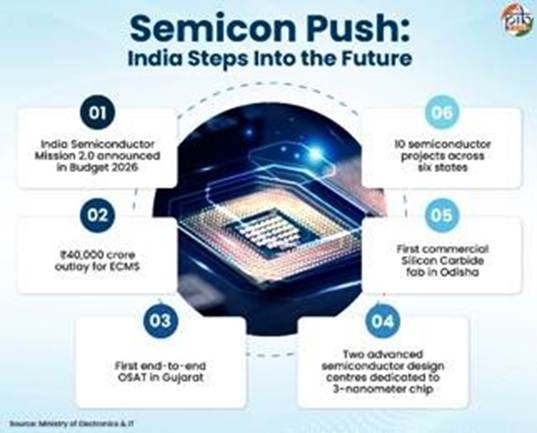
- Semiconductor push includes India Semiconductor Mission (₹76,000 crore) and ISM 2.0, alongside 10 approved projects worth ₹1.6 lakh crore investments.
- Establishment of India’s first end-to-end OSAT facility in Sanand marks a shift from assembly dependency toward backend semiconductor integration and supply chain resilience.
Automobile Industry
- Automobile production increased from 22.6 million units (FY21) to 31 million units (FY25), reflecting strong domestic demand recovery and expanding export penetration.
- India is the largest global market for two-wheelers and three-wheelers, and third-largest for passenger vehicles, with employment exceeding 30 million people.
- PLI-Auto (₹25,938 crore) and PM E-DRIVE (₹10,900 crore) incentivise Advanced Automotive Technologies, EV manufacturing, and battery ecosystem development.
- Export growth from 4.13 million units to 5.36 million units (FY21–FY25) indicates integration into global automotive supply chains.
Pharmaceuticals and Medical Devices
- India ranks 3rd globally by volume and 11th by value in pharmaceuticals, with industry turnover reaching ₹4.72 lakh crore (FY25).
- PLI for Bulk Drugs created annual capacity of 55,000 MT for 26 critical APIs, reducing strategic vulnerability from import dependence.
- Medical device exports expanded from USD 2.5 billion (FY21) to USD 4.1 billion (FY25), strengthening indigenous manufacturing capabilities.
- WHO Global Traditional Medicine Centre in Jamnagar enhances global institutional recognition of India’s AYUSH systems and integrative health frameworks.
Defence Manufacturing
- Indigenous defence production rose from ₹46,429 crore (FY15) to ₹1.54 lakh crore (FY25), reflecting policy emphasis under DAP 2020 reforms.
- Defence exports surged from less than ₹1,000 crore (2014) to ₹23,622 crore (FY25), with exports to over 100 countries.
- Defence corridors in Uttar Pradesh and Tamil Nadu attracted investments exceeding ₹9,145 crore, fostering regional industrial ecosystems.
- Target of ₹3 lakh crore defence production and ₹50,000 crore exports by 2029 signals ambition to transition from importer to global supplier.
Export Resilience and Diversification
- Total exports (Apr–Jan FY26) reached USD 720.76 billion, indicating broad-based resilience despite global economic uncertainty and geopolitical tensions.
- Services exports hit an all-time high of USD 387.5 billion (FY25) with USD 188.8 billion trade surplus, cushioning merchandise volatility.
- Under UNCTAD trade diversity indices, India ranks among top Global South economies for product and partner diversification.
- Nine FTAs covering 38 countries now provide access to nearly 70% of global GDP, reducing overdependence on limited markets.
Governance and Institutional Reforms
- Export Promotion Mission (₹25,060 crore) integrates finance, logistics, compliance, and market intelligence to enhance MSME export readiness.
- Interest subvention of 2.75% for export factoring reduces working capital constraints for small exporters and first-time market entrants.
- TRACE scheme reimburses 60–75% compliance costs, strengthening India’s conformity with global certification and regulatory standards.
- Districts as Export Hubs approach decentralises trade strategy, promoting balanced regional export growth and inclusive development.
Constitutional and Legal Dimensions
- Article 19(1)(g) guarantees freedom of trade and profession, forming constitutional basis for industrial and export activity.
- Article 301 ensures freedom of trade, commerce, and intercourse throughout India, strengthening internal market integration.
- WTO compatibility requires ensuring subsidies and incentives do not violate principles of Most Favoured Nation (MFN) and national treatment.
Economic and Structural Significance
- Manufacturing expansion increases employment elasticity, particularly in electronics assembly, textiles, and defence MSMEs, supporting demographic dividend utilisation.
- Diversified exports reduce current account vulnerability and enhance macroeconomic stability against commodity price and demand shocks.
- Integration into GVCs enhances technology transfer, productivity growth, and domestic value addition across industrial clusters.
Challenges
- Logistics costs remain high at approximately 13–14% of GDP, reducing export price competitiveness compared to East Asian economies.
- Semiconductor ecosystem remains capital-intensive with high water-energy requirements and continued dependence on imported equipment.
- R&D expenditure remains around 0.7% of GDP, limiting transition from assembly-driven growth toward innovation-led manufacturing leadership.
Way Forward
- Increase R&D spending toward 2% of GDP, incentivising private sector research and academia-industry collaboration in deep technology domains.
- Reduce logistics costs through PM Gati Shakti, multimodal integration, and port modernisation to achieve global benchmark efficiency levels.
- Negotiate high-quality FTAs with EU and UK while safeguarding domestic industry interests through calibrated tariff rationalisation.
- Strengthen skill ecosystems for semiconductors, EVs, and advanced manufacturing through industry-linked vocational and technical training reforms.
Prelims Pointers
- ISM Outlay: ₹76,000 crore (2021).
- ECMS revised outlay: ₹40,000 crore.
- Defence exports FY25: ₹23,622 crore.
- Services exports FY25: USD 387.5 billion.
- Export Promotion Mission outlay: ₹25,060 crore.
Seva Sankalp Resolution – Department of Drinking Water and Sanitation (DDWS)
Why in News?
- On 2 March 2026, DDWS adopted the Seva Sankalp Resolution, following the Union Cabinet’s decision on 24 February 2026 at “Seva Teerth”, emphasising service-oriented governance and citizen-centric administration.
- The Resolution operationalises the Prime Minister’s renewed governance vision rooted in constitutional values, transparency, accountability, and “Nagrik Devo Bhava”, particularly within rural drinking water and sanitation delivery frameworks.
- It mandates Ministries to internalise a service culture, ensure prudent public expenditure, and translate policy intent into measurable outcomes, aligning with performance-based governance reforms.
Relevance
GS II – Polity & Governance
- Article 21 – Right to safe drinking water (judicial interpretation).
- Article 47 – Public health mandate.
- 73rd Constitutional Amendment – Panchayati Raj decentralisation.
- Shift from scheme implementation to service delivery outcomes.
GS II – Social Justice
- Jal Jeevan Mission (FHTCs for all rural households).
- SBM-G Phase II – ODF sustainability.
- Focus on last-mile inclusion & dignity.
Practice Question
- Discuss how decentralised governance strengthens rural drinking water service delivery in India. (250 Words)
Static Background
- The Department of Drinking Water and Sanitation (DDWS) functions under the Ministry of Jal Shakti, implementing flagship rural schemes such as Jal Jeevan Mission (JJM) and Swachh Bharat Mission–Grameen (SBM-G).
- Jal Jeevan Mission (2019) aims to provide Functional Household Tap Connections (FHTCs) to every rural household, shifting from infrastructure creation to assured service delivery.
- Swachh Bharat Mission–Grameen (Phase II) emphasises sustaining Open Defecation Free (ODF) status through solid-liquid waste management and behaviour change interventions.
- The 73rd Constitutional Amendment institutionalised Gram Panchayats and Gram Sabhas as decentralised governance units, central to water and sanitation planning and accountability.
Core Features of Seva Sankalp Resolution
- Reaffirms governance based on service, duty, dedication, and citizen primacy, embedding ethical administration within rural drinking water and sanitation delivery.
- Emphasises safe, reliable, sustainable drinking water at village and household levels, ensuring policy implementation translates into tangible, measurable ground outcomes.
- Mandates prudent and judicious use of public resources, aligning with fiscal responsibility, outcome budgeting, and performance audit principles.
- Strengthens Gram Panchayat capacity and Gram Sabha accountability, promoting decentralised planning, implementation, operation, and maintenance of water assets.
- Calls for inter-ministerial convergence, especially with the Ministry of Panchayati Raj, State Governments, and stakeholders to improve institutional coordination.
- Reinforces focus on the “last person standing”, ensuring equity, dignity, and universal access under decentralised rural governance frameworks.
Constitutional and Legal Dimensions
- Aligns with Article 21, as the right to safe drinking water is recognised by the Supreme Court as intrinsic to the right to life and human dignity.
- Supports Article 47 (Directive Principles), which mandates the State to improve public health and raise the standard of living.
- Strengthens implementation of the 73rd Constitutional Amendment, deepening decentralisation and local accountability in water and sanitation governance.
- Embeds transparency and accountability consistent with principles of good governance under Articles 14 and 38, ensuring equitable access to public services.
Governance and Administrative Significance
- Shifts focus from scheme-driven implementation to service delivery outcomes, emphasising reliability, sustainability, and behavioural change.
- Institutionalises daily administrative introspection, encouraging officials to align routine decisions with measurable citizen welfare outcomes.
- Encourages convergence across ministries, reducing duplication and promoting integrated rural development planning.
- Promotes capacity building of local bodies, addressing operational challenges such as water quality monitoring, maintenance, and community ownership.
Economic Dimensions
- Prudent public expenditure improves cost-effectiveness of water infrastructure, reducing wastage and improving long-term sustainability of assets.
- Strengthened local governance reduces transaction costs and enhances efficiency through decentralised planning and community oversight.
- Reliable drinking water supply improves rural productivity by reducing time spent on water collection, especially for women.
- Improved sanitation and water access reduce disease burden, lowering healthcare expenditure and increasing workforce participation.
Social and Ethical Dimensions
- Operationalises the principle of “Nagrik Devo Bhava”, embedding dignity, empathy, and citizen-centricity within administrative functioning.
- Promotes gender equity by reducing drudgery and enhancing safety for women and girls through assured water and sanitation access.
- Reinforces collective ownership through Gram Sabha engagement, strengthening participatory democracy and social accountability.
- Advances inclusive development by targeting marginalised households, ensuring no exclusion in access to basic services.
Environmental and Sustainability Aspects
- Emphasises sustainable drinking water services, encouraging source sustainability, groundwater recharge, and efficient water use.
- Integrates sanitation with solid and liquid waste management, reducing contamination of water bodies and improving rural environmental health.
- Encourages long-term asset management and preventive maintenance, reducing ecological stress from abandoned or dysfunctional infrastructure.
Challenges
- Ensuring sustainability of rural water supply amid declining groundwater levels and climate variability remains a structural constraint.
- Capacity gaps at Gram Panchayat level may limit effective operation and maintenance of water systems without sustained training and funding support.
- Behavioural change under SBM-G requires continuous social mobilisation beyond infrastructure provision.
- Monitoring service quality, water safety, and grievance redressal requires robust digital and institutional systems.
Way Forward
- Institutionalise performance-based monitoring linking fund releases to service reliability, water quality, and community satisfaction indicators.
- Strengthen water quality surveillance through community testing labs and digital dashboards integrated with district-level monitoring systems.
- Enhance convergence with MGNREGA and watershed programmes for source sustainability and groundwater recharge.
- Expand continuous capacity building for Panchayat functionaries under a structured rural water governance curriculum.
- Promote behavioural nudges and social campaigns to embed sanitation practices as enduring social norms.
Prelims Pointers
- Jal Jeevan Mission launched in 2019 to provide Functional Household Tap Connections (FHTCs) to all rural households.
- Swachh Bharat Mission–Grameen Phase II focuses on sustaining ODF status and waste management systems.
- Article 47 directs the State to improve public health.
- 73rd Constitutional Amendment (1992) institutionalised Panchayati Raj and Gram Sabha accountability.