
Published on Nov 5, 2025
Daily PIB Summaries
PIB Summaries 05 November 2025

Content
- India’s Leap in Research and Innovation
- Access and Benefit-Sharing Framework
India’s Leap in Research and Innovation
Why in News?
- India launched the ₹1 lakh crore Research, Development and Innovation (RDI) Scheme on 3 November 2025 during ESTIC 2025 (Emerging Science, Technology and Innovation Conclave) at Bharat Mandapam, New Delhi.
- Marks a historic boost for private-led innovation to accelerate India’s transition toward Viksit Bharat@2047.
- Reflects India’s rising R&D expenditure and strategic focus on high-impact technologies like AI, Quantum, Semiconductors, Deep Ocean, and Biotechnology.
Relevance
- GS-3 (Science & Technology):
Boosts R&D and innovation through ₹1 lakh crore RDI Scheme 2025.
Focus on AI, Quantum, Semiconductors, Space, and Biotech for Atmanirbhar Bharat. - GS-3 (Economy):
Promotes private-led R&D, tech-driven industries, and high-value job creation.
Targets 2% R&D–GDP ratio for Viksit Bharat@2047. - GS-2 (Governance):
Institutional reforms via ANRF Act 2023, BioE3 Policy 2024, Indian Space Policy 2023.
Strengthens PPPP model for innovation-led growth.
Evolution of India’s R&D Ecosystem
- Objective: Build a self-reliant, knowledge-driven economy through science and innovation.
- Transformation: Shift from public-funded research to public–private innovation partnerships.
- Drivers: Policy reforms, digital infrastructure, innovation missions, and private sector participation.
Key Data and Trends in India’s R&D
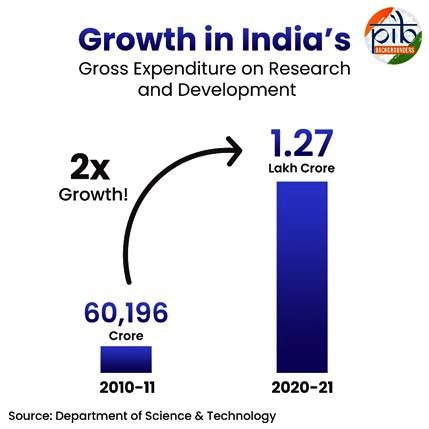
- Gross Expenditure on R&D (GERD):
- ₹60,196 crore (2010–11) → ₹1.27 lakh crore (2020–21) → projected ₹2.5 lakh crore (2025–26).
- R&D Share in GDP: ~0.7% (India) vs 2–3% (OECD average).
- Sectoral Contribution:
- Government: 64% of GERD
- Private sector: 36% (rising trend)
- Human Capital in Science:
- 40,813 PhDs awarded (2018–19), 60% in Science & Technology.
- India ranks 3rd globally after USA & China.
- Patents filed: 24,326 (2020–21) → 68,176 (2024–25).
₹1 Lakh Crore RDI Scheme (2025) – The Game Changer
Launch Context: ESTIC 2025 (3–5 Nov 2025), Theme – “Viksit Bharat 2047: Pioneering Sustainable Innovation.”
Aim: Build a private-sector-driven innovation ecosystem with long-term, low-cost financing for R&D.
Core Features
- Long-term refinancing with low or nil interest rates for R&D projects.
- Growth and risk capital for private research in strategic sectors.
- Deep-Tech Fund of Funds to strengthen financing for start-ups.
- Encourages commercialisation of high-end research.
Objectives
- Private Sector Push: Expand R&D in sunrise and strategic sectors.
- Transformative Financing: Fund advanced technology readiness projects.
- Tech Acquisition: Support access to critical technologies of strategic value.
- Deep-Tech Focus: Foster start-ups in AI, quantum, space, bio, and defense tech.
Institutional and Policy Pillars of India’s Innovation Framework
Anusandhan National Research Foundation (ANRF)
- Legal Basis: ANRF Act, 2023 (effective Feb 2024).
- Goal: Mobilise ₹50,000 crore (2023–28).
- Funding Mix: ₹14,000 crore (Govt) + ₹36,000 crore (Industry & Philanthropy).
- Focus: Strengthen academia–industry linkage and fund high-impact research.
National Geospatial Policy, 2022
- Liberalised geospatial data access for research and governance.
- Target: Comprehensive Digital Elevation Model by 2030.
- Promotes open-data ecosystem for innovation in mapping and planning.
Indian Space Policy, 2023
- Enables private participation in end-to-end space activities.
- IN-SPACe acts as regulator and facilitator.
- Supports commercial space manufacturing and international collaboration.
BioE3 Policy, 2024 (Biotechnology for Economy, Environment, Employment)
- Promotes bio-manufacturing, bio-AI hubs, and biofoundries.
- Encourages sustainable, circular, and bio-based industries.
Atal Innovation Mission (AIM) 2.0
- Continuation till March 2028 with ₹2,750 crore.
- Network of Atal Tinkering Labs & Atal Incubation Centres.
- Builds innovation culture among students and MSMEs.
National Missions Driving Frontier Technologies
| Mission | Year | Key Focus | Budget/Outlay |
| National Quantum Mission (NQM) | 2023 | Quantum computing, secure comms | ₹6,003.65 crore |
| National Mission on Interdisciplinary Cyber-Physical Systems (NM-ICPS) | 2018 | AI, Robotics, IoT, Cybersecurity | ₹3,660 crore |
| National Supercomputing Mission (NSM) | 2015 | HPC systems, digital knowledge network | ₹4,500+ crore |
| India Semiconductor Mission (ISM) | 2021 | Chip design, fabrication, packaging | ₹76,000 crore PLI |
| Deep Ocean Mission (DOM) | 2021 | Marine resources, Blue Economy | ₹4,077 crore |
| IndiaAI Mission | 2024 | AI infra, ethics, innovation | ₹10,371.92 crore |
Digital Public Infrastructure (DPI) – Foundation of Modern Innovation
Purpose: Democratises data, improves governance, and supports R&D scalability.
| Platform | Function | Key Figures (as of 2025) |
| UPI | Digital payments backbone | ₹24.85 lakh crore/month; 7-country presence |
| Co-WIN | Vaccination logistics & health data | 220+ crore doses delivered |
| DigiLocker | Verified document repository | 60.35 crore users |
| Aadhaar & e-KYC | Identity authentication | 143+ crore Aadhaar IDs |
| DBT Platform | Direct subsidy transfer | ₹43.95 lakh crore cumulative transfers |
Challenges in India’s R&D Landscape
- Low Private Investment: 36% vs >70% in OECD economies.
- Fragmented Research Institutions: Weak industry–academia collaboration.
- Brain Drain: Skilled researchers migrating for better opportunities.
- Limited IP Commercialisation: Patent filings high but technology transfer low.
- Underdeveloped Venture Capital: Especially in deep-tech and early-stage research.
Way Forward – Towards Viksit Bharat @2047
- Enhance R&D–GDP Ratio to 2% by 2047.
- Institutionalise Public–Private–Philanthropy Partnerships (PPPP).
- Promote Multidisciplinary Research Universities.
- Incentivise Private R&D Investments through tax credits and equity support.
- Leverage Digital Infrastructure for data-driven research and innovation.
- Strengthen Intellectual Property (IP) Regime and technology transfer pathways.
Significance
- Economic: Enhances global competitiveness and productivity.
- Strategic: Builds self-reliance in defense, space, and critical technologies.
- Social: Solves challenges in health, energy, agriculture, and climate.
- Global Standing: Positions India among the top 5 global R&D powers.
Access and Benefit-Sharing Framework
Why in News?
- The National Biodiversity Authority (NBA) has released ₹3 crore under the Access and Benefit-Sharing (ABS) mechanism to 199 beneficiaries — including 198 Red Sanders farmers and the University of Andhra.
- Marks a major milestone in linking biodiversity conservation with community livelihoods under the Biological Diversity Act, 2002.
- Focus species: Red Sanders (Pterocarpus santalinus) — an endemic, high-value and endangered tree species native to the Eastern Ghats of Andhra Pradesh.
Relevance
- GS-3 (Environment & Ecology):
Implements Biological Diversity Act, 2002 and Nagoya Protocol for equitable benefit-sharing.
Promotes conservation and legal trade of Red Sanders through incentive-based ABS. - GS-2 (Governance):
Decentralised biodiversity governance via NBA–SBB–BMC structure.
Advances India’s global biodiversity commitments. - GS-3 (Economy):
Links biodiversity with livelihoods and rural income generation.
Supports Mission LiFE, Green Credit, and National Biodiversity Mission.
Context and Background
- Red Sanders is listed in CITES Appendix II (Convention on International Trade in Endangered Species).
- Known for its deep red timber, used in musical instruments, furniture, and traditional medicine.
- Historically subject to illegal felling and smuggling, leading to stringent controls on trade.
- Biological Diversity Act, 2002 and Access and Benefit-Sharing (ABS) mechanism aim to ensure equitable sharing of benefits from the use of biological resources and associated traditional knowledge.
The Current Initiative (2025)
- Amount Released: ₹3.00 crore
- Beneficiaries: 198 farmers + 1 academic institution (University of Andhra)
- Facilitated by: Andhra Pradesh State Biodiversity Board
- Districts Covered: Chittoor, Tirupati, Nellore, and Cuddapah (48 villages)
- Benefit Range: ₹33,000 – ₹22 lakh per farmer (based on quantity supplied)
- Outcome: Payments exceed market sale value — incentivising conservation and legal cultivation.
Broader NBA Initiatives on Red Sanders
| Year / Phase | Recipient | Amount | Purpose |
| Earlier Releases | AP & Karnataka Forest Depts, AP Biodiversity Board | ₹48.00 crore | Conservation of Red Sanders forests |
| Tamil Nadu Farmers (2023) | Individual cultivators | ₹55.00 lakh | Incentive for cultivated Red Sanders |
| Current Phase (2025) | AP farmers & University of Andhra | ₹3.00 crore | Fair benefit sharing under ABS |
Policy and Institutional Foundations
Biological Diversity Act, 2002
- Legal framework for conservation, sustainable use, and fair benefit-sharing.
- National Biodiversity Authority (NBA) oversees implementation.
- State Biodiversity Boards (SBBs) and Biodiversity Management Committees (BMCs) facilitate local participation.
Access and Benefit-Sharing (ABS) Mechanism
- Access: Regulates utilisation of biological resources by companies, researchers, or exporters.
- Benefit Sharing: Ensures that local communities and custodians receive a share of monetary and non-monetary gains.
- Promotes incentive-based conservation.
Expert Committee on Red Sanders (2015)
- Developed Policy for Conservation, Sustainable Use and Fair & Equitable Benefit Sharing of Red Sanders (2019).
- Recommended mechanisms to legalise cultivated Red Sanders trade.
DGFT Policy Relaxation (2019)
- Allowed export of Red Sanders from cultivated sources, aligning trade policy with conservation and livelihood goals.
Significance of the 2025 ABS Disbursement
Environmental
- Promotes in-situ and ex-situ conservation of a critically threatened endemic species.
- Reduces illegal logging and trafficking by incentivising legal cultivation.
Socio-Economic
- Empowers local farmers by converting conservation into an income-generating activity.
- Encourages community stewardship of biodiversity.
- Demonstrates fair benefit-sharing in action — farmers receiving more than market value.
Governance and Policy
- Operationalises the Nagoya Protocol (2010) on ABS, to which India is a signatory.
- Reinforces the decentralised governance structure of biodiversity conservation.
- Acts as a model for benefit-sharing in other bioresource sectors (e.g., medicinal plants, NTFPs).
Challenges
- Low awareness among local communities about ABS provisions.
- Complex approval processes for resource access.
- Valuation issues in determining benefit share for cultivators vs wild resources.
- Need for traceability systems to distinguish cultivated from wild-sourced products.
Way Forward
- Scale up ABS Implementation: Extend similar frameworks to other bioresource-rich states (e.g., NE India, Western Ghats).
- Capacity Building: Strengthen SBBs and BMCs for local biodiversity governance.
- Digital Monitoring: Use blockchain or GIS to trace bioresource use and ensure transparency.
- Mainstream Biodiversity Economy: Integrate ABS into agri-exports, biopharma, and forestry sectors.
- Enhance Farmer–Industry Linkages: Facilitate contracts between cultivators and legal exporters.
Broader Significance for India
- Aligns with SDGs: Especially SDG 15 (Life on Land) and SDG 12 (Responsible Consumption & Production).
- Supports National Missions: Complementary to Mission LiFE, Green Credit Programme, and National Biodiversity Mission.
- Strengthens India’s Global Leadership: Demonstrates compliance with Convention on Biological Diversity (CBD) and Nagoya Protocol commitments.
Conclusion
- The ₹3 crore ABS release for Red Sanders farmers represents India’s evolving biodiversity governance model — where conservation, commerce, and community welfare converge.
- It showcases how economic incentives can drive sustainable utilisation of natural resources while ensuring fair equity for biodiversity custodians.
- With stronger implementation, India’s ABS framework could become a global exemplar of inclusive biodiversity economics.