

Content
- National Cooperative Development Corporation (NCDC)
- Agricultural Education & Training in India
National Cooperative Development Corporation (NCDC)
Why in News ?
- Rs. 49,799.06 crore disbursed by NCDC as of October 2025 (FY 2025–26).
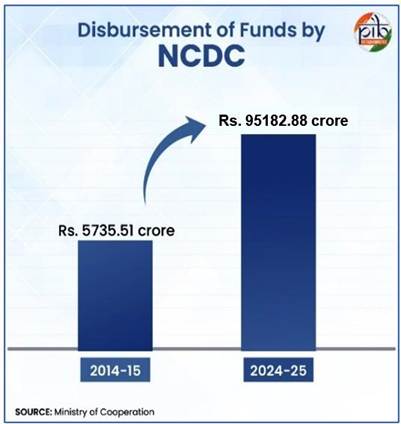
- Rs. 95,182.88 crore disbursed in FY 2024–25 — a 16.5× rise from Rs. 5,735.51 crore in FY 2014–15.
- New Central Sector “Grant-in-Aid to NCDC Scheme” (2025–29) approved —₹2,000 crore outlay, leveraging ₹20,000 crore market funding.
- Launch of National Cooperation Policy 2025, aligning with Viksit Bharat 2047 and Sahkar se Samriddhi vision.
Relevance :
- GS-3 (Economy): Strengthens cooperative-based rural credit, enterprise formation, and value chains; aligns with Atmanirbhar Bharat & Viksit Bharat 2047.
- GS-2 (Governance): Implements National Cooperation Policy 2025 for transparency, professionalism & digital cooperatives.
- GS-3 (Inclusive Growth): Focus on SC/ST/Women cooperatives, job creation, and decentralized development through “Sahkar se Samriddhi.”
- GS-3 (Agriculture): Expands financing for dairy, fisheries, sugar, and allied sectors via modernized cooperative structures.
NCDC – The Backbone of India’s Cooperative Economy
- Statutory body, established in 1963 under the National Cooperative Development Corporation Act, 1962.
- Administrative Ministry: Ministry of Cooperation.
- Mandate: Promote, strengthen & develop cooperatives in agriculture, allied, and non-farm sectors via financial & technical support.
Key Objectives
- Financing cooperatives in production, processing, storage, marketing, cold chains, and input supply.
- Supporting non-farm cooperative activities – dairy, poultry, fishery, handloom, SC/ST & women cooperatives.
- Strengthening value chains & post-harvest infrastructure for rural development.
India’s Cooperative Landscape
- Total cooperatives: 8.44 lakh
- Membership: >30 crore individuals
- Farmer linkage: 94% of Indian farmers associated with cooperatives (credit, dairy, sugar, etc.)
- Economic sectors: Credit, sugar, dairy, fertilizers, textiles, marketing, housing, fishery, handicrafts.
NCDC’s Financial Growth
| Year | Financial Assistance (₹ crore) | Growth |
| 2014–15 | 5,735.51 | Base Year |
| 2024–25 | 95,182.88 | +1,560% rise |
| 2025–26 (till Oct 2025) | 49,799.06 | 52% of previous FY achieved mid-year |
Sectoral Focus
- Sugar sector: ₹33,311.79 crore cumulative (as of Mar 2025)
- Women cooperatives: ₹4,823.68 crore (FY 2021–25)
- SC/ST cooperatives: ₹57.78 crore (FY 2021–25)
Flagship Schemes of NCDC
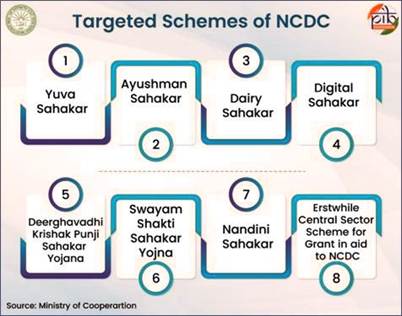
Yuva Sahakar (2019–20)
- Promotes start-up cooperatives and innovation-driven youth entrepreneurship.
- Focus: Aspirational districts, NER, women, SC/ST/PwD cooperatives.
- Support: Cooperative Start-up & Innovation Fund.
- Performance:
- 32 cooperatives supported
- ₹49.35 crore sanctioned; ₹3.71 crore released
Ayushman Sahakar (2020–21)
- Cooperative model for holistic healthcare and AYUSH promotion.
- Supports hospital infrastructure, digital health, and health education.
- Performance (till FY 2024–25):
- 9 cooperatives
- ₹161.90 crore sanctioned; ₹43.19 crore released
Dairy Sahakar (2021–22)
- Strengthens dairy cooperatives; covers procurement, processing, value addition, export.
- Also supports ICT, renewable energy, R&D, veterinary services.
- Performance:
- 16 cooperatives
- ₹162.28 crore sanctioned; ₹177.72 crore released
Digital Sahakar (2021–22)
- Aligns with DigitalIndia.
- Promotes digitally enabled cooperatives, improved credit access, transparency, and integration with e-governance schemes.
- Eligible entities: Cooperatives, FPOs, FFPOs, SHG federations.
Deerghavadhi Krishak Punji Sahakar Yojana (2022–23)
- Long-term capital support for agricultural credit cooperatives.
- Targets PACS, DCCBs, StCBs, PCARDBs, SCARDBs.
- Performance:
- 5 cooperatives
- ₹5,400.76 crore sanctioned; ₹2,137 crore released
Women-centric Schemes
Swayam Shakti Sahakar Yojana (2022–23)
- Extends loans via cooperative banks to Women SHGs & federations for rural enterprise creation.
Nandini Sahakar (2020–21)
- Empowers women-led cooperatives via business planning, credit, and training.
- Performance (FY 2021–25):
- 34 cooperatives assisted
- ₹6,283.71 crore sanctioned; ₹4,823.68 crore released
- ₹2.37 crore for infrastructure (2022–25)
Cooperative Sugar Mills Assistance
- Grant-in-Aid Scheme: ₹1,000 crore (2022–23 to 2024–25)
- Enables loans up to ₹10,000 crore for ethanol/cogeneration plants & working capital.
- Funding pattern revised: 90:10 (society: NCDC).
- Interest: 8.5% term loan rate.
- Outcome: ₹10,005 crore to 56 sugar mills.
Recent Developments
Grant-in-Aid Scheme (2025–26 to 2028–29)
- Outlay: ₹2,000 crore (₹500 crore annually).
- Leverage potential: ₹20,000 crore from open market.
- Coverage: ~13,288 cooperatives; 2.9 crore members.
- Target sectors: Dairy, fisheries, textiles, sugar, storage, women cooperatives, etc.
National Cooperation Policy (NCP) 2025
- Vision: “Sahkar se Samriddhi” – cooperatives as drivers of Viksit Bharat 2047.
- Focus areas:
- Legal reforms for transparency and professionalism
- Technology-driven and market-linked cooperatives
- Collaboration with IFFCO, NAFED, KRIBHCO, AMUL, NDDB, NCEL & NABARD
- Promoting “Cooperation among Cooperatives” model
Significance & Impact
Economic Impact
- Enhances rural credit and enterprise formation.
- Boosts value-added agriculture and farm-to-market linkages.
- Generates employment and local entrepreneurship.
Social Impact
- Empowers marginalized groups (SC/ST/Women) through inclusive finance.
- Strengthens social capital via participatory governance.
Strategic Impact
- Reduces dependence on state subsidies by fostering self-sustaining cooperatives.
- Aligns with Atmanirbhar Bharat and Vocal for Local missions.
Critical Analysis
| Parameter | Achievement | Challenge |
| Credit Growth | 16× growth in disbursement (2014–25) | Uneven access across states |
| Inclusivity | Dedicated schemes for women, SC/ST | Limited scale of disbursement to marginalized groups |
| Digitalization | Launch of Digital Sahakar | Digital literacy & infra gaps in PACS |
| Health Sector Expansion | Ayushman Sahakar model | Low adoption rate |
| Policy Support | National Cooperation Policy 2025 | State-level cooperative law fragmentation |
Way Forward
- Uniform Cooperative Legal Framework across states for ease of operation.
- Stronger credit monitoring to reduce NPAs in cooperative banks.
- Skill & capacity building through cooperative training institutes.
- Technology infusion: Blockchain, AI-driven traceability, digital payments.
- Women & youth-focused financial instruments for social inclusion.
Conclusion
The National Cooperative Development Corporation has emerged as a key financial and institutional pillar of India’s cooperative resurgence. With record disbursements, targeted social schemes, and integration under National Cooperation Policy 2025, NCDC is central to realizing a “Self-reliant and Inclusive Cooperative India” by 2047. Its sustained focus on credit expansion, inclusivity, and modernization positions cooperatives as engines of rural prosperity and equitable growth.
Agricultural Education & Training in India
Why in News ?
- PIB release highlights India’s integrated approach toward agricultural education, research, and farmer training under the vision “One Nation – One Agriculture – One Team.”
- Focus: Strengthening agricultural human capital, digital technologies (AI, IoT), and farmer skilling to achieve “Viksit Krishi aur Samruddh Kisan” — a pillar of Viksit Bharat 2047.
Relevance :
- GS-2 (Education & Governance): Strengthens institutional capacity through ICAR, CAUs, KVKs; aligns with NEP 2020 and DARE-led reforms.
- GS-3 (Agriculture): Integrates AI, IoT, and digital skilling for climate-smart, precision-based agriculture.
- GS-3 (Science & Tech): Promotes AgriTech innovation via Technology Innovation Hubs and startup incubation under RKVY.
- GS-3 (Rural Development): Enhances farmer training, mechanization, and human capital for “Viksit Krishi aur Samruddh Kisan.”
Importance of Agricultural Education
- Economic significance: Agriculture supports ~50% of India’s work force and contributes ~18% of GDP.
- Objective: Build a scientifically trained, tech-enabled workforce for 5% annual agri growth.
- Three Pillars: Education, Research, and Extension — interlinked to raise productivity, reduce costs, and enhance sustainability.
Institutional Framework — ICAR System
Indian Council of Agricultural Research (ICAR)
- Established: 1929; under Department of Agricultural Research & Education (DARE), MoA&FW.
- Mandate: Apex body for agricultural education, research, and extension.
- Network:
- 113 National Research Institutes
- 74 Agricultural Universities (State, Central, Deemed, and ICAR-affiliated)
- 731 Krishi Vigyan Kendras (KVKs) — frontline extension units.
- Major Achievements:
- Led the Green Revolution; now drives climate-resilient crop and livestock innovations.
- ICAR Model Act (Revised 2023): Standardized academic & governance norms.
- Accreditation: Through National Agricultural Education Accreditation Board (NAEAB).
University Ecosystem in Agriculture
| Category | No. of Institutions | Key Highlights |
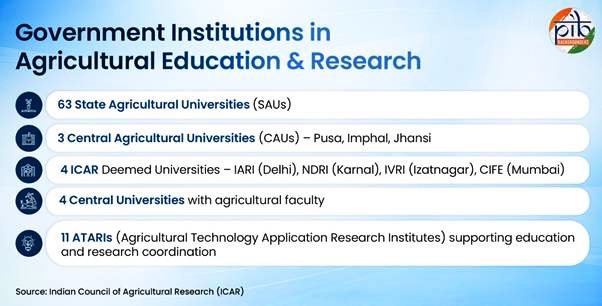
| State Agricultural Universities (SAUs) | 63 | Mainstream under state governments |
| Central Agricultural Universities (CAUs) | 3 | Pusa (Bihar), Imphal (Manipur), Jhansi (UP) |
| Deemed Universities (ICAR) | 4 | IARI (Delhi), NDRI (Karnal), IVRI (Izatnagar), CIFE (Mumbai) |
| Central Universities with Agri Faculties | 4 | Offer agriculture and allied science programs |
| Private ICAR-accredited Colleges | 22 (up from 5 in 2020–21) | Reflects growing private participation |
Central Agricultural Universities — Regional Impact
- (a) Dr. Rajendra Prasad CAU, Pusa (Bihar)
- Converted from State Univ. (2016); 8 constituent colleges, 18 KVKs.
- Offers UG, PG, PhD + short-term industry-linked diplomas.
- Focus: Eastern India agrarian upliftment.
- (b) CAU, Imphal (Manipur)
- Established 1993; serves 7 NE hill states.
- 13 constituent colleges, 10 UG + 48 PG + 34 PhD programs.
- Enrolment 2024–25: 2,982 students.
- (c) Rani Lakshmi Bai CAU, Jhansi (UP)
- Established 2014; national importance.
- Focus: Dryland farming, veterinary, horticulture, agri-engineering.
- Colleges across UP & MP.
Digital & Technological Transformation
AI & IoT in Agriculture
- Applications: Precision farming (smart irrigation, pest prediction, drone spraying, livestock monitoring).
- Innovation Hubs:
- 25 Technology Innovation Hubs (TIHs) under DST’s NM-ICPS (2022).
- IIT Ropar (IoT for saffron), IIT Bombay (IoE Hub), IIT Kharagpur (AI4ICPS).
- Digital Centres:
- IoT Centres of Excellence — Bengaluru, Gurugram, Gandhinagar, Visakhapatnam (AgriTech hub).
- e-Governance Plan for Agriculture: States funded to deploy AI/ML, IoT, blockchain solutions.
- Start-up Promotion (RKVY-Agripreneurship):
- Launched 2018–19.
- Supports startups in agro-processing, AI, IoT, blockchain, food tech.
Farmer Skilling & Vocational Training
(a) Krishi Vigyan Kendras (KVKs)
- Frontline ICAR training units.
- Farmers trained:
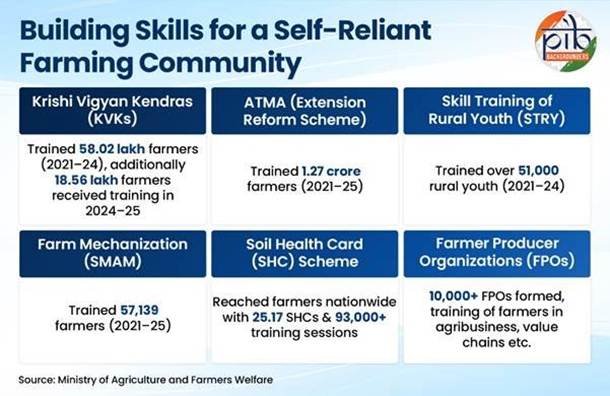
- 2021–22 to 2023–24 → 58.02 lakh
- Apr–Oct 2024–25 → 18.56 lakh
- Focus: Agronomy, livestock, soil health, post-harvest tech.
(b) ATMA (Agricultural Technology Management Agency)
- Decentralised extension scheme.
- Farmers trained:
- 2021–22: 32.38 lakh
- 2022–23: 40.11 lakh
- 2023–24: 36.60 lakh
- Jan 2025 cumulative: 1.27 crore
- Focus: Integrated local training + agri-business linkages.
(c) Skill Training of Rural Youth (STRY)
- Short-term (7-day) vocational training in horticulture, dairy, fisheries.
- Trained:
- 2021–22: 10,456
- 2022–23: 11,634
- 2023–24: 20,940
- Total till Dec 2024 → ~51,000 rural youth.
(d) Sub-Mission on Agricultural Mechanization (SMAM)
- Promotes mechanization via training/demonstrations.
- Farmers trained (2021–25): 57,139
- Focus: Efficient machinery use, custom hiring.
(e) Soil Health Card Scheme
- Promotes balanced nutrient management.
- By July 2025:
- 25.17 crore cards issued,
- 93,000+ trainings, 6.8 lakh demonstrations.
(f) Farmer Producer Organizations (FPOs)
- >10,000 FPOs registered.
- Trained in business management, digital marketing, and collective procurement.
Emerging Trends
- Shift from degree-centric to skill-centric and tech-based learning.
- NEP 2020 integration: Multi-disciplinary courses, short-term diplomas, employability focus.
- PPP in agri-education: Rise of private colleges and industry-academia linkages.
- Digital inclusion: Smart classrooms, agri-data platforms, AI-based curricula.
Challenges
- Regional disparities in institutional capacity (esp. Eastern & NE India).
- Low employability among graduates due to theoretical-heavy curricula.
- Need for AI-ready, climate-smart pedagogy.
- Limited private investment in agricultural R&D.
Policy Implications
- Strengthen synergy of ICAR–SAUs–KVKs–ATMA–FPOs.
- Institutionalize agri-tech incubation and digital learning ecosystems.
- Expand international collaborations for advanced agri-research.
- Align education reforms with Viksit Bharat 2047 agricultural goals.
Conclusion
- India’s agricultural education ecosystem — 113 ICAR institutes, 74 universities, 731 KVKs, 1.27 crore farmers trained (2021–25) — reflects a robust national capacity-building effort.
- Integration of AI, IoT, start-ups, and skilling is bridging research-to-field gaps.
- As agriculture evolves from subsistence to knowledge-driven enterprise, the synergy between education, research, and farmer training will determine India’s agri-future and rural prosperity.