
Published on Oct 7, 2025
Daily PIB Summaries
PIB Summaries 07 October 2025
Content
- Leprosy in India: The Road to a Disease-Free Future
- ICG conducts 10th NATPOLREX-X & 27th NOSDCP off Chennai Coast
Leprosy in India: The Road to a Disease-Free Future
Why in News ?
- As of March 2025, India has sustained leprosy elimination status nationally with 31 States and 638 districts achieving prevalence rate <1/10,000 population.
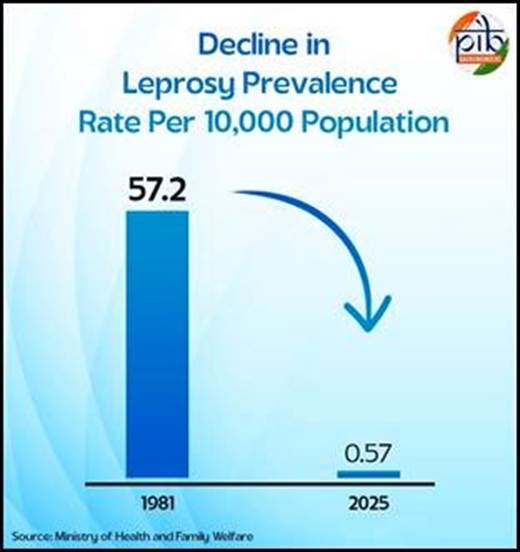
- Leprosy prevalence dropped from 57.2 (1981) to 0.57 (2025) per 10,000 population — a 99% reduction.
- Child cases reduced from 9.04% (2014–15) to 4.68% (2024–25) — key indicator of interrupted transmission.
- India’s National Strategic Plan (NSP) and Roadmap for Leprosy 2023–27 aims for zero indigenous cases by 2030.
Relevance
- GS-2 (Health & Social Justice): NLEP, NHM integration, anti-discrimination, digital trackin (Nikusth 2.0), WHO alignment.
- GS-3 (Science & Tech): Vaccine research, AMR surveillance, ICT-based monitoring.
- GS-1 (Society): Stigma reduction, social inclusion, awareness campaigns.
What is Leprosy ?
- Causative agent: Mycobacterium leprae (chronic bacterial infection).
- Transmission: Respiratory droplets during prolonged contact with untreated patients.
- Organs affected: Skin, peripheral nerves, eyes, upper respiratory tract.
- Types:
- Paucibacillary (PB): Few bacilli, mild infection.
- Multibacillary (MB): High bacilli density, severe infection.
- Symptoms:
- Discoloured skin patches, loss of sensation, non-healing ulcers, deformities in limbs and face.
- Treatment:
- Multi-Drug Therapy (MDT) introduced in 1983: Rifampicin, Clofazimine, and Dapsone — provided free by WHO.
- Prevents disability if diagnosed early.
Evolution of India’s Leprosy Programme
Phase I: Control (1955–1982)
- National Leprosy Control Programme (NLCP, 1955):
- Focus on Survey, Education, and Treatment (SET).
- Relied on dapsone monotherapy, provided through domiciliary care.
- 1970s: Became a centrally sponsored scheme during Fourth FYP.
- Strengthened NGO participation; house-to-house surveys and community education initiated.
- Prevalence in 1951: 38.1/10,000 (13.74 lakh cases).
Phase II: Eradication (1983–2004)
- National Leprosy Eradication Programme (NLEP, 1983):
- Integration of MDT (endorsed by WHO, 1982).
- Shift from control to eradication approach.
- Impact:
- Prevalence reduced from 57.2 (1981) → 2.4 (2004) per 10,000.
- Grade II deformities declined from 20% (1981) → 1.5% (2004).
- World Bank projects (1993–2004):
- Funded community participation and IEC innovations.
- Focus on women, tribals, urban poor.
- 2005: India achieved elimination as a public health problem nationally (<1/10,000 prevalence).
Phase III: Sustaining Elimination (2005–Present)
Core Strategies under NLEP
- Free diagnosis and MDT for all cases.
- Post-Exposure Prophylaxis (PEP): Single dose rifampicin (SDR) for contacts of leprosy patients.
- Early Case Detection Campaigns (ECDC):
- Leprosy Case Detection Campaign (LCDC) – Door-to-door surveys.
- Focused Leprosy Campaigns – Targeted surveillance in affected clusters.
- ABSULS – ASHA-Based Surveillance for Leprosy Suspects (grassroots detection).
- Disability Prevention and Medical Rehabilitation (DPMR):
- Distribution of MCR footwear, Self-care kits, aids and appliances, ₹12,000 compensation for reconstructive surgery-related wage loss.
- Community Awareness:
- Sparsh Leprosy Awareness Campaign on Anti-Leprosy Day.
- Digitalization:
- Nikusth 2.0 (2023): ICT-based portal for patient tracking and drug logistics.
- Anti-Discrimination Drive:
- States encouraged to repeal discriminatory laws against leprosy.
Institutional and Legal Strengthening
- Integration with NHM: Centrally sponsored scheme under National Health Mission.
- Inclusion in national health platforms:
- Screening integrated with Ayushman Bharat (30+ years), RBSK, and RKSK.
- AMR Surveillance:
- National Anti-Microbial Resistance Surveillance for Leprosy launched in 2023.
- Mental Health Integration:
- National Framework for Integration of Mental Health Services for Leprosy Patients (2023).
- Revised Treatment Regimen (2025):
- Triple-drug therapy standardized for both PB & MB cases.
- Focus on PVTGs:
- Nikusth 2.0 tagging for PVTGs across 17 States under PM-JANMAN.
Quantitative Outcomes (As of 2025)
| Indicator | 2014–15 | 2024–25 | % Change |
| Prevalence rate (per 10,000) | 0.69 | 0.57 | ↓17% |
| New case detection rate (per 100,000) | 9.73 | 7.0 | ↓28% |
| Child cases among new detections | 9.04% | 4.68% | ↓48% |
| Grade II disability rate (per million) | 4.68 | 1.88 | ↓60% |
| PEP coverage | 71% (2019–20) | 92% (2024–25) | ↑21% |
| LCDC cases detected (FY 2024–25) | — | 27,428 | — |
- Top endemic states: Chhattisgarh (1.80), Jharkhand (1.46), Odisha (1.37), Maharashtra (1.12).
- Lowest prevalence: Meghalaya (0.03), Manipur (0.05), J&K (0.07).
National Strategic Plan & Roadmap (2023–2027)
- Aligned with: WHO Global Leprosy Strategy 2021–2030 & WHO NTD Roadmap 2021–2030.
- Goal: Interrupt transmission by 2027 and achieve zero indigenous cases by 2030.
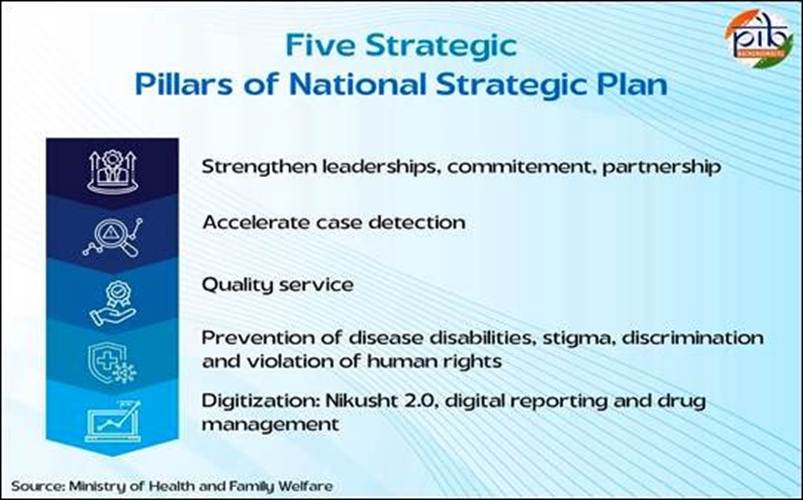
- Strategic Pillars:
- Accelerated case detection (targeted approach).
- Intensified surveillance and digitalization (Nikusth 2.0).
- Chemoprophylaxis for all contacts.
- Vaccine introduction (under evaluation).
- Anti-microbial resistance & adverse drug monitoring.
- Post-treatment surveillance & integrated rehabilitation.
- Behavioural change communication (BCC) to eliminate stigma.
- Repeal discriminatory laws.
- Multi-disease service integration and retention of leprosy expertise.
International Cooperation
- WHO:
- Free MDT drug supply, technical guidance, evaluation, and training.
- Supported MLECs, COMBI (Bihar), and surveillance.
- World Bank: Funded community-oriented projects (1993–2004).
- ILEP, GPZL, Sasakawa Health Foundation, ALERT India, Schieffelin Institute, Hind Kusht Nivaran Sangh:
- Strengthened IEC, rehabilitation, and advocacy against stigma.
- Global Recognition:
- WHO dropped India (2006) from the list of non-eliminated countries.
- India featured in The Global Appeal annually since 2006.
Key Challenges
- Residual endemic pockets in Chhattisgarh, Jharkhand, Maharashtra, Odisha.
- Persistent social stigma and legal discrimination in some states.
- Post-COVID disruption to active case detection and surveillance.
- Need for new diagnostics and vaccine development.
- Underreporting due to stigma and private sector data gaps.
Way Forward
- Whole-of-government and whole-of-society approach integrating NHM, AYUSH, and social justice mechanisms.
- Sustain early detection through ASHA and digital surveillance tools.
- Enhance rehab and mental health support for affected persons.
- Focus on zero child cases for five consecutive years as proof of interrupted transmission.
- Policy integration: NLEP to merge with broader Neglected Tropical Diseases (NTDs) platform.
- Continued international partnerships for research and innovation.
Conclusion
- India’s leprosy control is a global public health success, reflecting:
- 99% drop in prevalence (1981–2025).
- 98% decline in patients under treatment.
- From stigma to integration: India’s journey aligns medical success with social justice.
- However, elimination ≠ eradication — vigilance must continue.
- With political will, digital innovation (Nikusth 2.0), community participation, and global collaboration, India is poised to achieve zero transmission by 2030, marking a historic humanitarian milestone in global disease elimination.
ICG conducts 10th NATPOLREX-X & 27th NOSDCP off Chennai Coast
Why in News
- Indian Coast Guard (ICG) conducted 10th National Level Pollution Response Exercise (NATPOLREX-X) and 27th National Oil Spill Disaster Contingency Plan (NOSDCP) meeting off Chennai coast on October 5–6, 2025.
- 40 foreign observers from 32 countries and 105 national delegates participated.
- Aimed to test and strengthen national preparedness and inter-agency coordination for marine oil spill response.
Relevance
- GS-3 (Environment & Disaster Management): Marine pollution control, NOSDCP framework, coastal resilience, SDG-14, Blue Economy.
- GS-2 (Governance & IR): Inter-agency coordination, institutional roles (ICG, ministries), international maritime cooperation.
Background & Institutional Context
- Indian Coast Guard (ICG) is the Central Coordinating Authority for oil spill response since March 1986.
- NOSDCP (National Oil Spill Disaster Contingency Plan):
- Drafted by ICG and approved in 1993.
- Provides a national framework for preparedness and response to oil spills.
- Supported by four Pollution Response (PR) Centres:
- Mumbai, Chennai, Port Blair, Vadinar (Gujarat).
- NATPOLREX is a biennial flagship exercise under NOSDCP.
- Tests operational readiness, equipment efficacy, and joint coordination among agencies.
Objectives of NATPOLREX-X
- Assess national capability to detect, contain, and clean up oil spills.
- Evaluate coordination between ICG, central ministries, coastal states, and ports.
- Validate communication, logistics, and decision-making protocols.
- Strengthen international collaboration and knowledge sharing in marine environmental protection.
Key Highlights of NATPOLREX-X (2025 Edition)
- First-ever shoreline clean-up drill at Marina Beach, Chennai.
- Conducted by Greater Chennai Corporation, Tamil Nadu Pollution Control Board, State Disaster Management Authority, Police, and other state agencies.
- ICG Asset Deployment:
- Pollution Control Vessels (PCVs)
- Offshore Patrol Vessels (OPVs)
- Fast Patrol Vessels (FPVs)
- Chetak helicopters and Dornier aircraft for aerial surveillance and dispersant spraying.
- Supervision:
- Exercise overseen by DG Paramesh Sivamani, Director General, ICG & Chairperson, NOSDCP.
- Reviewed response coordination, operational efficiency, and inter-agency synergy.
Technical Sessions – Contemporary Focus Areas
- Nurdle Spills and their Environmental Impact: Microplastic pollution from plastic pellets.
- Case Studies on Hazardous & Noxious Substances (HNS).
- Post-Spill Monitoring & Environmental Impact Assessments (EIA).
- Shoreline Cleanup Lessons from MV MSC ELSA 3 Incident.
- Provided a platform for scientists, policymakers, and experts to exchange best practices and recovery strategies.
National and International Participation
- Attended by:
- Central ministries, Coastal State Governments, Major Ports, Oil Handling Agencies, Maritime Organizations, and Foreign Observers.
- 32 countries represented — enhancing global cooperation in marine spill management.
- Reinforced India’s regional leadership role in the Indian Ocean Region (IOR) for maritime environmental protection.
Strategic and Policy Significance
- India imports over 75% of its crude oil by sea → oil spill preparedness is strategically critical.
- Exercise enhances energy security resilience and environmental safety.
- Aligns with PM Modi’s Aatmanirbhar Bharat vision:
- Showcased indigenous pollution response technology and Make in India maritime assets.
- Encouraged self-reliance in environmental response systems.
Broader Environmental and Governance Linkages
- Supports Sustainable Development Goal (SDG) 14 – Life Below Water.
- Integrates with Blue Economy framework through marine pollution control.
- Promotes inter-agency collaboration among:
- ICG, MoEFCC, MoPNG, Shipping Ministry, and Coastal States.
- Enhances marine biodiversity protection and resilience of coastal ecosystems.
Outcome and Way Forward
- Validated the multi-layered pollution response mechanism of the ICG.
- Improved response coordination protocols across agencies and ports.
- Strengthened international engagement for capacity building in the Indian Ocean Region.
- Will feed into updating the NOSDCP 2026–2030 roadmap, incorporating:
- New technologies (AI-based surveillance, satellite mapping).
- Local community participation in shoreline response.
Conclusion
- NATPOLREX-X (2025) marks a milestone in India’s marine environmental governance.
- Reinforces India’s commitment to clean oceans, climate resilience, and maritime sustainability.
- Positions ICG as a regional hub for pollution response expertise under the broader Indo-Pacific cooperation framework.