
Published on Sep 9, 2025
Daily PIB Summaries
PIB Summaries 09 September 2025
Content
- Sanchar Saathi App: Telecom Empowerment at Citizens’ Fingertips
- GST Reforms in Agriculture A Farmer-Friendly, Pro-Rural, and Pro-Sustainability Step
Sanchar Saathi App: Telecom Empowerment at Citizens’ Fingertips
Context and Background
- India’s telecom landscape:
- 1.1+ billion subscribers; 2nd largest telecom ecosystem globally.
- Mobile phones central to banking, e-learning, healthcare, entertainment, and governance services.
- Rising cyber threats:
- Cybercrime incidents rose from 15.9 lakh (2023) to 20.4 lakh (2024) (CERT-In).
- Digital arrest scams & cyber fraud: 1.23 lakh cases in 2024; 17,718 cases already by Feb 2025.
- Need for intervention: Protecting mobile users became a national security + citizen welfare priority.
Relevance : GS III (Internal Security – Cybersecurity, Telecom Regulation, Digital Governance, Citizen Empowerment in Cybercrime Prevention).
Launch and Adoption
- Launched: 17 January 2025 by DoT.
- Adoption milestones (as of Aug 2025):
- 50 lakh+ downloads (Android + iOS).
- 37.28 lakh lost/stolen devices blocked.
- 22.76 lakh devices traced.
- Impact of broader Sanchar Saathi ecosystem:
- 3 crore+ fraudulent mobile connections terminated.
- 3.19 lakh devices blocked.
- 16.97 lakh WhatsApp accounts disabled.
- 20,000+ bulk SMS senders blacklisted.
Citizen-Centric Features
- Chakshu: Report fraud calls/SMS/WhatsApp, esp. fake KYC-update scams.
- IMEI Tracking & Blocking: Nationwide mechanism for stolen/lost phone tracking + prevention of counterfeit/clone devices.
- Verify Number of Mobile Connections: Detect & block unauthorized SIMs issued via forged KYC.
- Check Device Genuineness: Ensures handset authenticity before/after purchase.
- Report Spoofed International Calls: Illegal foreign-origin calls disguised with +91.
- Know Your ISP: Pin-code/address-based search of wireline ISPs.
- TRAI-TCCCPR Compliance: Strengthens UCC/spam reporting under telecom regulations.
Governance and User Empowerment
- Jan Bhagidari model: Encourages citizen participation in fraud detection.
- Transparency: Real-time dashboards publicly display fraud reports, blocked numbers, and traced devices.
- Ease of access:
- Available in Hindi + 21 regional languages.
- Inclusive reach across urban and rural users.
Legal and Regulatory Framework
- IT Act 2000: Governs cybercrime, secure data transmission, hacking/data theft.
- DPDP Act 2023:
- Minimization of data collection.
- Consent-driven processing.
- Strict restrictions on third-party sharing.
- Privacy safeguards:
- No profiling/marketing use of data.
- Data shared only with law enforcement when legally required.
Strategic Significance
- National Security: Prevents telecom misuse by fraudsters, cyber criminals, and cross-border spoofing operations.
- Digital Confidence: Reinforces trust in mobile-based governance and financial services.
- Economic Implications:
- Reduces fraud losses.
- Supports growth of digital payments and e-commerce by ensuring safer telecom ecosystem.
- Global positioning: India emerges as a case study in large-scale citizen-driven telecom security innovation.
Limitations and Challenges
- Digital literacy gaps: Rural/elderly citizens may face difficulties in adoption.
- Dependence on user reporting: Requires active citizen participation for full effectiveness.
- Implementation capacity: Coordination with police, telecom operators, and CERT-In is resource-intensive.
- Privacy skepticism: Despite safeguards, some users may fear misuse of personal data.
Way Forward
- Wider outreach: Awareness campaigns in rural areas and vernacular media.
- Integration with Fintech & Banks: Automatic fraud alerts linked with payment gateways.
- AI-driven fraud detection: Enhance predictive analytics for early scam detection.
- Cross-border cooperation: Collaboration with global telecom regulators to curb spoofed calls originating abroad.
- Periodic audits: Independent reviews of privacy practices to sustain citizen trust.
Conclusion
- The Sanchar Saathi App is more than a telecom utility—it is a citizen empowerment + national security tool.
- By combining fraud detection, mobile tracking, and KYC verification with privacy-first design, it strikes a balance between user empowerment and state oversight.
- With sustained adoption and awareness, it has the potential to become a global benchmark for telecom fraud prevention in large, diverse democracies
GST Reforms in Agriculture A Farmer-Friendly, Pro-Rural, and Pro-Sustainability Step
Context and Rationale
- Agriculture’s role: Engages ~60% of India’s workforce; consumption-driven economy still heavily reliant on rural demand.
- Pre-reform issues:
- High input costs (tractors, fertilisers, machinery).
- Inverted duty structures burdened manufacturers.
- Post-harvest losses due to poor processing/cold storage.
- Government’s objective:
- Farmer welfare + rural growth.
- Encourage sustainable practices.
- Support allied activities (dairy, honey, aquaculture).
- Align with Atmanirbhar Bharat and sustainable agriculture vision.
Relevance : GS III (Economy – Agriculture, Rural Development, Inclusive Growth, Sustainable Farming Practices).
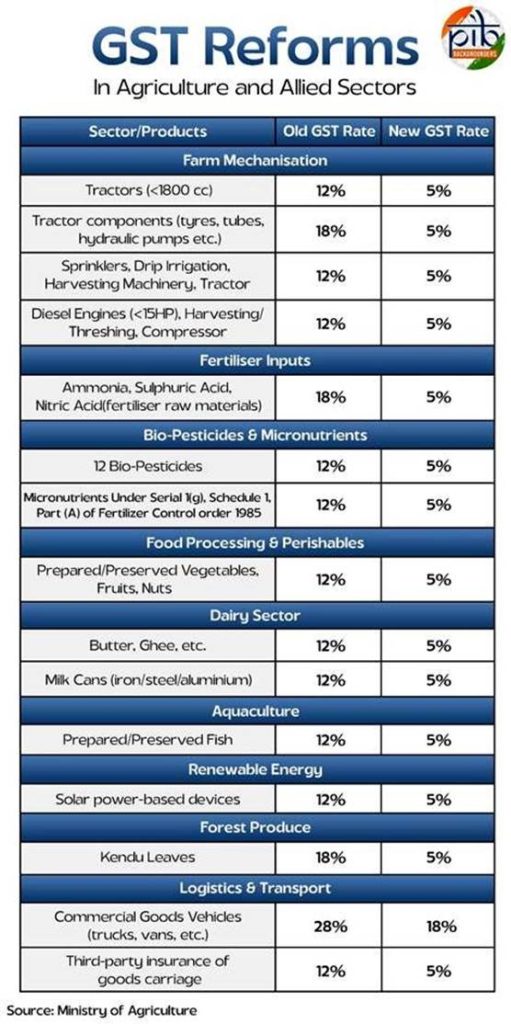
Major GST Reforms by Sector
a) Farm Mechanisation
- Tractors (<1800 cc): GST cut to 5% → affordable for small/marginal farmers.
- Tractor components (tyres, tubes, hydraulic pumps): 18% → 5%.
- Impact:
- Expands mechanisation, boosts productivity.
- Encourages cooperative/FPO-based shared usage.
- Creates demand for rural tractor finance and leasing models.
b) Irrigation & Harvesting Equipment
- Diesel engines ≤15 HP, threshers, harvesters, composting machines: 12% → 5%.
- Impact:
- Affordable access to small farmers.
- Promotes water-saving irrigation (drip, sprinklers).
- Improves sowing, harvesting, and crop yields.
c) Fertilisers
- Raw materials (Ammonia, Sulphuric Acid, Nitric Acid): 18% → 5%.
- Impact:
- Corrects inverted duty structure.
- Lowers fertiliser production costs.
- Ensures stable, affordable fertiliser prices during sowing seasons.
d) Bio-Pesticides & Micronutrients
- Bio-pesticides & micronutrients: 12% → 5%.
- Impact:
- Boosts natural farming and organic cultivation.
- Improves soil health & reduces chemical dependence.
- Supports small organic farmers and aligns with Natural Farming Mission.
e) Fruits, Vegetables & Food Processing
- Prepared/Preserved fruits, vegetables, nuts: 12% → 5%.
- Impact:
- Encourages cold storage & food processing investment.
- Reduces wastage, raises farmer returns.
- Enhances agri-exports & competitiveness.
f) Dairy
- Milk & paneer: No GST.
- Butter, ghee: 12% → 5%.
- Milk cans: 12% → 5%.
- Impact:
- Raises rural incomes, especially women-led SHGs.
- Promotes nutritional security (milk as affordable protein).
- Strengthens cooperatives (e.g., Amul).
g) Aquaculture
- Prepared/preserved fish: 12% → 5%.
- Impact: Boosts pisciculture and coastal economy.
h) Honey
- Natural honey: Lower GST.
- Artificial honey (with/without natural): 18% → 5%.
- Impact: Benefits beekeepers, tribals, rural SHGs; strengthens allied incomes.
i) Renewable Energy
- Solar-based irrigation devices: 12% → 5%.
- Impact: Reduces irrigation costs, aligns with green energy goals.
j) Tribal Livelihoods
- Kendu leaves: 18% → 5%.
- Impact:
- Supports tribal collectors in Odisha, MP, Chhattisgarh.
- Enhances incomes via higher procurement & sales volumes.
k) Logistics
- Commercial vehicles (trucks, delivery vans): 28% → 18%.
- Insurance of goods carriers: 12% → 5%.
- Impact:
- Reduces freight & logistics costs (65–70% of goods move by road).
- Improves export competitiveness.
- Reduces cascading tax burden on food distribution.
Strategic Implications
- Economic:
- Cuts farm input costs, boosts disposable income.
- Encourages rural consumption & demand revival.
- Social:
- Benefits small farmers, women-led enterprises, and tribals.
- Enhances income diversification through allied activities.
- Environmental:
- Promotes bio-inputs, drip irrigation, and solar-based devices.
- Reduces dependence on chemical-intensive farming.
- Institutional: Strengthens FPOs, cooperatives, and rural NBFCs.
Limitations & Challenges
- Awareness gap: Farmers may not fully understand GST benefits.
- Implementation: Risk of dealers not passing GST cuts to end-users.
- Revenue concerns: Lower GST rates may impact govt. revenue in short run.
- Structural issues: Beyond GST, farmers need credit access, infrastructure, and market reforms.
Way Forward
- Awareness campaigns in rural & tribal areas about GST benefits.
- Strict monitoring to ensure dealers pass on GST rate cuts.
- Integration with PM-KUSUM, PMFBY, FPO schemes for maximum impact.
- Periodic review of GST rates based on farmer adoption & sectoral needs.
- Export push: Incentivise agro-processing & value-added exports.
Conclusion
- The 2025 GST rationalisation in agriculture is a farmer-friendly, pro-rural, and pro-sustainability step.
- By lowering input costs, boosting mechanisation, encouraging natural farming, and supporting allied activities, the reform strengthens farm incomes, rural enterprises, and food security.
- It is not just a tax adjustment but a holistic policy intervention driving India towards Atmanirbhar Krishi and sustainable rural development.