
Published on Feb 10, 2026
Daily PIB Summaries
PIB Summaries 10 February 2026
Content
- Artificial Intelligence for Culture and Languages
- Swavalambini Scheme
Artificial Intelligence for Culture and Languages
Concept & Rationale
Meaning and Scope
- Artificial Intelligence for culture and languages uses computational tools for preservation, translation, and dissemination of heritage, enabling inclusive access to knowledge systems, governance, and public services in multilingual societies.
India’s Linguistic Context
- As per Census 2011, India has 22 Scheduled languages, 99 Non-Scheduled languages, and thousands of mother tongues, necessitating technology-driven preservation and access frameworks for linguistic diversity and cultural continuity.
Relevance
GS I (Indian Society & Culture)
- Language preservation, cultural heritage digitisation, and protection of intangible heritage strengthen India’s pluralism, identity diversity, and intergenerational knowledge transmission.
GS III (S&T, Economy)
- AI, NLP, OCR, speech tech applications in language ecosystems promote digital economy, creative industries, GI-based markets, and technology-driven livelihood generation.
Practice Question
- “Artificial Intelligence can become a tool of cultural preservation as well as cultural homogenisation.” Critically examine. (250 Words)
Constitutional–Legal Foundations
Constitutional Support
- Articles 29–30, Eighth Schedule, and Directive Principles protect linguistic and cultural rights, legitimising state-led digitisation, language promotion, and technological preservation as instruments of constitutional morality.
Democratic Pluralism
- Linguistic diversity strengthens unity in diversity, safeguards minority identities, and deepens participatory democracy, making language technologies tools for substantive equality and inclusive citizenship.
Governance & Administrative Dimensions
Language as Digital Public Infrastructure
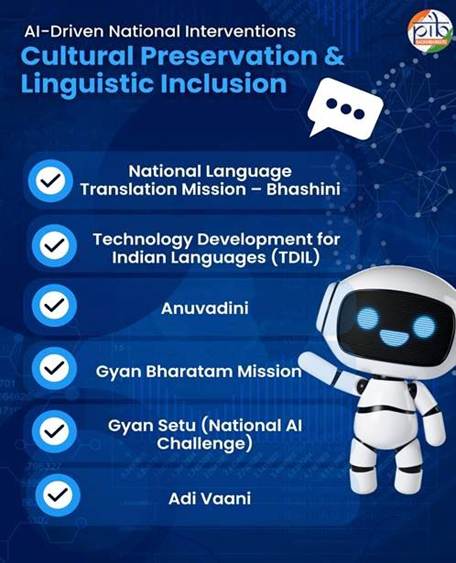
- Under Digital India and National Language Translation Mission, language is treated as Digital Public Infrastructure (DPI), embedding multilingual AI into e-governance, judiciary, and citizen service platforms for accessibility.
Administrative Efficiency
- Multilingual AI improves last-mile delivery, reduces interface complexity, standardises multilingual records, and enables vernacular governance, supporting cooperative federalism and citizen-centric administration.
Key National Platforms
BHASHINI (NLTM, 2022)
- BHASHINI builds multilingual AI addressing language, digital, and literacy barriers through translation, speech-to-text, text-to-speech, transliteration, and document understanding, functioning as foundational language DPI.
BHASHINI – Scale & Data
- Supports voice in 22 languages, text in 36 languages, hosts 350+ AI models/datasets, and has crossed 4+ billion language inferences, indicating large-scale multilingual digital adoption.
BHASHINI – Use Cases
- Enabled real-time Hindi–Tamil translation at Kashi Tamil Sangamam 2.0 and powered Kumbh Sah’AI’yak chatbot at Maha Kumbh 2025 providing multilingual assistance in 11 languages.
TDIL (Technology Development for Indian Languages)
- TDIL developed foundational Indian language computing tools like machine translation, OCR, speech systems, and transliteration, creating datasets and standards enabling scalable multilingual digital ecosystems.
Anuvadini (AICTE)
- Anuvadini provides AI-based multilingual translation for textbooks and technical materials, integrates with e-KUMBH, and expands regional-language access to higher education and skilling ecosystems.
Gyan Bharatam Mission
- National mission for survey, digitisation, and dissemination of manuscripts using HTR, OCR, and metadata extraction, enhancing discoverability and long-term preservation of traditional knowledge.
Gyan Bharatam – Data
- 44 lakh+ manuscripts documented in Kriti Sampada; mission outlay ₹482.85 crore (2024–31) supports scaling digitisation, digital repositories, and public cultural access.
Gyan-Setu
- National AI Innovation Challenge promoting solutions for cataloguing, script deciphering, and archival restoration, creating deployable prototypes and linking AI innovators with heritage institutions.
Adi Vaani
- AI platform for tribal language preservation enabling real-time translation, speech transcription, and learning modules, covering languages like Santali, Bhili, Mundari, and Gondi to enhance inclusion.
Economic Dimensions
Creative Economy
- Multilingual AI boosts handicrafts, tourism, publishing, and GI products through better market visibility, storytelling, branding, and price discovery, integrating artisans into digital value chains.
Livelihoods
- Voice-first vernacular interfaces reduce digital exclusion, enable e-commerce onboarding and skilling, and monetise traditional knowledge, strengthening sustainable livelihoods and dignity of labour.
Social & Ethical Dimensions
Inclusion
- Language AI supports mother-tongue education under NEP 2020, reduces the digital divide, and preserves intangible heritage, but requires safeguards against algorithmic bias and exclusion.
Cultural Identity
- AI documentation of oral traditions, folklore, and indigenous knowledge strengthens intergenerational transmission, identity preservation, and cultural resilience amid globalisation and linguistic homogenisation.
Challenges
Structural Gaps
- Low-resource languages, dataset scarcity, limited digitisation capacity, connectivity gaps, and archival sustainability issues constrain the scalability of inclusive multilingual AI ecosystems.
Ethical Concerns
- Risks of data extraction without consent, misappropriation of community knowledge, and cultural misrepresentation demand benefit-sharing, community ownership, and ethical AI governance frameworks.
Way Forward
Policy Measures
- Promote open interoperable datasets, community-led corpus creation, and archival capacity-building, aligning language AI with education, tourism, and creative economy policies for convergence.
Inclusive AI Model
- Develop public-funded, open-source multilingual AI aligned with SDGs, preventing monopolisation of linguistic data and treating language infrastructure as a digital public good.
Swavalambini Scheme
Concept & Rationale
Purpose and Vision
- Swavalambini Scheme is a women-focused entrepreneurship programme promoting entrepreneurial mindset, self-reliance, and enterprise creation among female students by combining training, mentoring, funding support, and institutional ecosystem linkages.
Policy Context
- Aligns with Skill India, Startup India, and Women-Led Development vision, recognising female entrepreneurship as driver of inclusive growth, employment generation, and demographic dividend utilisation in emerging knowledge economy.
Relevance
GS I (Society)
- Promotes women empowerment, changing gender roles, and entrepreneurship culture among young women, aiding social transformation and reducing gender-based occupational gaps.
GS II (Governance)
- Example of targeted policy intervention for women-led development, inter-institutional collaboration (MSDE–NITI Aayog), and outcome-based governance models.
Practice Question
- Women entrepreneurship is key to achieving women-led development in India. Evaluate in the context of recent government initiatives. (250 Words)
Institutional Framework
Nodal Ministry & Partners
- Implemented by Ministry of Skill Development and Entrepreneurship (MSDE) with NITI Aayog’s Women Entrepreneurship Platform as knowledge partner, ensuring policy convergence, mentoring support, and innovation-driven ecosystem development.
Implementing Agencies
- Executed through NIESBUD (Noida) and Indian Institute of Entrepreneurship (IIE, Guwahati), leveraging their expertise in entrepreneurship training, incubation support, and capacity-building for scalable programme delivery.
Coverage & Target Group
Beneficiary Base
- Targets female students in HEIs and Universities, aiming to convert youth potential into entrepreneurial ventures, with structured exposure to schemes, credit access, compliance norms, and market ecosystems.
Geographic Spread
- Pilot launched across Assam, Meghalaya, Mizoram, Uttar Pradesh, and Telangana, reflecting focus on regional inclusion, North-East empowerment, and balanced spatial entrepreneurship development.
Programme Design
Multi-Stage Model
- Structured pipeline moves from Entrepreneurship Awareness (EAP) to Entrepreneurship Development (EDP) and finally 21-week mentorship, ensuring progression from ideation to sustainable enterprise formation with institutional support.
Training Components
- Covers skilling, access to finance, legal compliance, market linkages, networking, and business services, addressing major entry barriers faced by first-generation women entrepreneurs in formal and semi-formal sectors.
Capacity Building
Faculty Development
- Faculty Development Programme (FDP) trains educators through five-day modules, creating in-campus mentors who institutionalise entrepreneurship culture and provide continuous guidance to aspiring women entrepreneurs.
Mentorship Ecosystem
- Industry leaders and successful entrepreneurs provide practical mentoring, sharing real-world insights on risk management, resilience, market adaptation, and scaling strategies, strengthening experiential learning.
Data & Performance
Training Targets vs Achievement
- Out of 1,200 EAP target, 1,110 trained; from 600 EDP target, 302 trained; 75 FDP target fully achieved, showing strong awareness outreach but moderate conversion to advanced training.
State-wise Overview
- Uttar Pradesh leads with 491 EAP and 254 EDP trainees, while North-Eastern states show high awareness participation but EDP still under implementation, indicating phased programme maturity.
Financial Dimensions
Budgetary Support
- ₹40.46 lakh allocated for training; ₹10.11 lakh released, indicating cautious pilot-stage financing with scope for scale-up based on outcome evaluation and demonstrated success.
Governance & Monitoring
Oversight Mechanism
- MSDE and NITI Aayog maintain monitoring and evaluation frameworks tracking progress, outcomes, and impact, ensuring accountability, data-driven policy refinement, and evidence-based scaling decisions.
Socio-Economic Significance
Women Empowerment
- Promotes financial independence, leadership roles, and decision-making capacity among women, directly contributing to SDG-5 (Gender Equality) and enhancing female labour-force participation.
Economic Multiplier
- Women-led enterprises generate local employment, diversified incomes, and community-level growth, strengthening grassroots economies and reducing gender gaps in entrepreneurship and asset ownership.
Challenges
Structural Constraints
- Barriers include credit access limitations, socio-cultural norms, risk aversion, limited networks, and market uncertainties, often discouraging women from transitioning from training to actual enterprise creation.
Implementation Gaps
- Lower EDP conversion rates, limited scale, and pilot-restricted geography suggest need for stronger handholding, credit linkages, and post-training incubation support for sustainability.
Way Forward
Policy Measures
- Expand programme nationally, integrate with MUDRA, Stand-Up India, and Digital India platforms, and strengthen credit guarantees, incubation hubs, and market access support for women-led startups.
Ecosystem Approach
- Encourage public-private partnerships, alumni networks, and digital mentorship platforms, ensuring continuous support beyond training and building resilient women entrepreneurship ecosystems.