
Content
- Year End Review 2025 – Ministry of Women & Child Development (MWCD)
- Digitalising India’s Dairy Sector
Year End Review 2025 – Ministry of Women & Child Development (MWCD)
Why in News?
- PIB release dated 09 January 2026 published the Year End Review 2025 of MWCD.
- Highlights scale-up of nutrition, women safety, maternity benefits, child protection, and digital governance.
- Emphasises technology-led welfare delivery, DBT expansion, and convergence with NEP 2020 & tribal welfare missions.
Relevance
GS II – Governance & Social Justice
- Welfare delivery: Poshan 2.0, PMMVY, Mission Shakti, Mission Vatsalya
- E-governance: Poshan Tracker, FRS, Helpline 1515
- Cooperative federalism: Suposhit GP Abhiyan, DAJGUA, ERSS-112
- Institutions: OSCs, SHe-Box, Child Helpline, CARINGS
GS I – Indian Society
- Women empowerment: Mission Shakti, PMMVY, shelters
- Children & vulnerable groups: ECCE, Mission Vatsalya, BVMB
- Gender issues: GBV (Nayi Chetna, 16 Days of Action)
- Tribal inclusion: PM-JANMAN AWCs, DAJGUA convergence
Macro Overview
- Focus: Inclusive development, safety, nutrition, early childhood education, women-led growth.
- Flagship umbrellas:
- Mission Saksham Anganwadi & Poshan 2.0
- Mission Shakti
- Mission Vatsalya
- Strong push towards real-time monitoring, biometric verification, grievance redressal.
Mission Saksham Anganwadi & Poshan 2.0
(Nutrition + ECCE + Adolescent Girls)
- Coverage:
- 8.69 crore beneficiaries (PWLMs, children 0–6 yrs, adolescent girls) (as on 30 Nov 2025)
Anganwadi Infrastructure
- 2 lakh AWCs approved for upgradation.
- 94,077 AWCs upgraded with improved infrastructure incl. LED screens.
- PVTG Focus (PM-JANMAN):
- 2,500 AWCs sanctioned, 2,326 operational.
- MWCD awarded Best Performing Ministry for PM-JANMAN implementation.
- Tribal Convergence (DAJGUA – MoTA):
- 875 AWCs sanctioned, 455 operational.
- 27,785 tribal beneficiaries covered.
Digital Governance – Poshan Tracker
- Launched: March 2021
- Nature: End-to-end, real-time governance tool for ICDS.
Key Data (2025)
- 9+ crore beneficiaries registered
- ~8 crore children monitored monthly (height & weight)
- 14 lakh Anganwadi Centres connected
- 24 Indian languages supported
- PM’s Award for Excellence in Public Administration 2024 (Innovation – Centre)
Functional Scope
- Attendance & AWC opening
- HCM & THR distribution
- ECCE instructional content
- ABHA & APAAR ID creation
- Citizen module for self-registration at nearest AWC
Suposhit Gram Panchayat Abhiyan
- Launched: 26 Dec 2024
- Objective: Identify 1,000 high-performing Panchayats.
- Criteria:
- Nutrition outcomes
- Infrastructure
- Malnutrition reduction
- Methodology:
- Poshan Tracker-based benchmarking
- Cross-State peer review
- Goal: Malnutrition-free Bharat
Nutrition Outreach & Behaviour Change
8th Rashtriya Poshan Maah (2025)
- Launched: 17 Sept 2025, Dhar (MP)
- Theme: Swasth Nari, Sashakt Parivar Abhiyaan
- 14.33 crore activities conducted nationwide.
- Convergence with 20+ Ministries.
PMMVY DBT Push
- ₹450 crore transferred in one day
- Beneficiaries: 15 lakh+ women
Strengthening ECCE – Poshan Bhi Padhai Bhi
- Alignment: NEP 2020
Capacity Building
- 8,55,728 Anganwadi Workers trained
- 41,645 State/Local Master Trainers trained
- Curricula:
- Aadharshila (0–3 yrs)
- Navchetana (3–6 yrs)
- Translated into 12 regional languages
Digital Learning
- 2.56 crore preschool activities/month logged on Poshan Tracker.
Co-location with Schools
- Guidelines issued: 3 Sept 2025
- 2.9 lakh AWCs already within school premises.
Helpline Rationalisation – 1515
- Unified helpline for:
- PM CARES
- Poshan 2.0
- PMMVY
- Short code changed: 14408 → 1515
- Grievances (till Dec 2025):
- Received: 1,40,862
- Resolved: 1,04,662
FRS-Based Verification (Governance Reform)
Anganwadi – THR Delivery
- Aadhaar-based Face Recognition System (FRS) via Poshan Tracker.
- No separate app.
- Status (31 Dec 2025):
- Eligible: 4.73 crore
- eKYC completed: 4.51 crore (91.38%)
- THR via FRS (Dec): 2.79 crore (52.68%)
PMMVY
- Mandatory FRS for new enrolments since 21 May 2025.
- 17.82 lakh beneficiaries enrolled via FRS (till 17 Nov 2025).
- Outcome: Reduced leakages, enhanced transparency.
Mission Shakti – Women Safety & Empowerment
- One Stop Centres (OSCs):
- Approved: 1025
- Operational: 865
- Women assisted: 12.67 lakh
- Women Helpline 181:
- Integrated with ERSS-112 in 35 States/UTs
- 93.48 lakh women supported
- Shelter Infrastructure:
- 411 Shakti Sadan
- 531 Sakhi Niwas
- PMMVY Overall Impact:
- 4.26 crore beneficiaries
- ₹20,060 crore DBT
Beti Bachao Beti Padhao – 10 Years
- Observed: 22 Jan – 8 Mar 2025
- Significance:
- Decade of girl child protection, education & empowerment
- Aligned with Viksit Bharat 2047
- Shift towards Women-Led Development
SHe-Box Portal
- Launched: 29 Aug 2024
- Purpose: Single-window SH Act (2013) grievance redressal
- Coverage:
- Organised & unorganised sectors
- Public & private
- Data (as on 05 Jan 2026):
- 1.3 lakh workplaces onboarded
- 50,000+ Internal Committees
- LCs of all 777 districts
- Languages: 22 + English
- Significance: Workplace safety, labour force participation
16 Days of Action & Nayi Chetna 4.0
- Period: 25 Nov – 10 Dec 2025
- Focus: Gender-based violence
- Nayi Chetna 4.0:
- 25 Nov – 22 Dec 2025
- Led by Women SHGs
- MoRD–MWCD convergence
Mission Vatsalya – Child Protection
- Unified Mission Vatsalya Portal operational.
- CARINGS adoption platform integrated.
- Child Helpline:
- Functional in all 36 States/UTs
- Installed in 728 districts
- Capacity Building:
- 303 Master Trainers trained
- Locations: Delhi, Bengaluru, Guwahati, Bhopal, Lucknow
- Karmayogi–iGOT Course (with LBSNAA):
- Enrolled: 37,242
- Completed: 19,728
Key Campaigns
PM Rashtriya Bal Puraskar 2025
- Ceremony: 26 Dec 2025, Vigyan Bhawan
- 20 children from 18 States/UTs
- Fields: Bravery, Art & Culture, Environment, Social Service, S&T, Sports
Veer Bal Diwas 2025
- Observed: 26 Dec 2025
- Nationwide celebrations
- PM interaction with PMRBP awardees
Bal Vivah Mukt Bharat (BVMB)
- 1 year completed: 27 Nov 2025
- 100-day intensive campaign launched: 4 Dec 2025
- Portal:
- 58,262 CMPOs listed
- 92,819 awareness activities
- 1.79 crore participants
- 8 lakh pledges recorded
Takeaway
- Shift from welfare delivery to welfare governance.
- Strong use of biometrics, real-time dashboards, convergence models.
- Nutrition & ECCE positioned as human capital foundations.
- Aligns with:
- SDG 2, 3, 5
- NEP 2020
- Tribal inclusion & Women-led development.
Digitalizing India’s Dairy Sector
Why in News?
- PIB release dated 09 January 2026 published the Year End Review 2025 on digital transformation of India’s dairy sector.
- Highlights NDDB-led technology-driven reforms covering livestock identification, milk procurement, breeding, ERP systems, logistics, and cooperative governance.
- Reinforces India’s push towards traceability, farmer-centric DBT, productivity enhancement, and cost efficiency in the world’s largest dairy ecosystem.
Relevance
GS III – Agriculture & Economy
- Allied sector: Dairy & agri-GDP
- Farmer income: AMCS, DBT, cooperatives
- Agri-tech: NDLM, Pashu Aadhaar, INAPH, SSMS
- Logistics: GIS route optimisation, ERP
- DPI: Bharat Pashudhan, i-DIS, NDERP
India’s Dairy Sector: Strategic Context
- India accounts for ~25% of global milk production (largest producer globally).
- Dominated by small & marginal farmers → high need for:
- Transparency
- Payment assurance
- Disease control
- Productivity enhancement
- NDDB positioned as the technology backbone of cooperative dairying.
National Digital Livestock Mission (NDLM) – “Bharat Pashudhan”
Implementing agencies: NDDB + Department of Animal Husbandry & Dairying (DAHD)
Core Objective
- Create a unified national digital livestock ecosystem with individual animal traceability.
Pashu Aadhaar
- 12-digit unique ear tag (barcode-based) aligned with global best practices.
- Acts as primary key for all animal-related transactions.
- Coverage (till Nov 2025):
- 35.68 crore animals tagged
- Enables tracking of:
- Vaccination
- Breeding & AI
- Treatment & health services
Bharat Pashudhan Database
- 84+ crore field transactions recorded.
- Users:
- Farmers
- Veterinarians
- Extension workers
- Benefit: Single-window animal health & productivity history.
Farmer Support Tools
- 1962 App & Toll-Free Helpline (1962):
- Best practices
- Scheme information
- Doorstep veterinary services via Mobile Veterinary Units
Analytical Value
→ NDLM strengthens disease surveillance, productivity analytics, insurance readiness, and export compliance.
Automatic Milk Collection System (AMCS)
Purpose: Transparent, error-free, and farmer-friendly milk procurement.
Functional Design
- Digitally records:
- Quantity
- Fat/SNF quality
- Price
- Instant DBT to farmers’ bank accounts
- Real-time SMS alerts to farmers.
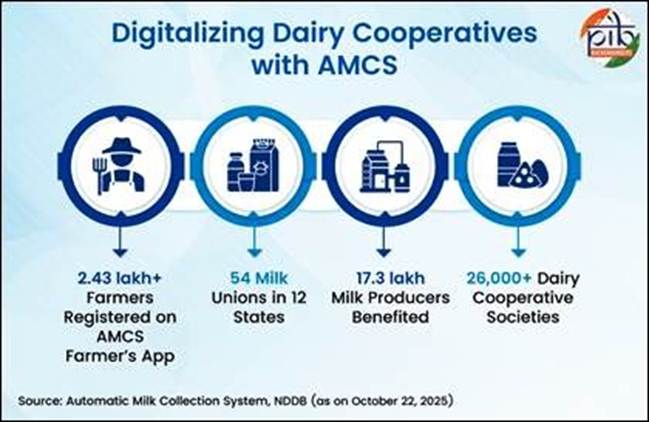
Coverage (as on 22 Oct 2025)
- 17.3 lakh milk producers
- 26,000+ Dairy Cooperative Societies
- 54 milk unions
- Operational in 12 States/UTs
System Architecture
- DCS Application: Windows / Linux / Android
- Central Portals: Union, Federation, National
- Mobile Apps:
- Farmer
- Society Secretary
- Dairy Supervisor
AMCS Mobile App Adoption
- 2.43 lakh farmers
- 13,644 society secretaries
- 1,374 supervisors
Governance Impact
- Eliminates manual manipulation
- Enhances price transparency & trust
- Strengthens cooperative accountability
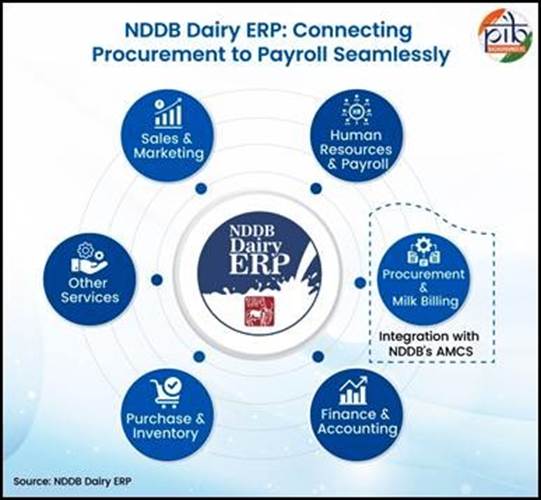
NDDB Dairy ERP (NDERP)
Nature: End-to-end digital backbone for dairy & edible oil sectors.
Key Features
- Web-based ERP (built on Frappe ERPNext – open source)
- No license or installation cost.
- Modules:
- Finance & Accounts
- Purchase & Inventory
- Sales & Marketing
- Manufacturing
- HR & Payroll
- Maker–checker workflows for internal controls.
Distributor Interface
- iNDERP portal + mNDERP app (Android/iOS):
- Orders
- Invoices
- Delivery challans
- Payment tracking
System Integration
- Fully integrated with AMCS → cow to consumer digital chain.
- Uses mass-balance technique to minimise processing losses.
Analytical Value
→ Supports cost optimisation, supply chain transparency, and financial discipline in cooperatives.
Semen Station Management System (SSMS)
Objective: Quality assurance & traceability in artificial insemination.
Operational Scope
- Bull lifecycle management
- Frozen Semen Dose (FSD) production
- Quality control & biosecurity
- Farm & fodder management
- Sales & distribution tracking
Integration
- Linked with INSPRM (national portal).
- Connected to INAPH for field-level traceability.
- Uses RFID bull tags & lab equipment integration.
Coverage
- 38 graded semen stations nationwide.
- Developed under National Dairy Plan-I (World Bank funded).
Significance
- Improves genetic quality
- Enhances milk yield
- Reduces regional productivity gaps
INAPH (Information Network for Animal Productivity & Health)
- Captures real-time data on:
- Breeding
- Nutrition
- Health services
- Enables project monitoring & outcome assessment.
- Supports evidence-based livestock interventions.
Internet-based Dairy Information System (i-DIS)
Purpose: National cooperative dairy MIS & benchmarking platform.
Coverage
- 198 milk unions
- 29 marketing dairies
- 54 cattle-feed plants
- 15 federations
Functional Utility
- Tracks:
- Milk procurement & sales
- Manufacturing & distribution
- Input supply
- Enables inter-union benchmarking.
Institutional Role
- Creates National Cooperative Dairy Industry Database.
- NDDB conducts regular MIS capacity-building workshops.
Milk Route Optimisation (GIS-Based)
Objective: Reduce logistics cost & time.
Technology
- GIS-based digitised route planning.
- Replaces manual route mapping.
Impact Examples
- Vidarbha–Marathwada Dairy Development Project (Aug 2022):
- 4 milk chilling centres redesigned.
- Significant transport cost savings.
- Successful pilots in:
- Varanasi Milk Union
- West Assam Milk Union
- Jharkhand Milk Federation
- Indore Milk Union
Scaling Tool
- Web-based dynamic route optimisation software
- Free for dairy cooperatives.
- Enables:
- Fleet optimisation
- Real-time planning
- Fuel & emission reduction
Overall Impact Assessment
- Farmer-centric outcomes:
- Assured payments
- Service delivery at doorstep
- Digital inclusion
- Systemic gains:
- End-to-end traceability
- Reduced leakages
- Data-driven policymaking
- Strategic alignment:
- Doubling farmers’ income
- Digital Public Infrastructure (DPI)
- Climate-efficient logistics
Conclusion
India’s dairy digitalisation, led by NDDB, represents a rare case of technology successfully penetrating a smallholder-dominated sector, creating a transparent, traceable, and productivity-oriented ecosystem aligned with inclusive growth and cooperative federalism.