
Published on Dec 13, 2025
Daily PIB Summaries
PIB Summaries 13 December 2025

Content
- Cabinet approves scheme of Conduct of Census of India 2027
- A Sprinting Revival: The Return of the Cheetah
Cabinet approves scheme of Conduct of Census of India 2027
Why is this in news?
- Union Cabinet approved the Census of India 2027 with a financial outlay of ₹11,718.24 crore (PIB, 12 Dec 2025).
- First fully digital census and first to include nationwide caste enumeration (as per decision of 30 April 2025).
- Census delayed from 2021 due to COVID; 2027 becomes India’s 16th Census and 8th after Independence.
Relevance
GS-I: Indian Society
- Caste enumeration enables updated understanding of social stratification, inequalities, and demographic changes.
- Migration, literacy, fertility, and religious composition data help assess population dynamics and their impact on society.
- Urbanisation and housing data reflect changing social patterns, amenities, and living conditions.
GS-II: Governance, Constitution & Social Justice
- Census Act, 1948 → Statutory basis of data governance.
- Strengthens evidence-based policymaking in health, education, welfare, federal transfers, reservations, and targeted schemes.
- Enhances cooperative federalism through Centre–State execution, digital monitoring, and training.
- Real-time digital census contributes to transparency, accountability, and administrative efficiency.
What is the census?
- World’s largest administrative and statistical exercise.
- Legal basis: Census Act, 1948 and Census Rules, 1990.
- Provides granular, village/ward-level data on:
- Housing, amenities, assets
- Demography, religion
- SC/ST population
- Language, literacy, education
- Migration, economic activity
- Fertility indicators
Structure of census 2027
Two phases
- Houselisting & housing census: April–September 2026
- Population enumeration: February 2027
- Exception: Ladakh, snow-bound J&K, HP, Uttarakhand → September 2026
Scale
- 30 lakh field functionaries deployed nationwide.
- 1.02 crore man-days of employment generated.
Key features and new digital initiatives
- Digital-first census: Data collected using mobile apps (Android & iOS).
- Self-enumeration option: Citizens can submit their own data online.
- CMMS portal: Real-time, nationwide monitoring of enumerators and progress.
- HLB Creator web mapping: Geospatial mapping of every houselisting block.
- Census-as-a-service (CaaS): Clean, machine-readable datasets for ministries.
- Enhanced security protocols: Encryption, authentication, secured digital storage.
- Caste enumeration: Integrated into the population enumeration questionnaire.
- Nationwide publicity campaign: Awareness, inclusive participation, last-mile reach.
Benefits and governance significance
- Higher quality & faster data: Digital capture reduces errors and improves speed.
- Micro-level targeting: Enables accurate beneficiary identification and resource allocation.
- Support for SDGs: Better planning in health, education, sanitation, gender indicators.
- Skill development: 18,600 technical personnel trained in GIS, data systems.
- Improved public access: Data dissemination with dashboards and visualisation tools.
Administrative process and implementation
- Census work conducted by government teachers as enumerators, supervised by a multi-tier structure (district → charge officers → supervisors).
- Two detailed questionnaires used:
- Houselisting & housing schedule
- Population enumeration schedule (includes caste details)
- State governments appoint most field staff; Centre coordinates design and training.
Macro significance
- Strengthening digital state capacity: Comparable to Aadhaar and UPI in scale.
- Evidence-based policymaking: Caste + socio-economic data enables redesign of welfare architecture.
- Cooperative federalism: Requires close Centre–State coordination for staff and real-time reporting.
- Privacy & data sovereignty debates: Digital census raises issues of consent, encryption, access control.
- Implications of delay: Policies like delimitation, poverty estimates, population projections were operating on 2011 data; 2027 data will reset baselines.
A Sprinting Revival: The Return of the Cheetah
Why is this in news?
- India has reported a revived cheetah population of 30 individuals (12 adults, 9 sub-adults, 9 cubs) as of December 2025.
- Marks the completion of the world’s first inter-continental translocation of a large carnivore, with 20 cheetahs brought from Namibia and South Africa (2022–23).
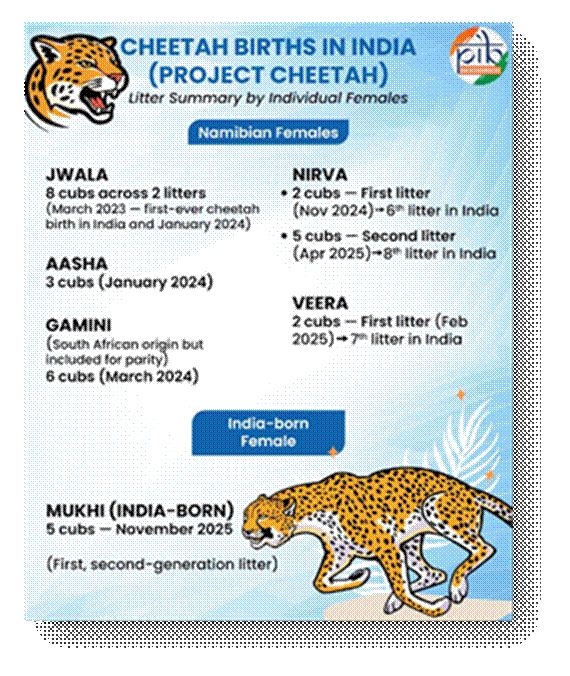
- Birth of second-generation cheetahs in 2025 (Mukhi’s litter of five cubs) signifies ecological success.
- India is on track to establish a self-sustaining metapopulation of 60–70 cheetahs across 17,000 km² by 2032, with Gandhi Sagar Sanctuary prepared for the next phase.
- Over 450 Cheetah Mitras, 380 jobs, and 5% eco-tourism revenue are already benefiting local communities.
Relevance:
GS-III: Environment, Ecology, Biodiversity
- Species reintroduction programme aligned with IUCN translocation guidelines.
- Restores a keystone/umbrella species → improves ecological health of grassland & scrub ecosystems.
- Contributes to SDG-15 (Life on Land) and CBD commitments.
- Demonstrates success in metapopulation planning, habitat restoration, prey base augmentation.
- Use of tech such as GPS collars, GIS mapping, distance sampling → scientific wildlife management.
- Community involvement (Cheetah Mitras, eco-tourism revenue) reflects inclusive conservation.
- Addresses challenges: human–wildlife conflict, carrying capacity, mortality reduction, genetic viability.
What is Project Cheetah?
- India’s official programme to reintroduce the cheetah, declared extinct in India in 1952.
- Led by MoEFCC and NTCA, launched on 17 September 2022 when the PM released the first 8 cheetahs in Kuno NP.
- Based on the 2013 Action Plan, updated in 2022, and implemented as per Supreme Court directions permitting experimental reintroduction.
- Aligns with CBD mandates and SDG-15 (Life on Land).
- Uses cheetah as a flagship species to restore India’s grasslands and savanna ecosystems.
Historical context: extinction to revival
- Cheetahs historically ranged across Punjab to Tamil Nadu and Gujarat to Bengal, occupying scrublands, savannas, and semi-arid habitats.
- Last confirmed sighting: 1947 in Koriya district (present-day Chhattisgarh).
- Declared extinct in 1952 due to:
- Over-hunting and coursing
- Habitat loss from agriculture
- Decline of prey base
- Genetic limitations and low reproduction
- Kuno NP chosen after relocation of 24 villages (1,545 families), creating 6,258 ha of inviolate habitat.
- Prepared under guidelines of NTCA, WII, and IUCN.
Key milestones
- Sept 2022: First 8 cheetahs from Namibia released by PM.
- Feb 2023: 12 cheetahs from South Africa arrive under bilateral MoU.
- 2023–24: First births in India in 70 years; multiple litters follow.
- Nov 2025: Botswana gifts 8 more cheetahs; Mukhi (India-born) gives birth to 5 cubs.
- 2024–25: Phase-wise open releases, expansion beyond Kuno.
Objectives and strategic framework
- Establish a metapopulation of 60–70 cheetahs in the 17,000 km² Kuno–Gandhi Sagar landscape.
- Restore grassland and semi-arid ecosystems, improving prey availability and ecological functioning.
- Treat the cheetah as an umbrella species for savanna conservation.
- Maintain 5% annual population growth toward long-term viability.
Phased ecological strategy
- Start with 12–14 genetically diverse founder animals; supplement as needed.
- Expand from Kuno’s 748 km² core to 3,200 km² landscape.
- Link with Gandhi Sagar Sanctuary (368 km²) and wider 2,500 km² potential habitat.
- Monitoring tools:
- GPS collars
- Camera traps
- Distance sampling (734–816 km transects)
Budgeting
- Phase-1 budget: ₹39 crore, integrated into CSS–Project Tiger, plus additional funds for prey augmentation and infrastructure.
Population status
- 30 cheetahs as of Dec 2025:
- 11 founder animals
- 19 India-born individuals
- Presence of second-generation births (e.g., Mukhi’s cubs) confirms successful adaptation.
Community and livelihood impact
- 450+ Cheetah Mitras trained across 80 villages.
- Employment creation:
- 80 local trackers
- 200 protection staff (“Suraksha Shramik”)
- Youth trained as safari guides
- Eco-development works in 100+ villages: roads, water structures, sanitation.
- 5% eco-tourism revenue shared with local communities.
- Model aligns with UNEP–CBD community-led conservation principles.
International collaboration
- Formal MoUs with Namibia (2022) and South Africa (2023) for translocation, training, and joint management.
- Expertise exchange in:
- Carnivore capture and transport
- Quarantine and boma design
- Radio-collaring and post-release protocols
- Project documented internationally as a case study in rewilding.
- India’s leadership reinforced through the International Big Cat Alliance (IBCA):
- Global platform for seven big cat species
- ₹150 crore support up to 2027–28
- Strengthens research, technology transfer, and multilateral cooperation
Why ecological scientists consider Project Cheetah a success ?
- Early reproduction indicates stress-free habitat adaptation.
- Adequate prey base and stable social behaviour observed.
- Minimal mortality relative to global relocation benchmarks.
- Clear evidence of site fidelity, territory formation, and sustained breeding cycles.
- Foundation laid for long-term genetic and demographic stability.
Challenges and critical evaluation
- Ensuring prey augmentation to sustain carrying capacity.
- Managing human–wildlife interface as populations expand beyond core zones.
- Addressing collar-related injury risks and refining monitoring tech.
- Diversifying habitats beyond Kuno to avoid overcrowding and inbreeding.
- Maintaining political and financial commitment over decades.
Significance for India and global conservation
- Restores an extinct species after 70+ years, a rare global achievement.
- Revives neglected grassland ecosystems, often overshadowed by forest-centric conservation.
- Positions India as a leader in rewilding science and large carnivore diplomacy.
- Enhances India’s environmental soft power through IBCA and CBD frameworks.
- Provides a replicable model for transboundary species recovery.
Conclusion
Project Cheetah marks a turning point in India’s ecological narrative—an experiment that has matured into a scientifically validated, community-inclusive revival of a lost species. With breeding success, metapopulation planning, and global partnerships, India has transformed an extinct echo into a living, thriving presence. The cheetah’s sprinting revival is not just a conservation milestone—it is a statement of national commitment to biodiversity stewardship.