
Published on Sep 13, 2025
Daily PIB Summaries
PIB Summaries 13 September 2025
Content
- The North East: Where the Sun of Development Rises
- GST Reforms in MSME
The North East: Where the Sun of Development Rises
The North East in India’s Development Map
- Geographical Identity: Comprises 8 states – Arunachal Pradesh, Assam, Manipur, Meghalaya, Mizoram, Nagaland, Sikkim, and Tripura.
- Strategic Location: Gateway to Southeast Asia; shares international borders with China, Bhutan, Myanmar, Bangladesh.
- Historical View: Long perceived as a remote “frontier region” with limited integration into mainstream development.
- Transformation Framework: Shift under “Act East Policy” and “EAST vision” (Empower, Act, Strengthen, Transform).
Relevance : GS2 (Governance, Policy, India’s Act East Policy) and GS3 (Infrastructure, Investment, Inclusive Growth, Internal Security).
Infrastructure Push
Railways
- ₹62,477 crore allocated to NE railways since 2014 (5x increase).
- ₹77,000 crore worth projects underway.
- Bairabi–Sairang line (Mizoram)
- 51 km line, ₹8,000 crore cost.
- Connects Aizawl to national rail grid for first time.
- Engineering marvel: 143 bridges, 45 tunnels (bridge taller than Qutub Minar).
- Boosts freight (bamboo, horticulture), tourism, jobs.
- New trains: Sairang–Delhi (Rajdhani), Sairang–Kolkata (Mizoram Express), Aizawl–Guwahati (Intercity).
- Strategic projects: Jiribam–Imphal, Dimapur–Kohima lines; 17 new surveys covering 1,790 km.
Roads & Highways
- 16,207 km National Highways built till July 2025.
- Example: Mangaldoi–Mazikuchi (15 km, ₹45.3 crore, NESIDS).
- Aizawl Bypass (45 km, ₹500+ crore, PM-DevINE) to decongest traffic.
- Chhimtuipui River Bridge for Kaladan Multimodal Transit → cross-border trade with Myanmar.
Rural Connectivity (PMGSY)
- Sanctioned: 89,436 km roads, 2,398 bridges.
- Completed: 80,933 km roads, 2,108 bridges.
- Major improvement in last-mile connectivity in hilly & remote areas.
Air Connectivity (UDAN)
- Regional airports & heliports linked; previously underserved/unserved regions connected.
- Enhances tourism, business travel, medical access.
Digital Connectivity
- BharatNet & Digital Bharat Nidhi expanded to Gram Panchayats.
- Mobile towers commissioned across region.
- Facilitates e-governance, telemedicine, online education, and start-up ecosystem.
Government Schemes Driving Transformation
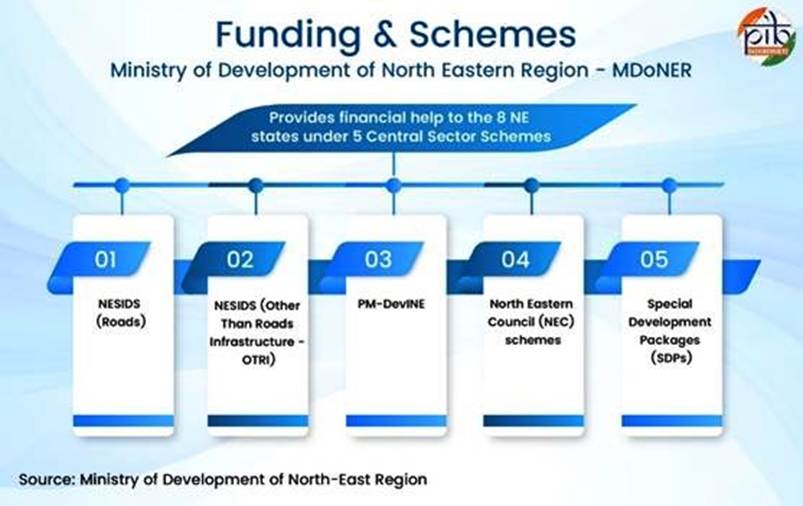
- PM-DevINE (2022–26): ₹6,600 crore; funds infra + social dev; supports youth & women.
- NESIDS (Roads): Launched 2017–18; extended till 2026; gap-funding for roads/bridges not covered elsewhere.
- NESIDS-OTRI: Non-road infra (health, education, aviation, telecom, water); 29 projects, ₹462.2 crore spent (till July 2025).
- NEC Schemes: Focus on bamboo, piggery, tourism, higher education, tertiary health, livelihoods.
- Special Packages: Assam (₹4,000 crore for 2025–30), Tripura (₹250 crore for 2025–29) → peace, stability, skill development, local economy boost.
Rising Northeast Investors Summit 2025
- Investment interest: ₹4.48 lakh crore.
- Sectors: energy, agro-processing, textiles, healthcare, IT, entertainment, logistics.
- States facilitating investment: single-window clearances, land banks, eco-friendly projects.
- Direct benefits: job creation, industrial hubs, youth entrepreneurship.
Governance & Transparency
- Poorvottar Vikas Setu (PVS) Portal:
- Digital platform for proposal submission, approvals, fund releases.
- Cuts delays, ensures transparent monitoring.
- Central–State coordination improved.
Fiscal Impact
- Record budgetary allocations for NE post-2014.
- Integrated planning under PM Gati Shakti framework.
- Convergent funding across ministries (Railways, MoRTH, Civil Aviation, DoNER).
Strategic & National Importance
- Gateway to Act East Policy: Enhances connectivity with Myanmar, Bangladesh, ASEAN.
- Security Angle: Road/rail infra aids troop movement in border areas.
- Cultural Integration: Linking NE communities to rest of India strengthens national identity.
- Tourism Potential: Eco-tourism, cultural circuits, adventure tourism.
- Resource Utilization: Bamboo, hydropower, horticulture exports facilitated.
Challenges Ahead
- Difficult terrain → cost overruns, engineering challenges.
- Insurgency & law-and-order concerns in pockets.
- Need for balancing development vs ecological fragility.
- Inclusion of remote tribal areas in decision-making.
- Ensuring jobs for locals from large-scale investments.
Conclusion: The Road Ahead
- NE is transitioning from frontier to front-runner of growth.
- Holistic approach combining connectivity, investment, livelihood, governance reforms.
- With infrastructure, digital access, and inclusive development, the region is becoming a key driver of Viksit Bharat 2047 vision.
GST Reforms in MSME
Basics: GST and MSMEs
- Goods and Services Tax (GST): Indirect tax regime introduced in July 2017, subsuming multiple central and state taxes.
- MSMEs (Micro, Small & Medium Enterprises): Backbone of Indian economy, contributing ~30% to GDP, 45% to exports, and employing ~11 crore people.
- Challenges for MSMEs under GST (pre-reform):
- Higher tax rates on raw materials → costlier production.
- Inverted duty structures → refunds delayed, working capital stress.
- Compliance burden → filing multiple returns.
- Rationale for Reform (2025):
- Align with flagship schemes – Make in India, PM Gati Shakti, Aatmanirbhar Bharat, PMAY.
- Lower input costs, reduce inflation, improve competitiveness.
- Targeted support to labour-intensive sectors (textiles, handicrafts, toys, leather, logistics, food).
Relevance : GS3 (Economy, Employment, MSME sector, Inclusive Growth, Government Policies & Reforms)
Sector-wise GST Rationalisation & Impact
Automobiles and Transport
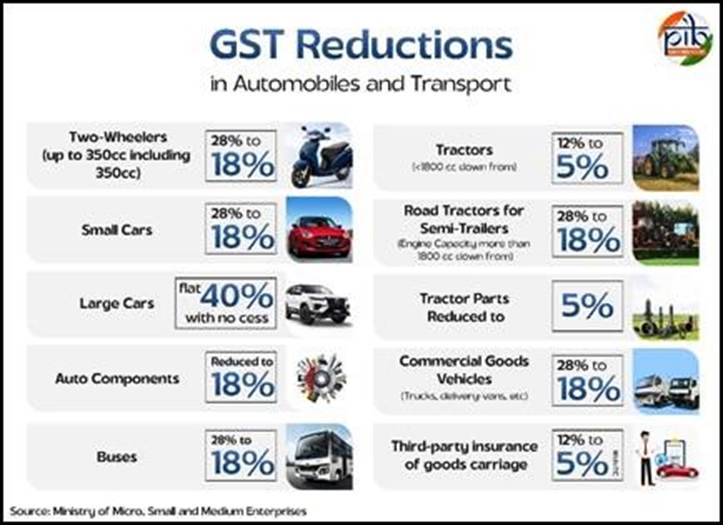
- GST cut on two-wheelers, cars, buses, tractors → stimulates demand.
- Tractors (<1800 cc): GST reduced to 5% → supports farmers + boosts India’s tractor export leadership.
- Commercial vehicles (trucks, vans): 28% → 18% → lowers logistics cost, inflation, supports MSME truck operators.
- Buses (10+ seats): 28% → 18% → affordable public transport, benefits workers & schools.
- Multiplier Effect: MSMEs in tyres, batteries, plastics, glass benefit from higher demand.
Food and Dairy
- Basic food items: GST 12–18% → 5% or NIL → relief for processors, SHGs, dairy cooperatives.
- Dairy: Milk/paneer NIL; butter/ghee 12% → 5% → nutrition security + women-led dairy MSMEs.
- Confectionery (chocolates, cakes): cheaper → boosts small sweet makers.
- Diabetic foods: 12% → 5% → supports healthcare needs.
- Dried fruits, fish products, milk-based drinks: 12% → 5% → healthier diets + agro-MSME push.
Textiles, Apparel, Leather
- Man-Made Fibres: 12% → 5% → corrects inverted duty structure, helps exporters.
- Readymade garments: 5% slab limit expanded from ₹1,000 to ₹2,500 → demand surge in Tier-2/3 towns.
- Leather/footwear (<₹2,500): 12% → 5% → relief for tanneries, small footwear manufacturers.
- Employment: Boosts jobs, especially for women in stitching, tailoring, apparel.
Housing & Construction Materials
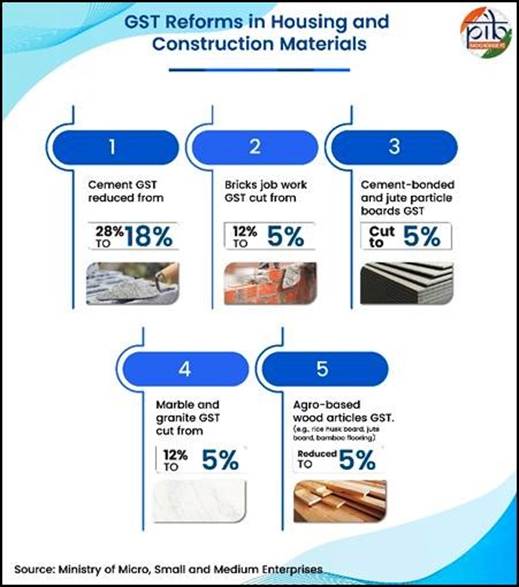
- Cement: 28% → 18% → reduces housing costs under PMAY, generates jobs in mining & logistics.
- Bricks job work: 12% → 5% → relief for rural housing, brick kiln MSMEs.
- Boards (cement/jute): 12% → 5% → cheaper prefab houses.
- Marble, granite: 12% → 5% → strengthens local stone industry.
- Agro-based wood products (bamboo flooring, husk boards): 12% → 5% → eco-friendly housing, MSME growth.
Handicrafts & Creative Industries
- Handicrafts: 12% → 5% → idols, paintings, terracotta, tableware → boosts artisans’ incomes.
- Toys & sports goods: 12% → 5% → supports “Vocal for Local”, reduces import dependence.
Logistics, Packaging, Sustainability
- Packaging (paper, cartons, crates): 12% → 5% → cuts e-commerce/logistics costs.
- Biodegradable bags: 18% → 5% → promotes sustainable start-ups, reduces plastic use.
- Logistics Competitiveness: India’s World Bank LPI rank improved from 54 (2014) to 38 (2023); GST reforms reduce costs further, aligning with supply-chain digitization & Gati Shakti.
Tourism & Hospitality
- Hotels <₹7,500/day: 12% → 5% → boosts budget tourism, mid-segment hotels.
- Tourism GDP share: 1.5% (2020–21) → 5.22% (2023–24 provisional).
- GST cut expected to push further growth in domestic & international tourism.
Broader Impacts
- For MSMEs:
- Reduced input costs & working capital stress.
- Lower compliance → easier scaling up.
- Level playing field vs large corporates.
- For Employment:
- Labour-intensive industries (garments, leather, handicrafts) benefit.
- Women entrepreneurs in textiles, dairy, tailoring gain new opportunities.
- Rural informal sector (brick kilns, food processing, packaging units) integrated.
- For Consumers:
- Lower retail prices → improved affordability across essential & lifestyle goods.
- Higher demand → multiplier effect on jobs.
- For Economy:
- Strengthens domestic value chains.
- Promotes exports via competitive pricing.
- Supports Aatmanirbhar Bharat & Viksit Bharat 2047 vision.
Challenges & Considerations
- Potential short-term revenue loss for states (to be offset by higher demand + formalisation).
- Need to ensure timely refunds & compliance simplification for MSMEs.
- Balancing tax cuts vs fiscal consolidation.
- Monitoring pass-through of benefits (ensuring industries actually lower prices for consumers).
Conclusion
- GST reforms (2025) are pro-MSME, pro-employment, pro-consumer.
- They align taxation with Make in India, PMAY, Gati Shakti, Aatmanirbhar Bharat.
- By correcting inverted duty structures, lowering costs, and making goods affordable, they create a more competitive, resilient, and inclusive economy.
- MSMEs, as the largest job creators, will be central to India’s Viksit Bharat 2047 journey through these rationalised GST policies.