
Published on Dec 18, 2025
Daily PIB Summaries
PIB Summaries 18 December 2025
Content
- Department of Space – Year End Review 2025
- SABHASAAR Initiative
Department of Space – Year End Review 2025
Strategic Missions & Technology Demonstrations
- SPADEX Mission: Successful in-orbit docking, undocking, circumnavigation and power transfer (Jan & Apr 2025) — foundational for space stations, on-orbit servicing, human missions under Space Vision 2047.
- Gaganyaan Progress:
- First Integrated Air Drop Test (IADT-01) validating parachute-based Crew Module recovery.
- Axiom-04 Mission: First Indian (Shubhanshu Shukla) completed 18-day ISS mission, executing 7 Indian microgravity experiments.
- Semi-Cryogenic Engine (SE2000): Third successful hot test of Power Head Test Article — critical for LVM3 payload enhancement.
- C25 Cryogenic Stage Restart: First-ever in-space restart during LVM3-M5, enabling multi-orbit deployment.
Relevance : GS III – Science & Technology
Strategic Missions & Technology
- Indigenous space docking, power transfer, cryogenic restart → advancement in critical frontier technologies.
- Human spaceflight technologies (Gaganyaan, ISS exposure) → transition from experimental to operational space capability.
- Semi-cryogenic engine (SE2000) → higher payload efficiency, launch cost optimisation.
- Demonstrates technology maturity curve of India’s space programme.
Launch Infrastructure & Capacity Expansion
- Third Launch Pad (TLP) approved at Sriharikota for next-generation and human missions.
- SSLV Launch Complex, Kulasekarapattinam: Launch pad foundation laid; dedicated hub for SSLV & private launches.
- 100th Launch from Sriharikota: GSLV-F15/NVS-02 (milestone despite post-injection anomaly).
- ISRO’s 101st Launch Attempt: PSLV-C61/EOS-09 (partial mission shortfall; transparency maintained).
Launch Vehicles & Satellites
- LVM3-M5: Successfully launched CMS-03, India’s heaviest GTO communication satellite (~4.4 t).
- NISAR (NASA–ISRO): Landmark Indo-US collaboration; dual-frequency SAR for global, all-weather Earth observation.
- EOS-09: Strengthening radar-based EO capability (mission anomaly acknowledged).
- PSLV POEM-4: Completed 1000 orbits with 24 payloads; record in low-cost in-orbit experimentation.
Science, Research & Exploration
- CROPS-1: Successful seed germination & two-leaf growth in microgravity — leap in space biology.
- Aditya-L1: Public release of solar data; insights into photosphere, chromosphere, corona & solar wind.
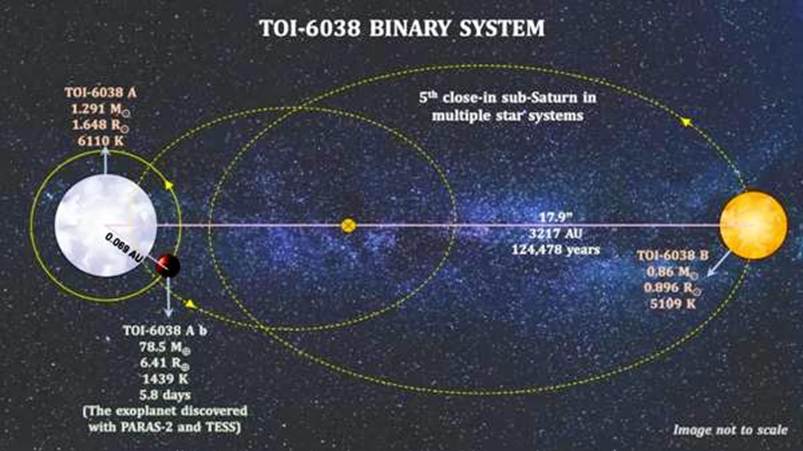
- Exoplanet Discovery: PRL discovered TOI-6038A b (sub-Saturn) using PARAS-2 — strengthens India’s astronomy credentials.
- Space Analog Missions: HOPE mission in Ladakh simulating Mars-like conditions for human exploration readiness.
Indigenous Technology & Manufacturing
- Make-in-India Space Microprocessors:
- VIKRAM3201 (launch vehicles).
- KALPANA3201 (SPARC V8, satellite applications).
- Electric Propulsion: 1000-hr life test of Stationary Plasma Thruster — mass savings, higher satellite efficiency.
- New Facilities:
- MPTTF & ITPF at LPSC (thruster testing, titanium tanks).
- Centre of Excellence (Fluid & Thermal Sciences) at IIT Madras.
Industry, Startups & Reforms
- SSLV Technology Transfer to HAL — major step in commercialisation & private sector participation.
- Private Launch Ecosystem: Successful static test of KALAM-1200 solid motor (Skyroot).
- POEM Platform: Enabled startups to test AI models and novel sensors in orbit.
Space Applications for Society
- Disaster Management Leadership: ISRO led International Charter on Space & Major Disasters (Apr–Sep 2025).
- Agriculture:
- Satellite-based wheat production estimate ~122.7 MT.
- CROP framework integrating SAR + optical data.
- Education & Outreach:
- NE-SPARKS: ~700 NE students exposed to ISRO facilities.
- National Space Day & NM 2.0 aligned with Viksit Bharat 2047.
International Cooperation & Diplomacy
- GLEX 2025 (New Delhi): India positioned as a global space collaboration hub.
- IAC 2025 (Sydney): India Space Pavilion showcased missions, startups, and future vision.
- MoU on Space Medicine: ISRO–SCTIMST partnership supporting human spaceflight & biomedical research.
Vision & Governance
- Chintan Shivir 2025: Roadmap for Space Vision 2047 and beyond, covering transportation, infrastructure, human exploration, industry enablement.
Conclusion
2025 marks ISRO’s transition from mission-centric achievements to ecosystem leadership — combining human spaceflight readiness, indigenous deep-tech, private sector integration, and global collaboration, firmly anchoring India’s ambitions for Space Vision 2047.
SABHASAAR Initiative
What is SabhaSaar?
- SabhaSaar is an AI-enabled voice-to-text automated meeting summarisation tool.
- Launched by the Ministry of Panchayati Raj on 14 August 2025.
- Designed for Gram Sabha and Panchayat meetings to auto-generate Minutes of Meeting (MoM).
- Supports vernacular, large-scale grassroots governance digitisation.
Relevance
GS II – Polity & Governance
Decentralisation & Local Governance
- Strengthens Article 243 (Panchayati Raj) institutions.
- Enhances Gram Sabha effectiveness, procedural legitimacy.
- Improves documentation of deliberative democracy.
GS II – E-Governance
- Example of AI-enabled public service delivery.
- Demonstrates shift from digitisation → intelligent governance.
- Supports Digital India + Viksit Bharat 2047.
Objectives
- Improve transparency, accountability and record-keeping in Panchayati Raj Institutions (PRIs).
- Reduce manual paperwork and dependence on clerical capacity.
- Enable data-driven local governance aligned with Digital India.
- Standardise documentation of Gram Sabha resolutions.
Scale of Adoption (as of 3 Dec 2025)
- Total Gram Panchayats in India: 2,67,940
- GPs using SabhaSaar: 92,376 (~34.5%)
- Rapid scale-up:
- 15 Aug 2025: 12,667 GPs
- 2 Oct 2025: 77,198 GPs
- Pilot success:
- Tripura: 1,047 out of 1,194 GPs (≈ 87%) used SabhaSaar on launch day.
High Adoption States
- Tamil Nadu: 11,874 GPs
- Uttar Pradesh: 27,352 GPs
- Odisha: 6,239 GPs
- Chhattisgarh: 8,707 GPs
- Bihar: 5,988 GPs
- Tripura: 1,061 GPs
→ Indicates administrative readiness and digital capacity variation across states.
Technology & Governance Framework
- Built on AI + cloud infrastructure via:
- India AI Compute Portal
- India AI Mission (MeitY) as nodal authority.
- Data sovereignty ensured:
- Data processed entirely within Government infrastructure.
- No third-party data sharing.
- Data protection:
- Governed by Digital Personal Data Protection (DPDP) Rules, 2025.
- Legal backing via Gazette notification (13 Nov 2025).
Capacity Building & Awareness
- Standard Operating Procedure (SOP) issued to all States/UTs.
- Multiple physical and virtual training sessions for officials.
- States responsible for last-mile dissemination to Panchayats.
- Designed for ease of use to overcome digital literacy barriers.
Governance Significance
- Strengthens Article 243 (Panchayati Raj) institutions.
- Promotes procedural transparency in grassroots democracy.
- Converts deliberative democracy into machine-readable governance data.
- Supports Viksit Bharat 2047 through tech-enabled decentralisation.
Key Challenges (Implicit)
- Uneven adoption across states and districts.
- Digital infrastructure and connectivity gaps.
- Need for language robustness and accent accuracy.
- Long-term issues of data standardisation and archival use.
Conclusion
SabhaSaar represents India’s first large-scale application of sovereign AI in grassroots governance, transforming Gram Sabha deliberations into transparent, standardised, and data-driven democratic records while operating fully within India’s data protection and AI governance framework.