
Published on Feb 18, 2026
Daily PIB Summaries
PIB Summaries 18 February 2026

Content
- India’s Drone Ecosystem: Policy to Public Service Transformation
- Circular Economy in Agriculture: Waste to Wealth
India’s Drone Ecosystem: Policy to Public Service Transformation
A. Issue in Brief
- India has developed a regulated drone ecosystem integrating drones into governance, agriculture, infrastructure, and defence, enabled by Drone Rules 2021, Digital Sky, PLI incentives, and GST reduction.
- As of Feb 2026, India records 38,500+ UIN-registered drones, 39,890 certified pilots, and 244 RPTOs, signalling institutional maturity and transition of drones from experimental tools to governance infrastructure.
- Government-led schemes like SVAMITVA and Namo Drone Didi use drones for land governance, precision agriculture, and women-led rural enterprises, linking technology adoption with inclusion and productivity.
Relevance
GS 2 (Polity & Governance)
- Regulatory reforms: Drone Rules 2021, trust-based governance
- Digital governance platforms (Digital Sky, eGCA)
- Centre–State coordination in airspace, land records, agriculture delivery
- Public service delivery through emerging tech
GS 3 (Economy / S&T / Security / Environment)
- Sunrise sector, PLI-led manufacturing, startup ecosystem
- Precision agriculture, cost and input efficiency
- Internal security: counter-drone, border surveillance
- Tech convergence: AI, IoT, GIS
- Environmental gains from optimised spraying
B. Static / Legal Background
- Union List Entries 29 & 30 empower Centre to regulate aviation and air navigation, forming constitutional basis for DGCA control over drone certification, safety, and operational airspace.
- Drone Rules 2021 introduced self-certification, trust-based regulation, and reduced compliance burden, replacing approval-heavy regime and encouraging start-ups, MSMEs, and Drone-as-a-Service models.
- Nearly 90% airspace designated Green Zone permitting flights up to 400 feet without prior approval, significantly lowering entry barriers for commercial and public-service drone usage.
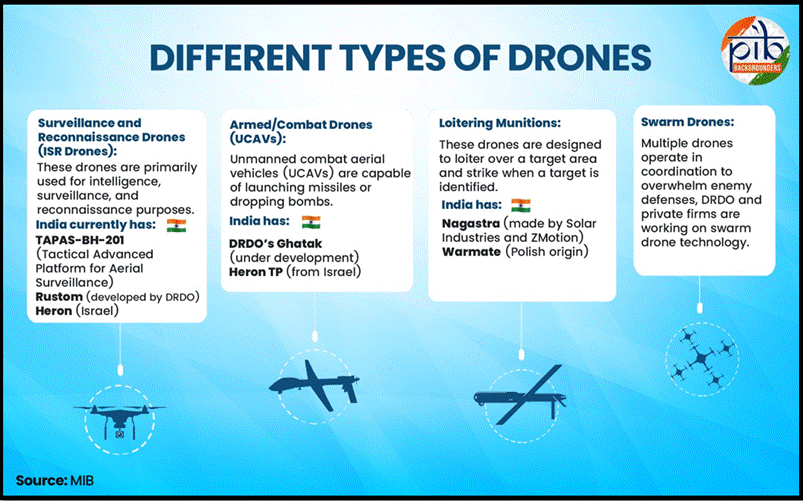
C. Types of Drones in India (DGCA Classification)
- Nano drones: ≤ 250 g, minimal regulation, used in photography, education, and hobby applications; limited payload and range but important for entry-level innovation and consumer markets.
- Micro drones: 250 g–2 kg, widely used in surveys, agriculture spraying, policing, and inspections, forming backbone of civil and commercial drone operations in India.
- Small drones: 2–25 kg, used for precision agriculture, mapping, logistics trials, and disaster response, balancing payload capacity with operational flexibility.
- Medium drones: 25–150 kg, deployed in industrial surveys, defence logistics, and high-endurance missions, requiring stricter compliance and skilled operators.
- Large drones: > 150 kg, mainly for defence, strategic surveillance, and high-altitude operations, treated closer to aircraft-level regulation and certification.
D. Key Dimensions
Governance / Administrative
- SVAMITVA Scheme has completed drone surveys in 3.28 lakh villages (~95% target) and generated 2.76 crore property cards in 1.82 lakh villages across 31 States/UTs, strengthening tenure security and credit access.
- Drone-based mapping reduces land disputes, litigation burden, and survey delays, improving Panchayat-level fiscal planning and supporting evidence-based rural governance.
Economic
- PLI Scheme (₹120 crore) supports domestic manufacturing of drones and components, promoting value addition, scale economies, and global competitiveness in a sunrise technology sector.
- GST reduced to 5% (Sept 2025) from earlier 18–28% slabs, lowering acquisition and training costs, encouraging MSMEs, start-ups, and institutional adoption.
Social / Ethical
- Namo Drone Didi Scheme (2023) distributed 1,094 drones to women SHGs (500+ under NDD), enabling them to provide spraying services, earn income, and gain social empowerment.
- Drone Didi model shifts women from labour roles to tech-enabled service providers, strengthening rural entrepreneurship and gender inclusion in agri-value chains.
- Increased drone usage raises concerns on privacy, surveillance, and informed consent, necessitating strong data-protection and accountability frameworks.
Environmental
- Precision spraying reduces excessive fertiliser and pesticide use, lowering soil degradation, water contamination, and input costs, supporting sustainable and climate-smart agriculture.
- Environmental risks include battery waste, noise, and biodiversity disturbance, requiring lifecycle regulation and green standards.
Security / Strategic
- Drones enhance border surveillance, intelligence, and precision operations, acting as force multipliers and reducing human exposure in hostile terrains.
- Rising risks from rogue drones, smuggling, and swarm threats demand counter-drone systems, geofencing, and integrated airspace awareness.
Technology
- Convergence with AI, GIS, IoT, and satellite navigation enables autonomous flights, analytics, and real-time governance intelligence.
- Import dependence on chips, sensors, and GNSS exposes supply-chain vulnerabilities, highlighting need for indigenous R&D.
E. Critical Analysis
- India’s state-led demand model accelerates diffusion but risks overreliance on public procurement rather than sustainable private demand and export competitiveness.
- Rapid growth to 39,890 certified pilots raises quality and employability concerns, requiring strong training standards and periodic re-certification.
- Absence of clear aerial data governance policy risks misuse, commercial monopolisation, and national-security vulnerabilities.
F. Way Forward
- Create a Drone Data Governance Framework covering ownership, privacy, localisation, and lawful access aligned with digital data-protection architecture.
- Promote indigenous R&D and component manufacturing via mission-mode funding and defence–civil fusion.
- Expand counter-drone and airspace management systems around borders and critical infrastructure.
- Institutionalise drones in disaster management, agriculture extension, and urban governance with SOPs and trained local personnel.
G. Exam Orientation
Prelims Pointers
- Drone Rules 2021 reduced forms from 25 to 5 and approvals from 72 to 4, signalling major regulatory liberalisation.
- Remote Pilot Certificate (RPC) replaced traditional pilot licence for drone operators.
- Digital Sky Platform provides registration, UIN, and airspace maps; regulatory services now integrated with eGCA.
- Green Zone airspace (~90%) allows operations up to 400 ft without prior permission.
- GST on drones: Uniform 5% since Sept 2025.
- DGCA approves RPTOs for pilot training; as of 2026 there are 244 RPTOs.
- Namo Drone Didi focuses on women SHGs and agriculture services, not direct farm subsidies.
- Geofencing and NPNT (No Permission–No Takeoff) are core safety features.
Practice Question (250 Words)
- “Drones are redefining governance, agriculture, and security in India, but also raise regulatory and ethical challenges.”
Critically examine India’s drone ecosystem. Discuss opportunities, concerns, and the policy measures required for responsible scaling.
Circular Economy in Agriculture: Waste to Wealth
A. Issue in Brief
- India generates nearly 350 million tonnes of agricultural waste annually, including straw, husk, stubble, and processing by-products, creating environmental stress but also offering large waste-to-wealth and bioenergy potential.
- MNRE estimates 18,000+ MW power potential from agricultural residues, indicating major scope for biomass energy, biogas, and biofuels, reducing fossil-fuel dependence and stubble-burning externalities.
- Government push via GOBARdhan, Crop Residue Management (CRM), AIF, and AHIDF signals policy shift from waste disposal to resource recovery, circularity, and climate-resilient agriculture.
Relevance
GS 3 (Economy / Environment / Agriculture)
- Bioenergy, bio-CNG, compost markets
- Climate mitigation via methane and emission reduction
- Sustainable agriculture and resource efficiency
- Green jobs, rural circular economy
- Carbon markets and climate finance potential
B. Conceptual / Theoretical Base
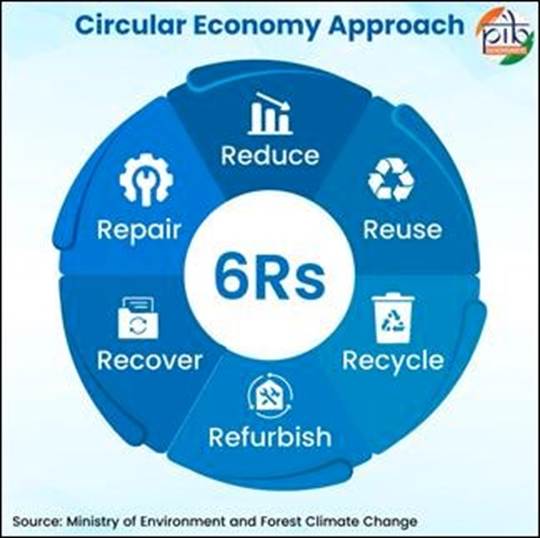
- Circular economy in agriculture aims to keep biomass, nutrients, and water in productive cycles through Reduce, Reuse, Recycle, Refurbish, Recover, and Repair (6Rs).
- Focuses on closing nutrient loops, minimising raw-material extraction, and converting farm and food waste into energy, organic manure, and bio-based products, reducing ecological footprint.
- Aligns with natural ecosystem principles, where waste of one process becomes input for another, promoting regenerative and resource-efficient agricultural systems.
C. Key Dimensions
Environmental
- Stubble burning causes severe air pollution, soil nutrient loss, and GHG emissions, especially in north India, undermining climate commitments and public health outcomes.
- Organic waste decomposition in landfills emits methane, a potent greenhouse gas, contributing to climate change and groundwater contamination.
Economic
- Circular agriculture can unlock a projected $2 trillion market value and 10 million jobs by 2050, linking sustainability with green growth and rural entrepreneurship.
- Bioenergy, composting, and biomass supply chains create additional farmer income streams and reduce dependence on chemical fertilisers.
Social
- Waste-to-wealth models support farmer incomes, FPO enterprises, and rural employment, strengthening inclusive growth and reducing agrarian distress.
- Improved waste management reduces health burdens from pollution, benefiting vulnerable rural and peri-urban populations.
Governance / Policy
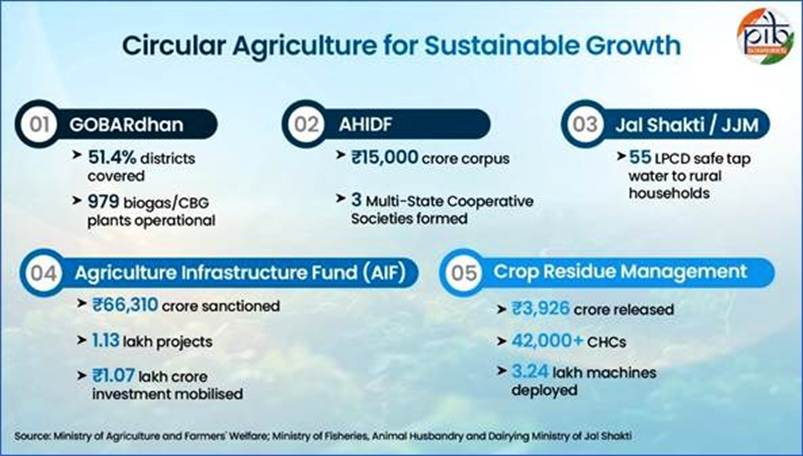
- Crop Residue Management (CRM) received ₹3,926 crore (2018–19 to 2025–26), promoting in-situ and ex-situ residue management alternatives to burning.
- Over 42,000 Custom Hiring Centres and 3.24 lakh machines deployed enable access to residue-management technologies for small and marginal farmers.
SDG Linkages
- Supports SDG 2 (Zero Hunger), SDG 12 (Responsible Consumption), SDG 13 (Climate Action) by improving soil health, reducing waste, and lowering emissions.
- Addresses global food waste of 1.05 billion tonnes (2022), of which 60% originates from households, highlighting consumption-side inefficiencies.
D. Major Government Initiatives
GOBARdhan
- Converts dung, crop residues, and food waste into Compressed Biogas (CBG) and organic manure, integrating sanitation, energy, and agriculture objectives.
- As of Jan 2026: 979 biogas plants across 51.4% districts, supported by Unified GOBARdhan Portal for transparency and coordination.
- Inclusion of CBG in carbon markets, tax relief, and FCO reforms improved viability and private investment in biogas sector.
Agriculture Infrastructure Fund (AIF)
- Provides medium–long term credit for post-harvest and value-chain infrastructure, supporting storage, grading, and processing.
- ₹66,310 crore sanctioned across 1.13 lakh projects, mobilising ₹1.07 lakh crore investment, reducing post-harvest losses and promoting value addition.
AHIDF — Animal Husbandry Infrastructure Development Fund
- ₹15,000 crore corpus to strengthen livestock value chains, including feed, processing, and waste-to-wealth systems.
- Promotes organic manure, biogas, and scientific carcass disposal, embedding circularity in animal husbandry.
Jal Shakti-linked Initiatives
- Promote treated wastewater reuse for irrigation and landscaping, improving water-use efficiency and reducing groundwater stress.
- JJM ensures 55 LPCD potable water, indirectly enabling better allocation of freshwater for productive uses.
E. Critical Analysis
- Subsidy-driven models risk fiscal dependence and uneven adoption unless supported by viable biomass markets and private-sector participation.
- Logistics and aggregation challenges limit biomass supply-chain efficiency, especially for smallholders.
- Awareness gaps and behavioural resistance hinder large-scale adoption of composting and residue incorporation.
- Lack of integrated policy across agriculture, energy, and waste sectors reduces systemic circularity gains.
F. Way Forward
- Develop National Biomass Grid and aggregation systems linking farmers with bioenergy plants and compost markets.
- Incentivise carbon credits and green finance for circular agriculture enterprises.
- Strengthen extension services and FPO-led models for technology adoption.
- Promote R&D in biochar, bio-CNG, and nutrient recycling technologies.
- Integrate circularity metrics into agricultural and climate policies.
G. Exam Orientation
Prelims Pointers
- 18,000+ MW bioenergy potential from residues.
- 350 million tonnes agricultural waste annually in India.
- 42,000+ CHCs and 3.24 lakh machines for residue management.
- GOBARdhan: 979 plants, 51.4% districts.
- Biochar = carbon-rich product from pyrolysed biomass.
- 6Rs principle under circular economy.
- Food waste 1.05 billion tonnes (2022), 60% households.
- SDG indicator 2.4.1 relates to sustainable agriculture.
Practice Question (250 Words)
- “Circular economy in agriculture offers a pathway to simultaneously address pollution, climate change, and farmer incomes.”
Discuss the potential, challenges, and policy measures needed to scale circular agriculture in India. (15 Marks)