

Content
- Viksit Bharat- G RAM G Bill 2025
- Gen Z Post Office Initiative – India Post
Viksit Bharat- G RAM G Bill 2025
(Guarantee for Rozgar and Ajeevika Mission – Gramin)
Why in News?
- 18 December 2025: Ministry of Rural Development released details via PIB Delhi.
- Government introduced the Viksit Bharat – G RAM G Bill, 2025, proposing:
- Statutory replacement of MGNREGA (2005)
- Alignment of rural employment with Viksit Bharat @2047 vision
- Marks the first complete legislative reset of India’s rural employment guarantee framework in 20 years.
Relevance
- GS II: Welfare schemes, decentralisation, Centre–State relations
- GS III: Inclusive growth, rural infrastructure, employment, public finance
What is the Viksit Bharat – G RAM G Bill, 2025?
- A new statutory framework for rural wage employment and livelihood-linked infrastructure.
- Replaces MGNREGA, 2005.
- Full name:
Viksit Bharat – Guarantee for Rozgar and Ajeevika Mission (Gramin) Bill, 2025 - Objective:
- Shift from “employment as relief” → “employment as productive investment”
- Integrate wage employment with durable rural infrastructure and climate resilience.
Historical Background: Evolution of Rural Employment Policy
Phase-wise Evolution
- 1960s–70s:
- Rural Manpower Programme
- Crash Scheme for Rural Employment
- 1977:
- Maharashtra Employment Guarantee Act
- First statutory “right to work” experiment
- 1980s–90s:
- NREP, RLEGP → Jawahar Rozgar Yojana
- Sampoorna Grameen Rozgar Yojana (1999)
- 2005:
- MGNREGA: Nationwide legal entitlement to 100 days of work
Inference
- G RAM G Bill is not incremental reform, but the next structural phase in this evolution.
MGNREGA: Achievements and Structural Limits
Major Achievements
- Legal right to work (100 days)
- Women participation increased:
- 48% (2013–14) → 58.15% (2025–26)
- Near-universal:
- Aadhaar seeding
- Electronic wage payments
- Large-scale:
- Geo-tagged assets
- Household-level individual assets
Structural Problems Identified
- Demand-based funding caused:
- Budget unpredictability
- Delayed wage payments
- Ground-level issues:
- Ghost works, machine usage
- Attendance bypassing
- Outcome gap:
- Very few households complete full 100 days
- Weak infrastructure durability
- Chronic administrative understaffing:
- Only 6% admin expenditure ceiling
Conclusion
- Delivery improved, but institutional architecture plateaued.
Why a New Statutory Framework Was Needed?
Changing Rural India Context
- Poverty reduction:
- 27.1% (2011–12) → 5.3% (2022–23)
- Rural economy now:
- Digitally connected
- Livelihood-diversified
- Infrastructure-hungry
- MGNREGA design (2005):
- Relief-centric
- Not infrastructure-led
- Weak climate focus
Policy Logic
- From wage employment alone → employment + productive assets + resilience
Key Features of Viksit Bharat – G RAM G Bill, 2025
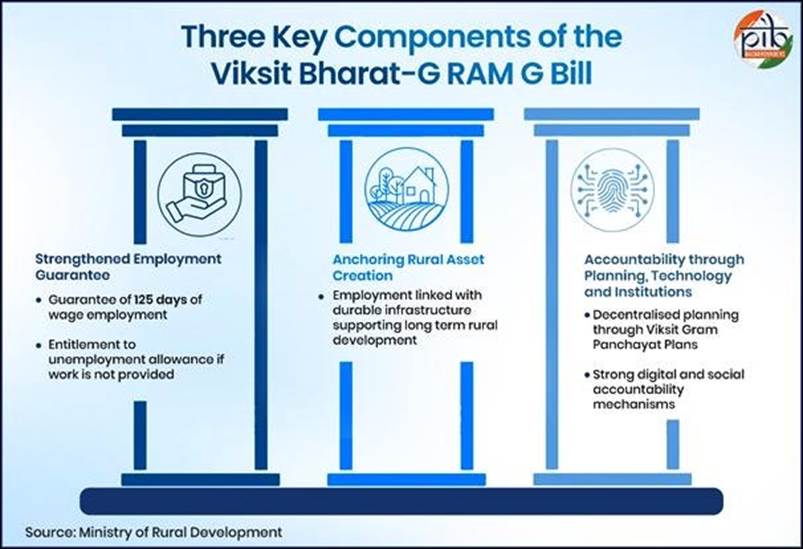
1. Enhanced Employment Guarantee
- 125 days wage employment per rural household (↑ from 100)
- 60-day no-work window during peak sowing/harvesting:
- Prevents farm labour shortages
- Wage payment:
- Weekly, or maximum within 15 days
2. Four Priority Infrastructure Verticals
- Water Security
- Irrigation, recharge, watershed works
- Core Rural Infrastructure
- Roads, connectivity, public assets
- Livelihood Infrastructure
- Storage, markets, production assets
- Extreme Weather Mitigation
- Flood control, drainage, soil conservation
Shift: From temporary works → durable national assets
3. Decentralised but Digitally Integrated Planning
- Viksit Gram Panchayat Plans
- Local needs-based planning
- Integrated with:
- PM Gati Shakti
- National spatial databases
- Assets pooled into:
- Viksit Bharat National Rural Infrastructure Stack
Financial Architecture: A Structural Shift
From Central Sector → Centrally Sponsored Scheme
- Cost sharing:
- 60:40 (Centre:State)
- 90:10 for NE & Himalayan states
- 100% for UTs without legislatures
Why Shift from Demand-Based to Normative Funding?
- Demand-driven model led to:
- Budget volatility
- Fiscal stress
- Normative allocation:
- Objective parameters
- Predictable budgeting
- Employment guarantee retained
Financial Outlay
- Total annual requirement:
₹1,51,282 crore - Central share:
₹95,692.31 crore
Administrative Strengthening
- Administrative expenditure ceiling:
- 6% → 9%
- Enables:
- Better staffing
- Training
- Technical capacity
- Reflects shift from scheme mentality → professional mission mode.
Governance & Institutional Framework
Multi-Level Architecture
- Central & State Gramin Rozgar Guarantee Councils
- Policy direction, accountability
- National & State Steering Committees
- Convergence, performance review
- Panchayati Raj Institutions
- At least 50% of works by cost via Gram Panchayats
- District Programme Coordinators & Programme Officers
- Gram Sabhas
- Mandatory social audits (every 6 months)
Transparency, Accountability & Enforcement
- Central Government empowered to:
- Investigate irregularities
- Suspend fund releases
- Order corrective action
- Digital tools:
- AI-based anomaly detection
- Biometric authentication
- GPS & mobile monitoring
- Public accountability:
- Weekly disclosures
- Real-time MIS dashboards
Social Protection Provisions
- Unemployment allowance:
- Payable after 15 days if work not provided
- Liability on States
- Rates and conditions:
- To be prescribed by rules (flexibility + rights protection)
Benefits: Multi-Stakeholder Impact
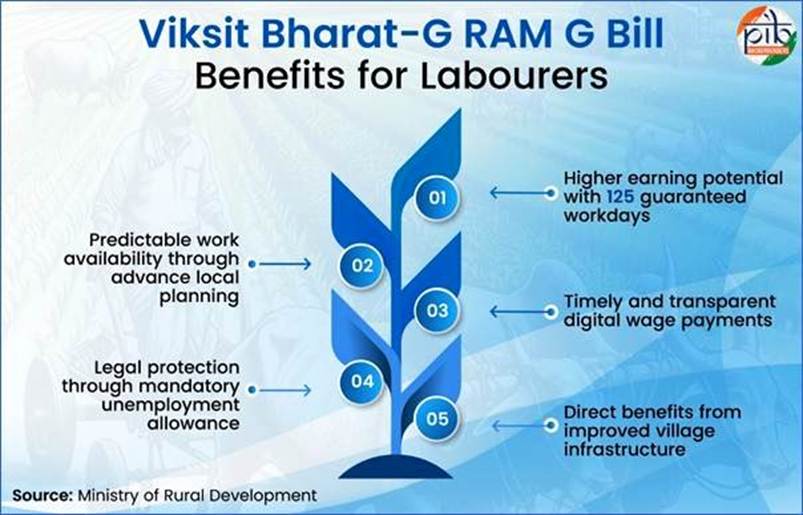
For Rural Households
- Higher income security (125 days)
- Predictable work availability
- Reduced distress migration
For Farmers
- Assured labour during peak seasons
- Improved irrigation & storage
- Prevention of wage inflation
For Rural Economy
- Asset-led growth
- Higher village consumption
- Climate-resilient infrastructure
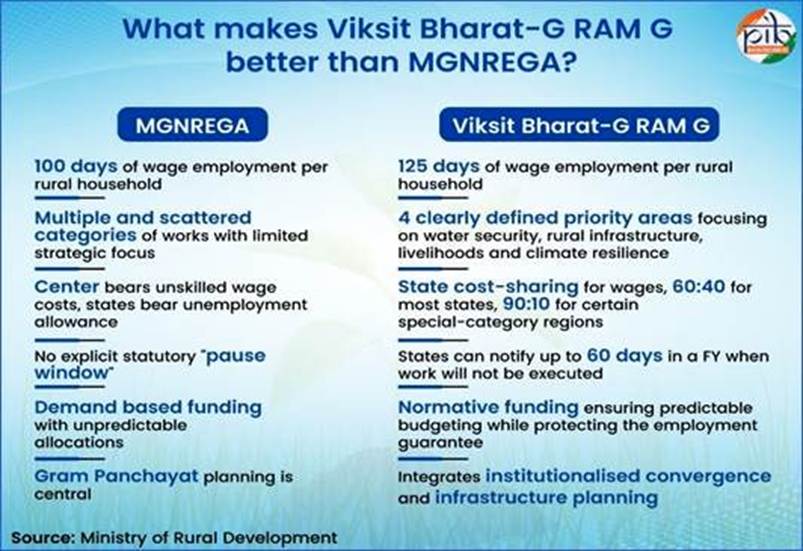
MGNREGA vs Viksit Bharat – G RAM G Bill (At a Glance)
- 100 days → 125 days
- Demand-based → Normative funding
- Temporary assets → Durable infrastructure
- Fragmented planning → National Infrastructure Stack
- Weak enforcement → Explicit central powers
Critical Concerns
- Risk of dilution of demand-driven ethos
- Higher state fiscal responsibility
- Capacity gaps across Panchayats
- AI/biometric over-reliance and exclusion risks
Conclusion
- The Bill marks a paradigm shift:
- From safety-net employment → developmental employment
- Retains legal guarantee while:
- Strengthening infrastructure
- Improving accountability
- Aligning with Viksit Bharat @2047
- Represents second-generation welfare reform:
Outcome-oriented, digitally governed, fiscally predictable.
Gen Z Post Office Initiative – India Post
Why in News?
- December 2025 witnessed multiple inaugurations of Gen Z–themed post offices across Indian campuses, signalling a nationwide rollout:
- Karnataka: Acharya Institute of Technology, Bengaluru (18 Dec 2025)
- Jammu & Kashmir: AIIMS Vijaypur – first AIIMS campus with Gen Z PO (17 Dec 2025)
- Kerala: CMS College, Kottayam – Kerala’s first Gen Z PO (9 Dec 2025)
- Andhra Pradesh: Andhra University campus (9 Dec 2025)
- PIB Delhi releases highlight this as part of India Post’s modernisation and youth-outreach strategy.
- The first Gen Z Post Office in India was earlier inaugurated at IIT Delhi, making this a scaling-up phase, not a pilot.
Relevance
- GS II: Public service delivery, citizen-centric governance, decentralisation
- GS III: Digital infrastructure, financial inclusion, institutional reforms
What is a Gen Z Post Office?
- A reimagined postal service model tailored to Generation Z (born ~1997–2012).
- Moves away from:
- Queue-based, transaction-only post offices
- Towards:
- Campus-embedded, digital-first, community-oriented service hubs
Core Philosophy
Adapt public institutions to citizen behaviour, not citizens to institutions.
Key Objectives
- Re-engage youth with formal public services
- Integrate postal + banking + logistics in a single, friendly space
- Modernise India Post’s institutional image
- Build early financial literacy and trust among students
Core Features (Common Across Campuses)
1. Youth-Centric Design & Space Reimagination
- Work-café aesthetics
- Comfortable seating, charging points, free Wi-Fi
- Recreation corners with:
- Books
- Board games
- Student artwork celebrating:
- Local culture
- India Post heritage
- Informal, non-bureaucratic ambience
2. Digital & Tech-Enabled Services
- Self-Booking Kiosks
- QR-code based instant payments
- Cashless, paper-light transactions
- Simplified workflows suited to DIY-oriented users
Policy linkage
- Digital India
- Ease of Living
- Paperless governance
3. Modernised Postal Services
- Rapid parcel booking and dispatch
- On-campus packaging facilities
- MyStamp printers:
- Personalised postage stamps
- Modern revival of philately
- Special event postal cancellations
4. Financial Inclusion via India Post
- Integrated access to:
- India Post Payments Bank (IPPB)
- Postal savings schemes
- Insurance products
- Awareness generation among:
- Students
- Researchers
- First-time earners
Why Focus on Gen Z?
Behavioural Rationale
- Digital-native
- Cashless-first
- Preference for:
- Informal spaces
- Speed & convenience
- Historically low engagement with traditional post offices
Policy insight
- Early institutional engagement shapes long-term civic and financial behaviour.
Governance Significance
1. Citizen-Centric Governance
- Service design based on user experience
- Shift from rule-centric to user-centric administration
2. Institutional Rebranding
- India Post repositioned as:
- Modern
- Youth-friendly
- Tech-enabled
- Crucial in:
- Fintech era
- Private logistics competition
3. Financial Inclusion & Literacy
- Early exposure to:
- Savings
- Digital banking
- Insurance
- Reduces future exclusion risks
4. Federal & Regional Balance
- Rollout across:
- Metro (Delhi, Bengaluru)
- Southern states
- J&K
- Indicates pan-India scalability, not elite urban focus.
Alignment with National Visions
- Digital India
- Ease of Living
- Financial Inclusion
- Citizen-centric governance
- Viksit Bharat @2047:
- Future-ready institutions
- Youth-first public services
Critical Evaluation
Strengths
- Innovative institutional design
- Student co-creation
- Digital-first delivery
- Financial inclusion potential
- Replicable campus model
Concerns
- Risk of:
- Cosmetic modernisation without outcomes
- Limited reach if confined to elite campuses
- Need for:
- Usage metrics
- Cost-benefit evaluation
- Digital divide concerns for non-tech-savvy users
Way Forward
- Expand to:
- Government colleges
- ITIs
- Universities in Tier-2 & Tier-3 cities
- Measure success via:
- IPPB accounts opened
- Parcel volumes
- Student footfall
- Integrate with:
- Startup logistics
- Scholarship & DBT services
Conclusion
The Gen Z Post Office initiative represents a quiet but significant administrative reform, where India Post adapts itself to the lifestyles, values, and expectations of young citizens. By combining technology, design, sustainability, and participation, it showcases how legacy public institutions can remain relevant in a digital, youth-driven India—fully aligned with the vision of Viksit Bharat.