
Published on Dec 23, 2025
Daily PIB Summaries
PIB Summaries 23 December 2025
Content
- India – New Zealand Free Trade Agreement
- PESA Mahotsav 2025 & the PESA Act, 1996
India – New Zealand Free Trade Agreement
Why in News ?
- 22 December 2025: Press Information Bureau announced conclusion of the India–New Zealand Free Trade Agreement.
- Concluded within ~9 months (March–December 2025) → among India’s fastest-negotiated FTAs.
Relevance
GS II – International Relations
- Bilateral & Regional Groupings
- Strengthens India’s engagement with Oceania / Indo-Pacific economic architecture.
- Enhances India’s role as a rule-shaper in services- and mobility-centric trade agreements.
- India’s Trade Diplomacy Strategy
- Post-RCEP calibrated FTA model: market access + protection of sensitive sectors.
- Continuity with India–UK CETA, India–Oman CEPA → coherent IR–economic alignment.
GS III – Indian Economy
- External Sector & Trade Policy
- 100% duty-free access for Indian exports; addresses tariff escalation barriers.
- Improves export competitiveness in textiles, engineering, pharma, leather, processed foods.
Strategic Context
- Oceania Pivot: Positions India as a preferred economic partner in the Pacific–Oceania supply chains.
- Trade Diplomacy Continuity: Follows India–Oman CEPA (2025), India–UK CETA (2025), EFTA TEPA (2024).
- Geoeconomic Logic: Diversification away from tariff and non-tariff barriers in traditional markets.
India–New Zealand Economic Snapshot
- New Zealand economy:
- Per capita income: USD 49,380
- Imports (2024): USD 47 bn | Exports: USD 42 bn
- Overseas investment stock (Mar 2025): USD 422.6 bn
- Diaspora leverage:
- ~300,000 persons of Indian origin (~5% of NZ population).
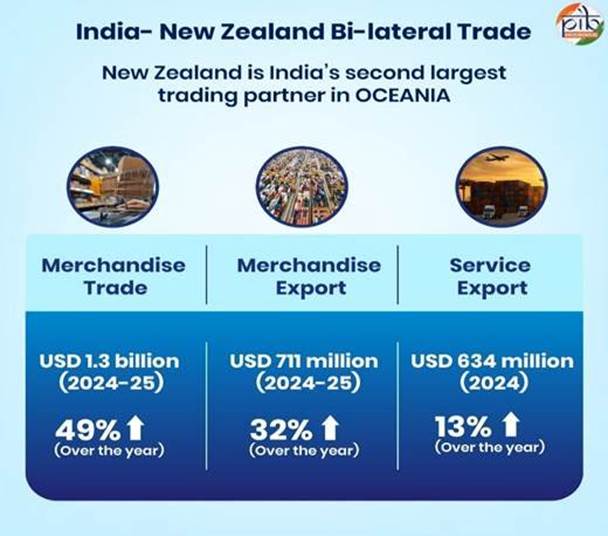
Bilateral Trade Trends
- Merchandise trade:
- USD 873 mn (2023–24) → USD 1.3 bn (2024–25) (+49%)
- Exports: USD 711 mn (+32%)
- India maintains positive trade balance.
- Long-term trend (2015–25):
- Exports from India: +130%
- Imports from NZ: +7.2%
- Services trade:
- USD 634 mn (2024); +13% YoY
- Key sectors: IT, travel, business services.
Core Architecture of the FTA
- Tariff liberalisation:
- 100% duty-free access for Indian exports into NZ (8,284 tariff lines).
- NZ average applied tariff 2.2% → 0% at EIF.
- India’s tariff offer:
- Coverage: 70.03% tariff lines
- Exclusions: 29.97% (dairy, sugar, key agri items, metals, arms).
- Phasing:
- 30%: Immediate elimination
- 35.6%: Phased (3/5/7/10 years)
- 4.37%: Tariff reduction
- 0.06%: TRQs (apples, kiwi, honey, albumins)
Protection of Sensitive Sectors
- Dairy & core agriculture fully excluded → shields small & marginal farmers.
- TRQs + Minimum Import Price + seasonality prevent import surges.
- Reflects India’s calibrated FTA approach post-RCEP exit.
Sector-wise Gains to India
- Textiles & Apparel:
- NZ imports from world: USD 1.9 bn
- Tariffs up to 10% → 0%
- Engineering goods:
- NZ imports: USD 11 bn
- India exports (FY25): USD 77.5 bn globally
- Pharmaceuticals:
- NZ pharma imports: USD 1.4 bn
- Regulatory annex for faster approvals.
- Leather & Footwear:
- NZ imports: USD 0.51 bn
- Zero duty across 181 tariff lines.
- Agri & Processed Food:
- 1,379 tariff lines (17%)
- Tea already zero; others peak 5% → 0%.
Services & Mobility: Biggest Structural Win
- Services coverage:
- Commitments in 118 sectors; MFN in 139 sectors.
- AYUSH & Traditional Medicine Annex (NZ first-ever):
- Ayurveda, Yoga, Siddha, Unani, Homeopathy.
- Coexists with Maori health systems → soft power synergy.
- Student mobility (binding commitments):
- Work: 20 hrs/week
- Post-study visas:
- STEM Bachelor: 3 yrs
- Master’s: up to 3 yrs
- PhD: up to 4 yrs
- Professional mobility:
- 5,000 visas (3 yrs) for:
- AYUSH practitioners, Yoga instructors, Indian chefs, music teachers
- IT, engineering, healthcare, education, construction.
- 5,000 visas (3 yrs) for:
- Working Holiday Visa:
- 1,000 Indians/year, multiple entry, 12 months.
Agriculture & Technology Cooperation
- Action Plans: Apple, Kiwi, Honey.
- Interventions:
- Centres of Excellence
- Planting material & orchard management
- Post-harvest & food safety
- Institutional mechanism:
- Joint Agriculture Productivity Council
- Outcome: Productivity gains without market distortion.
Investment & Regulatory Provisions
- FDI commitment: USD 20 bn over 15 years.
- IPR:
- NZ to amend laws within 18 months for EU-level GI protection.
- Trade facilitation:
- Customs clearance: 48 hrs (24 hrs for perishables)
- Advance rulings, e-documentation.
- Rules of Origin:
- Anti-circumvention safeguards.
Way Forward
- Ratification after domestic processes; EIF expected 2026.
- Model FTA for:
- Services-heavy agreements
- Mobility-centric trade diplomacy
- Balanced agri protection
Conclusion
- The India–New Zealand FTA marks a qualitative shift from tariff-centric FTAs to mobility, services, technology, and soft-power driven trade architecture, aligning directly with Viksit Bharat @2047 goals.
PESA Mahotsav 2025 & the PESA Act, 1996
Why in News ?
- 23–24 December 2025: PESA Mahotsav – Utsav Lok Sanskriti Ka organised by the Ministry of Panchayati Raj at Visakhapatnam.
- Commemorates the anniversary of the Panchayats (Extension to Scheduled Areas) Act, 1996 (PESA).
- Objective: Awareness, capacity-building, and celebration of community-led governance in Fifth Schedule Areas.
Relevance
GS II – Polity & Governance (CORE AREA)
- Constitutional Framework
- Article 244 + Fifth Schedule; operationalisation through PESA.
- Addresses the governance vacuum left by the 73rd Constitutional Amendment.
- Centre–State Relations
- States bound by PESA’s mandatory features; limits legislative discretion.
- Rights-based Governance
- Consent-based land acquisition; protection against displacement.
Constitutional & Demographic Context
- ST population: ~8.6% of India’s population.
- Scheduled Areas notified by the President under Article 244 + Fifth Schedule (excluding Assam, Meghalaya, Tripura, Mizoram).
- 73rd Constitutional Amendment (1993):
- Added Part IX + Eleventh Schedule (29 subjects).
- Did not automatically apply to Fifth Schedule Areas → governance gap.
- PESA Act, 1996 filled this gap by extending Panchayati Raj to Scheduled Areas with tribal-specific safeguards.
Core Philosophy of PESA
- Gram Sabha-centric governance reflecting tribal customary law.
- Asymmetric decentralisation: stronger village-level powers than general PRIs.
- Legal override: State laws cannot dilute PESA-mandated powers.
Salient Features of the PESA Act
- Gram Sabha as the fulcrum:
- Approval of development plans, projects, and programmes.
- Mandatory consultation/consent for land acquisition, rehabilitation.
- Resource sovereignty:
- Ownership & management of Minor Forest Produce (MFP).
- Control over minor water bodies and minor minerals.
- Cultural protection:
- Safeguards customs, traditions, dispute resolution mechanisms.
- Administrative accountability:
- Prior recommendation for mining leases.
- Regulation of money lending.
- Democratic deepening:
- Prevents alienation of tribal land; strengthens social justice.
Fifth Schedule Coverage:
- States with Scheduled Areas: 10
- Administrative footprint (Total):
- Villages: 77,564
- Panchayats: 22,040
- Blocks: 664
- Districts: 45
- Rules status:
- PESA Rules notified: Andhra Pradesh, Chhattisgarh, Gujarat, Himachal Pradesh, Madhya Pradesh, Maharashtra, Rajasthan, Telangana.
- Draft Rules: Odisha, Jharkhand.
Government Implementation Measures
- Capacity-building (2024–25):
- 2 rounds of master trainer programmes.
- >1 lakh elected representatives & officials trained.
- Digital governance:
- PESA–Gram Panchayat Development Plan Portal (launched Sept 2024).
- Enables hamlet-wise planning and tracking of:
- Central & State Finance Commission grants
- CSS, State schemes, local funds.
- Institutional support:
- Dedicated PESA Cell within MoPR (legal, social science, finance experts).
- Knowledge localisation:
- Manuals translated into Telugu, Marathi, Gujarati, Odia + tribal languages (Santhali, Gondi, Bhili, Mundari).
- Centres of Excellence (CoE):
- Indira Gandhi National Tribal University, Amarkantak:
- Central share: ₹8.01 crore (5 years).
- Focus: documentation, training, dispute resolution models, 5 model PESA Gram Sabhas.
- Indira Gandhi National Tribal University, Amarkantak:
Evidence from the Ground: Outcomes & Best Practices
- “PESA in Action” (July 2025):
- Compilation of 40 success stories across states.
1) Livelihoods & Local Economy (Chhattisgarh – Kanker)
- Village: Khamdhogi (443 population).
- Interventions:
- Mandatory male–female household representation in Gram Sabha.
- Committees + technical training.
- Outcomes:
- Forest produce, fisheries, bamboo-based activities.
- Shift from subsistence to diversified livelihoods.
2) Customary Law & MFP (Himachal Pradesh – Kinnaur)
- Product: Chilgoza pine nuts.
- Gram Sabha control over harvesting & revenue sharing.
- Equal household distribution + plot-wise allocation.
- Demonstrates custom + statutory harmony under PESA.
3) Minor Minerals & Revenue (Telangana – Godavari Basin)
- Tribal Sand Mining Cooperative:
- ₹40 lakh annual revenue.
- Funds channelled to education, health, infrastructure.
- Converts extractive activity into community asset creation.
4) Anti-displacement Shield (Rajasthan – Udaipur)
- Gram Sabha vetoed eviction under wildlife sanctuary notification.
- Used PESA + Rajasthan Panchayati Raj Act, 1999.
- Outcome: Land, livelihood, and cultural security preserved.
Governance Impact Assessment
- Economic: Local value capture from forests, minerals, water.
- Social: Inclusion of women, customary institutions revived.
- Political: Real decentralisation beyond devolution on paper.
- Environmental: Community-led sustainable resource management.
Challenges
- Delayed rule-making in some states.
- Variable administrative compliance with Gram Sabha consent.
- Capacity asymmetry across regions.
- Overlap/conflict with forest & mining departments.
Conclusion
- PESA Mahotsav 2025 symbolises a shift from bureaucratic tribal welfare to constitutional self-rule.
- With data-backed capacity-building, digital planning tools, cultural anchoring, and legal empowerment, PESA is evolving into India’s most radical decentralisation experiment.
- Effective implementation is central to inclusive growth, federal justice, and democratic deepening in Scheduled Areas.