
Published on Mar 23, 2026
Daily PIB Summaries
PIB Summaries 23 March 2026
Content
- MY Bharat to Organise Nationwide Shaheed Diwas Padyatra 2026 across 763 Districts under the theme “MY Bharat, My Responsibility”
- Road Safety Conclave 2026: Igniting a Nationwide Movement for Safer Roads and Responsible Citizens
MY Bharat to Organise Nationwide Shaheed Diwas Padyatra 2026 across 763 Districts under the theme “MY Bharat, My Responsibility”
Why in news?
- Ministry of Youth Affairs & Sports (via MY Bharat) is organising a nationwide Shaheed Diwas Padyatra on 23 March 2026 across all 763 districts, reflecting deep administrative penetration and mass civic mobilisation.
- Theme “MY Bharat, My Responsibility” signals a policy shift from commemorative nationalism → participatory citizenship, aligned with Viksit Bharat@2047.
Relevance
GS Paper II (Polity & Governance)
- Civic participation, Fundamental Duties (Art. 51A) operationalisation
- Youth-centric governance, participatory democracy
- Role of state in shaping constitutional patriotism
GS Paper I (Modern History & Society)
- Revolutionary nationalism (HSRA) → ideological diversity in freedom struggle
- Youth mobilisation & nation-building narratives
Practice Question
Q.“India’s demographic dividend can become civic capital only through institutionalised citizen engagement.” Discuss in the context of initiatives like MY Bharat and Shaheed Diwas Padyatra.(250 Words)
Shaheed Diwas
Historical context
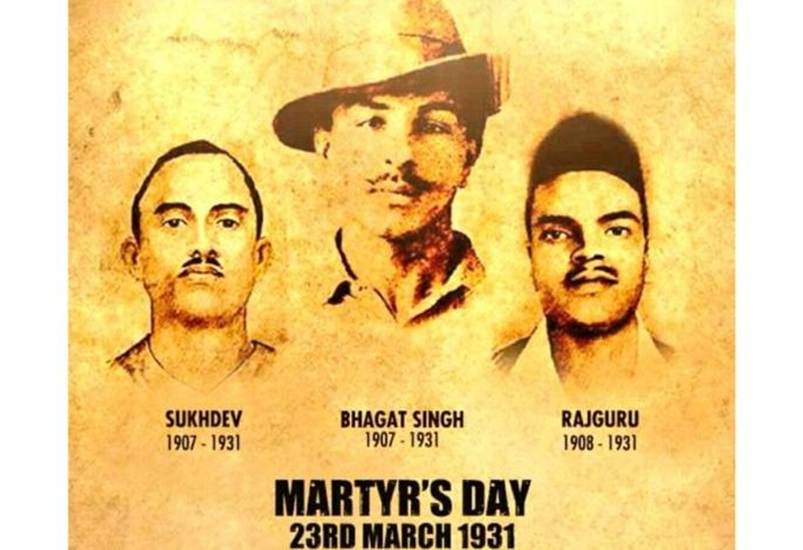
- Observed on 23 March to mark execution (1931, Lahore Central Jail) of:
- Bhagat Singh
- Shivaram Rajguru
- Sukhdev Thapar
- Linked with Lahore Conspiracy Case (1929–31).
- Immediate trigger:
- Assassination of J.P. Saunders (1928) to avenge Lala Lajpat Rai’s death during Simon Commission protests.
Revolutionary ideology & actions
- Members of Hindustan Socialist Republican Association (HSRA):
- Objective → overthrow colonial rule and establish socialist republic.
- Ideological influences:
- Marxism, Leninism, anti-imperialism; Bhagat Singh’s prison writings show advanced political consciousness.
- Key event:
- Central Legislative Assembly bombing (1929):
- Non-lethal; aimed at propaganda → “to make the deaf hear”.
- Central Legislative Assembly bombing (1929):
- Slogan:
- “Inquilab Zindabad” → transformed into mass political idiom.
Historical significance
- Expanded freedom struggle from elite leadership to youth-driven radical nationalism.
- Complemented Gandhian movements by creating multi-dimensional pressure on colonial state.
- Historian Bipan Chandra:
- Revolutionaries had limited military success but immense psychological and ideological impact.
MY Bharat
- Launched in 2023 under Ministry of Youth Affairs & Sports as a phygital youth mobilisation platform.
- Targets youth aged 15–29 (~27% of population) → core demographic dividend segment.
- Creates a national database of volunteers for real-time mobilisation in governance initiatives.
- Focus areas:
- Civic responsibility, environmental action, leadership, social service.
- Integrated with:
- Amrit Kaal priorities + SDGs (Goal 16: institutions, Goal 11: communities).
Significance of the initiative
- Administrative reach:
- Coverage of 763 districts ensures last-mile governance penetration and localised citizen engagement.
- Behavioural change approach:
- Promotes civic habits through:
- Shramdaan (cleanliness drives)
- Road safety awareness
- Public participation campaigns.
- Promotes civic habits through:
- Demographic utilisation:
- India’s ~65% population below 35 years (UNFPA) → converts demographic dividend into civic capital.
- Constitutional orientation:
- Reinforces Fundamental Duties (Article 51A), especially:
- Promoting harmony
- Safeguarding public property
- Striving for excellence.
- Reinforces Fundamental Duties (Article 51A), especially:
- Nation-building linkage:
- Bridges historical memory (freedom struggle) with present civic responsibilities.
Way forward
- Shift from events to institutionalised civic engagement cycles.
- Develop measurable KPIs: Civic participation index, behavioural change indicators.
- Strengthen local anchoring: Panchayats/ULBs as nodal agencies for youth engagement.
- Expand inclusivity: Focus on rural, tribal, women through offline mobilisation + local networks.
- Convergence: Integrate with NSS, NYKS, Skill India, Swachh Bharat Mission.
- Civic education: Embed Fundamental Duties and constitutional values in curriculum and campaigns.
Prelims pointers
- Shaheed Diwas → 23 March (execution of Bhagat Singh, Rajguru, Sukhdev in 1931).
- HSRA → aimed at socialist republic.
- Saunders killing → 1928 (Lahore).
- Central Assembly bombing → 1929 (non-lethal).
- MY Bharat:
- Launched 2023, under Ministry of Youth Affairs & Sports.
Road Safety Conclave 2026: Igniting a Nationwide Movement for Safer Roads and Responsible Citizens
Why in news?
- Road Safety Conclave 2026 held in Delhi under Ministry of Road Transport & Highways (MoRTH) to promote behavioural change and youth-led road safety awareness.
- Participation scale: ~4,000 students + 500 teachers from ~100 schools, indicating grassroots mobilisation through education systems.
- Focus on creating “Road Safety Ambassadors” → shift from enforcement-heavy approach to community-driven compliance.
Relevance
GS Paper II (Governance)
- Public policy implementation (Motor Vehicles Act, Good Samaritan framework)
- Centre–State coordination in road safety governance
GS Paper III (Economy, Infrastructure, Internal Security)
- Road infrastructure safety, logistics efficiency vs safety trade-off
- Public health burden → productivity loss, economic cost (~3–5% of GDP: World Bank estimates)
Practice Question
Q.“Road safety in India requires a shift from enforcement-driven governance to behavioural and systems-based interventions.”Examine with reference to recent initiatives like Road Safety Conclave 2026.(250 Words)
Road safety in India
Scale of the problem
- India accounts for ~11% of global road accident deaths (WHO) despite having ~1% of world vehicles.
- As per MoRTH Road Accidents Report 2022–23:
- ~4.6 lakh accidents annually
- ~1.68 lakh deaths per year → highest globally.
- Most vulnerable:
- Youth (18–45 years) → ~67% of fatalities.
- Two-wheeler users → ~45% of deaths.
Key causes
- Overspeeding → ~70% of accidents.
- Drunk driving, distracted driving (mobile use), non-use of helmets/seat belts.
- Poor road design, black spots, weak enforcement.
Institutional and legal framework
Policy & legal measures
- Motor Vehicles (Amendment) Act, 2019:
- Increased penalties (e.g., drunk driving fine up to ₹10,000).
- Introduced provisions for vehicle fitness, licensing reforms, and protection of Good Samaritans.
- National Road Safety Policy (2010):
- Focus on awareness, safer infrastructure, and data systems.
- Supreme Court Committee on Road Safety (Justice K.S. Radhakrishnan Committee):
- Monitors implementation across states.
Schemes & initiatives
1.PM RAHAT Scheme (Road Accident Victim Hospitalisation and Assured Treatment)
- Launched by Ministry of Road Transport & Highways (MoRTH) in 2026 as a flagship intervention to reduce preventable road fatalities through timely trauma care access.
- Provides cashless treatment up to ₹1.5 lakh per victim for first 7 days, applicable across all categories of roads (NH, SH, urban roads).
- Anchored in Golden Hour principle:
- Nearly 50% of road accident deaths are preventable if treatment is provided within first 60 minutes.
- Medical coverage design:
- Stabilisation care:
- Up to 24 hours (non-critical cases)
- Up to 48 hours (critical cases) subject to police authentication.
- Stabilisation care:
Implementation architecture
- Fully technology-integrated pipeline:
- eDAR (Electronic Detailed Accident Report) → accident data capture.
- TMS 2.0 (National Health Authority) → claim processing and settlement.
- Integrated with Emergency Response Support System (Dial 112):
- Enables ambulance dispatch + nearest hospital mapping.
Funding mechanism
- Funded through Motor Vehicle Accident Fund (MVAF):
- Insured vehicles → contribution from General Insurance Companies.
- Uninsured / hit-and-run → funded through Government budgetary support.
2.Good Samaritan Guidelines (2016, Supreme Court backed)
- Origin:
- Based on Supreme Court directions (SaveLIFE Foundation case, 2016) to encourage bystander assistance.
- Key provisions:
- Protects Good Samaritans from:
- Civil and criminal liability.
- Police harassment and repeated court appearances.
- Protects Good Samaritans from:
- Rights ensured:
- No obligation to disclose identity.
- Can leave hospital immediately after assisting victim.
3.National Road Safety Board (NRSB)
- Established under Motor Vehicles (Amendment) Act, 2019 as an advisory body to Central Government.
- Composition:
- Experts in road engineering, vehicle safety, traffic management, trauma care.
Key functions
- Recommend standards for:
- Road design and safety engineering.
- Vehicle safety norms (crashworthiness, testing).
- Conduct:
- Crash investigations and safety audits.
- Provide technical inputs on:
- road safety policies and interventions.
Government strategy – 4E approach
- Engineering: Black spot rectification, crash barriers, intelligent signage, pedestrian infrastructure.
- Enforcement: E-challan systems, automated cameras, stricter penalties post-2019 Act.
- Education: School-based programs, road safety clubs, awareness campaigns (as seen in conclave).
- Emergency Care: Trauma centres, highway ambulances, Golden Hour response systems.
Infrastructure and technology push
- National Highways network:
- Expanded to ~1.46 lakh km, among largest globally.
- Technology integration:
- AI-based traffic monitoring, Intelligent Transport Systems (ITS).
- FASTag → reduces congestion and accident risk at toll plazas.
- Safety interventions:
- Reflective markings, rumble strips, speed calming measures.
Significance of the conclave
- Behavioural shift strategy: Recognises that ~90% of accidents are due to human error → awareness critical.
- School-based intervention: Targets early-age behavioural conditioning → long-term impact.
- Community multiplier effect: Students influence family behaviour (helmet, seat belt usage).
- Participatory governance: Involves citizens, schools, civil society → beyond state-centric approach.
- Aligns with: UN Decade of Action for Road Safety (2021–2030) → target: 50% reduction in fatalities.
Challenges and gaps
- Implementation deficit: States vary widely in enforcement capacity and compliance.
- Weak urban planning: Lack of pedestrian/cyclist infrastructure → unsafe mobility ecosystems.
- Data issues: Underreporting and lack of real-time accident databases.
- Behavioural inertia: Low compliance with helmet/seat belt norms despite awareness.
- Emergency care gaps: Delays in trauma response → significant fatalities within “golden hour”.
- Institutional overlap: Multiple agencies (MoRTH, State police, municipalities) → coordination challenges.
Way forward
- Data-driven governance: Real-time accident dashboards, AI-based risk mapping.
- Urban design reforms: Complete Streets approach (pedestrian-first planning).
- Strengthen enforcement: Uniform e-enforcement across states with accountability metrics.
- Behavioural nudges: Mandatory road safety curriculum in schools.
- Emergency response upgrade: Universal trauma care within golden hour (≤60 minutes).
- Institutional strengthening: Empower National Road Safety Board with statutory backing.
- Public participation: Scale up Road Safety Clubs and youth ambassador models nationwide.
Prelims pointers
- Motor Vehicles (Amendment) Act → 2019.
- PM RAHAT Scheme → ₹1.5 lakh cashless treatment for accident victims.
- 4E Strategy → Engineering, Enforcement, Education, Emergency Care.
- India road deaths → ~1.68 lakh annually (highest globally).
- FASTag → RFID-based electronic toll collection system.