
Content
- Classrooms of Change: NEP 2020 and the New Era of Schooling
- Higher Education under NEP 2020: Reimagining India’s Academic Landscape
Classrooms of Change: NEP 2020 and the New Era of Schooling
Background and Vision
- Launched on July 29, 2020, NEP 2020 replaces the 34-year-old National Policy on Education (1986).
- Anchored in SDG-4: Inclusive and Quality Education for All by 2030.
- Envisions a learner-centric, flexible, and inclusive education system driven by curiosity, creativity, and critical thinking.
- Integrates India’s civilizational knowledge traditions with 21st-century skills.
Relevance : GS 2(Education , Schemes)
Structural Reforms: 5+3+3+4 and NCFs
- Replaces 10+2 with 5+3+3+4 structure:
- 5 years: Foundational (3 pre-primary + Grades 1–2)
- 3 years: Preparatory (Grades 3–5)
- 3 years: Middle (Grades 6–8)
- 4 years: Secondary (Grades 9–12)
- Supported by:
- NCF-FS 2022: Play-based foundational curriculum (ages 3–8).
- NCF-SE 2023: Multidisciplinary, competency-based learning framework.
Foundational Literacy and Numeracy (FLN) & ECCE
- >85% brain development occurs before age 6 – NEP prioritizes ECCE.
- Key programs:
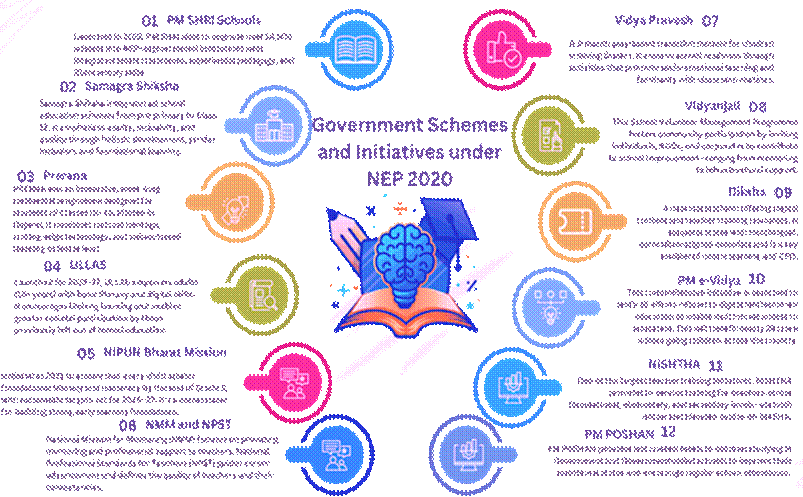
- NIPUN Bharat (2021): Targeting FLN for all by 2026–27.
- Vidya Pravesh: 12-week play-based school readiness program.
- Balvatikas: 3 crore+ children enrolled in pre-primary.
- NCF-FS adopted by all 36 States/UTs.
- Jadui Pitara: Toys, puppets, puzzles for age-appropriate, multilingual learning.
- Digital push: 2,778 FLN content pieces on DIKSHA; e-Jaadui Pitara launched.
- Teacher capacity: 12.97 lakh teachers trained under NISHTHA.
Impact:
- ASER 2024:
- Reading: 23.4% of Class III students in govt. schools read Grade II-level text (vs. 16.3% in 2022).
- Arithmetic: 27.6% perform subtraction (vs. 20.2% in 2022).
- PARAKH 2024: Rural Grade 3 students outperform urban peers in Math & Language.
Universal Access and Equity
- Samagra Shiksha ensures seamless schooling from pre-primary to Grade 12.
- Gross Enrolment Ratio (2023–24):
- Primary: 97.8%
- Upper Primary: 96.57%
- Infrastructure improvements:
- Drinking water (98.4%), Girls’ toilets (97.1%), Electricity (85.1%), Ramps (85.1%).
- Residential Schools:
- 1,137 Netaji Subhash Avasiya Vidyalayas (1.15 lakh SEDG students).
- 5,269 Kasturba Gandhi Balika Vidyalayas (7.58 lakh girls).
- NIOS: Re-integrating out-of-school children and Agniveers with flexible learning.
- Vidyanjali portal: 30,000+ assets contributed; 1.7 crore students impacted.
Inclusion and Disability Support
- PRASHAST app: Early disability screening tool under RPwD Act (2016).
- ISL as a Subject: Indian Sign Language now taught at secondary level.
- 1,000+ ISL videos and talking books in 46 subjects.
- UNESCO King Sejong Literacy Prize (2021) awarded to India for inclusive literacy efforts.
Curriculum Reform & Competency-Based Learning
- Emphasis on experiential, toy-based, and integrated learning.
- New textbooks:
- Mridang (English), Sarangi (Hindi), Joyful Mathematics.
- Introduction of new subject: “The World Around Us” (Grades 3–5).
- Vocational Education:
- Exposure from Grade 3.
- CBSE + UGC notify National Credit Framework (NCrF) implementation in schools (Grades 9–12).
Use of Technology
- DIKSHA platform:
- Available in 133 Indian languages.
- Includes QR-coded textbooks, teacher training (NISHTHA), and student resources.
- PM eVidya:
- “One Nation, One Digital Platform” with 200 DTH TV channels.
- Rashtriya Vidya Samiksha Kendra (RVSK):
- Real-time monitoring via State VSKs.
- Tracks KPIs for evidence-based decisions.
Teacher Development and Capacity Building
- NEP 2020 emphasizes teachers as change agents.
- NISHTHA: Over 14 lakh teachers trained across ECCE and FLN.
- DIKSHA provides:
- Interactive lessons, multilingual content, career advancement modules.
Reforming Assessment and School Quality
- Shift from rote to formative, holistic, and competency-based assessments.
- PARAKH: National Assessment Centre.
- 2024 survey covered 21.15 lakh students and 2.7 lakh teachers.
- Holistic Progress Cards:
- Cover academics, socio-emotional skills, creativity, and community engagement.
- SQAAF (School Quality Assessment and Assurance Framework):
- Quality evaluation across: Administration, Curriculum, Assessment, Infrastructure, Inclusiveness.
Challenges Ahead
- Digital divide persists: Only 72% of schools have internet access.
- Teacher shortages, especially in rural and tribal regions.
- FLN outcomes, while improving, still lag behind global benchmarks.
- Balancing multilingual education with standardisation in assessments.
- Integration of vocational and academic pathways still nascent.
Conclusion: Towards a New Paradigm
- NEP 2020 is a visionary step, aligning education with India’s demographic dividend and global aspirations.
- By fostering joyful learning, inclusion, critical thinking, and teacher empowerment, it transforms Indian classrooms from rote-centric spaces to hubs of innovation and equality.
- Continued investment, capacity building, and community participation will determine whether this reform becomes a revolution.
Higher Education under NEP 2020: Reimagining India’s Academic Landscape
Foundational Vision & Systemic Shift
- NEP 2020: First education policy in 34 years; adopted after 2L+ public suggestions & 5 years of consultations.
- Envisions a flexible, multidisciplinary, learner-centric ecosystem aligned with 21st-century skills and rooted in Indian knowledge systems.
- Anchored in 5 pillars: Access, Equity, Quality, Affordability, and Accountability.
Relevance : GS 2(Education , Schemes)
GER Target & Structural Reforms
- Target: 50% Gross Enrolment Ratio (GER) by 2035.
- 4-year UG programmes with Multiple Entry & Exit (MEME) options—already adopted by 153 universities.
- Academic Bank of Credits (ABC): Digital academic credit repository; 97 CFIs onboarded.
- Biannual Admissions: Implemented to enhance student flexibility and intake capacity.
- Curriculum & Credit Framework (2022): Interdisciplinary, credit-based, portable, and hybrid-friendly.
Inclusion & Access
- PM Vidya Lakshmi Scheme (2024):
- ₹2,358 crore loans sanctioned to 13,358 students; 8,379 loans disbursed.
- Collateral-free up to ₹7.5 lakh; 3% interest subvention for families below ₹8 lakh.
- Target: 22 lakh students annually + 7 lakh more till 2030–31.
- Support for Divyangjans: Inclusive pedagogy guidelines, assistive tech, personalised counselling.
- Standalone colleges converted to multi-disciplinary HEIs by 2040; 1 major HEI per district by 2030.
Digital & Online Education Expansion
- SWAYAM MOOCs: 5.15+ crore enrolments, 16,530+ courses; 388 universities permit 40% credit transfer.
- Virtual Labs: 900+ labs, 1,200+ experiments.
- NDLI: 8 crore+ digital resources (video, text, audio).
- SWAYAM Plus (2024): Industry-aligned digital university base (AI, Data Science).
- Anuvadini & e-KUMBH: Multilingual education in 22 Indian languages.
Equity Through Financing & Schemes
- PM-USHA:
- ₹100 crore to each of 35 public universities for research, autonomy, global linkages.
- Outcome-linked grants tied to NIRF & accreditation scores.
- HEFA (2017–2024):
- ₹44,449 crore sanctioned for 201 projects; benefited IITs, IIMs, NITs, CUs.
- NEAT & IDEA Labs:
- 393 EdTech partners onboarded; 1.15 lakh EWS students aided.
- 423 IDEA Labs established promoting STEM, AI, and experiential learning.
Quality Assurance & Autonomy
- Higher Education Commission of India (HECI): Upcoming single regulator replacing UGC, AICTE, NAAC.
- Graded Autonomy: Performance-based freedom via new Autonomous College (2023) & Deemed University (2023) regulations.
- NAAC Revamp: Outcome-linked metrics (employment, research, community impact).
- NIRF 2.0: Now linked with funding; includes equity, innovation, digital access.
Research, Innovation & Start-ups
- Anusandhan NRF (2023):
- ₹50,000 crore hybrid fund.
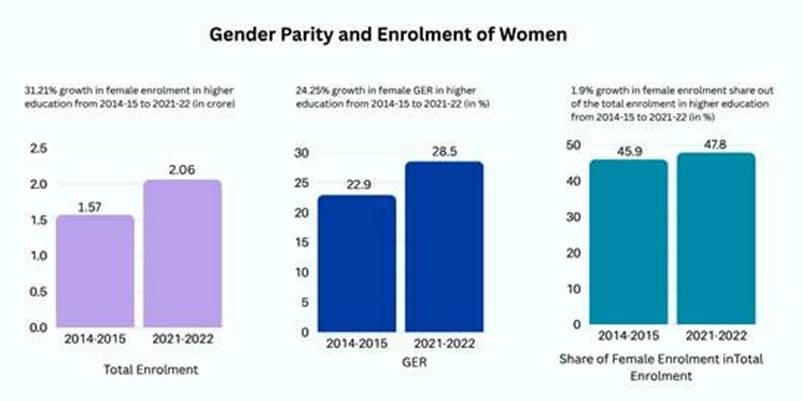
- PhD enrolment: 2.34 lakh (↑100%); Women ↑136%.
- India: 3rd globally in publications (2024); patent filings hit 92,168 (25% by HEIs).
- 16,051 Innovation Councils in HEIs across 28 States/8 UTs.
- KAPILA Scheme: 10,800 patents filed; 71,000 trained in IP literacy.
Faculty & Indian Knowledge Systems (IKS)
- Malaviya Mission (MMTTP): 2.5 lakh faculty trained in AI, STEM, ethics.
- IKS Mission: 51 centres; 88 research projects; 5,527 internships.
- RDCs (Research & Development Cells): Present in 2,871 HEIs.
- ASMITA: 22,000 books in 22 languages by 2029.
Globalization of Indian Higher Education
- Indian HEIs Abroad:
- IIT Madras–Zanzibar, IIT Delhi–Abu Dhabi, IIM Ahmedabad–Dubai.
- Foreign Universities in India:
- Deakin & Wollongong (Gift City), Southampton (Gurugram); 6 others given Letters of Approval.
- Study in India Campaign:
- 47,602 foreign students; 8,000+ courses; 600+ HEIs from 136+ countries.
- Twinning/Dual/Joint Degrees: 103 Indian HEIs collaborating with foreign universities.
- SPARC: ₹515 crore for 799 research projects, 51 patents filed.
Institutional Expansion (2014–2025)
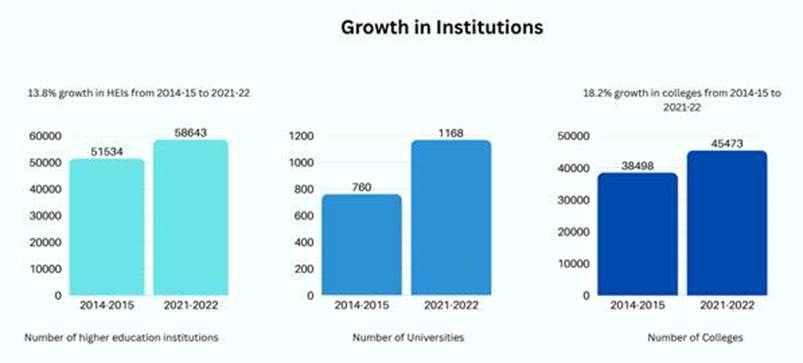
- Total Central HEIs rose from 115 → 157.
- Central Universities: 40 → 48
- IITs: 16 → 23
- IIMs: 13 → 21
- IIITs: 9 → 25
- NITs: 31 → 32
- Sindhu Central University in Ladakh launched PG courses in tech & public policy.
- Centers of Excellence in AI: IISc (Health), IIT Kanpur (Sustainable Cities), IIT Ropar (Agri), IIT Madras (Education) — ₹1,490 crore combined outlay.
International Rankings & Reputation
- India: Most represented in QS Asia Rankings 2025 – 163 universities out of 987.
- 7 Indian universities in Asia’s Top 100 (IITs, DU, IISc).
- QS Subject Rankings 2025: 79 Indian HEIs, 10 among global top 50.
- Strengthening global academic brand via dual degrees, SPARC, and Study in India.
Conclusion: India’s Higher Education – Future-Ready
NEP 2020 is not just a reform, but a reimagination of the Indian academic landscape:
- Bridging equity, inclusion, and excellence.
- Digital-first, industry-aligned, and research-driven.
- Positioned to become a global education and innovation hub by 2047.