
Content
- Smart Finance, Smart Future: GIFT City
- 8.2% GDP: India’s Growth Story Strengthens
Smart Finance, Smart Future: GIFT City
What is GIFT City?
- India’s first International Financial Services Centre (IFSC) under SEZ Act, 2005.
- Located in Gandhinagar, spread over ~1000 acres, expanding to 3300+ acres (DTA + GIFT SEZ).
- India’s first operational smart city + integrated financial hub.
- Hosts 1034+ registered entities, 38 banks, asset base $100.14 bn.
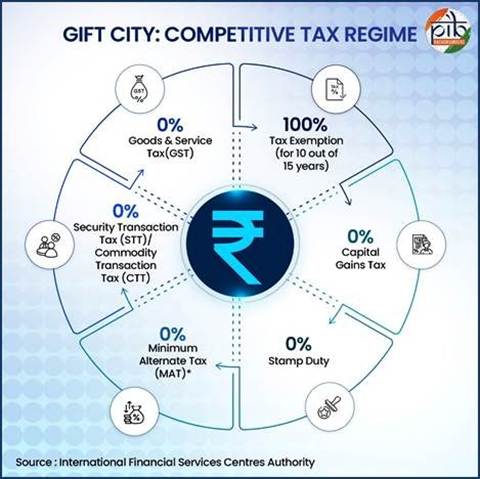
- Offers 10-year income tax holiday in a 15-year block.
- Competes with Singapore, Dubai, Hong Kong.
Relevance:
GS 3 – Economy
- International Financial Services Centre (IFSC): role in financial sector reforms.
- Capital markets, global financial integration, offshore vs onshore financial hubs.
- Regulatory architecture (IFSCA Act 2019) → institutional reforms.
- SEZ Act, tax incentives, competitiveness in global finance.
GS 3 – Infrastructure
- Smart city infrastructure: district cooling, utility tunnels, zero-discharge water, 99.999% power reliability.
- High-speed connectivity, metro linkages, airport access.
- Tier-IV data centre & digital backbone as critical infrastructure
Origins and Vision
- Conceived to bring offshore financial services onshore.
- Aims to position India as a top global financial centre by 2047.
- Strategy pillars:
- Attract global capital
- Enable regulatory innovation
- Build fintech-led financial infrastructure
- Generate high-skilled jobs
- Government-backed integrated planning ensures walk-to-work, sustainability, ease of doing business.
Governance and Regulatory Architecture
International Financial Services Centres Authority (IFSCA)
- Statutory regulator under IFSCA Act, 2019.
- Unifies powers of RBI, SEBI, IRDAI, PFRDA for IFSC.
- Regulates products, institutions, conduct, supervision.
- IFSC units treated as non-residents under FEMA → enhances international competitiveness.
Single Window Governance
- Powers delegated from SEZ Development Commissioner to IFSCA.
- SWITS (Single Window IT System) enables integrated approvals.
Key Institutions
India International Bullion Exchange (IIBX)
- Launched 2022; world-class bullion trading ecosystem.
- Complies with OECD due diligence standards.
- Enables transparent gold imports and bullion-linked financial products.
Financial Ecosystem Snapshot (2025)
- Fund Managers (FMEs): 194
- IFSC Exchanges: 2, monthly turnover $89.6 bn
- GIFT NIFTY monthly turnover: $102.35 bn
- Insurance + intermediaries: 52
- Aircraft lessors: 37 (303 aircraft leased)
- Ship lessors: 34 (28 ships leased)
- Banking assets: $100.14 bn
- Cumulative transactions: $142.98 bn
GIFT City as a Global GCC/GIC Hub
- Financial groups set up Global In-House Centres (GIC/GCC) under IFSCA GIC Regulations, 2020.
- Operate in foreign currency; serve global markets.
- Major players:
- Infineon (750 staff), Technip Energies (500), TELUS (500)
- Accenture, Capgemini, IBM, NASSCOM CoE
FinTech Growth Engine
Regulatory Framework
- FinTech regulations notified April 2022.
- Dual entry route: Direct Authorization + Sandbox.
- 20 FinTech/TechFin entities, 8 sandbox participants.
- Big players: Wipro, Infosys, Cognizant, Hexaware, KFintech, Signzy.
Fintech Innovation & Research Centre
- Joint initiative: Govt of Gujarat + Asian Development Bank.
- Partners: IITGN, Ahmedabad University, UC San Diego, Plug and Play.
- Focus: R&D, incubation, global collaboration.
Business Setup Framework
- Entities must be from FATF-compliant jurisdictions.
- Allowed structures: Company, LLP, Branch.
- Must be linked to financial products/services.
- IFSC units = non-resident status → regulatory clarity.
Infrastructure Excellence: GIFT as a Smart City
Utility Innovations
- District Cooling System: 30% energy saving.
- Automated Waste Collection System: Pneumatic, zero manual transport.
- 17-km Utility Tunnel: Digging-free city.
- Zero-Discharge Water: 24×7 potable supply; sewage reuse.
- Power Reliability: 99.999% uptime (≈5.3 min outage/year).
- Tier IV Green Data Centre: 99.999% uptime + global certifications.
Transport Connectivity
- Metro to Ahmedabad–Gandhinagar.
- 20 min from Ahmedabad airport.
- 15 min from high-speed rail terminal (proposed).
- EV bus network; NH-48 Delhi–Mumbai corridor.
Social Infrastructure
- 21-acre Central Park, riverfront, Lilavati Hospital.
- City Command Centre (C4): SCADA-based utility monitoring; 70,000+ I/O sensors.
Talent and Education Hub
- Access to top-tier institutions: IIM-A, IIT-Gn, GMU.
- Local professional pool:
- 86,000 software engineers
- 71,000 finance professionals
- 21,000 management professionals
- 142% growth in AI-skilled talent (Ahmedabad).
Global Universities
- Operational: Deakin University, University of Wollongong.
- Upcoming: Queen’s University Belfast, Coventry University.
- AISPs enable foreign campuses via infrastructure support.
Business Highlights (2025)
- 1034+ entities across finance, insurance, capital markets, fintech, leasing.
- Jumped to 46th in Global Financial Centres Index (2025).
- Ranked 5th among emerging centres; topped reputation index.
- Dollar loan market: $20 bn disbursed; overtook Singapore, London for India-linked dollar loans.
Fiscal & Non-Fiscal Incentives
Direct Tax
- 10-year tax holiday within 15-year block (Sec 80-LA).
- Reduced TDS on interest income.
Indirect Tax
- No GST on IFSC transactions.
- Custom duty exemption for SEZ imports.
Other Incentives
- No STT, CTT, stamp duty.
- Exemptions under Companies Act.
- 100% PF reimbursement.
- Gujarat IT/ITeS incentives: CAPEX/OPEX support, electricity duty waiver.
Why GIFT City is Rising Globally ?
- Unified regulator + predictable policy regime.
- Offshore-like environment within Indian jurisdiction.
- High-end infrastructure + global-grade digital backbone.
- Increasing shift of treasury operations, aircraft leasing, ship leasing, fintech innovation to GIFT.
- Strategic location in one of India’s fastest-growing economic corridors.
Challenges & Concerns
- Needs deeper liquidity, global investor diversity.
- Global competition from Singapore, Dubai, Shanghai.
- Talent density still lower than global hubs.
- Fiscal incentives must align with WTO rules.
- Regulatory adaptation needed for emerging products (crypto-assets, carbon markets, green finance).
Why It Matters ?
- Instrument for financial sector reforms, capital account liberalisation.
- Aligns with Viksit Bharat 2047, Make in India, Aatmanirbhar Bharat.
- Anchor for India’s fintech and digital public infrastructure exports.
- Critical for globalising Indian rupee, boosting India-linked dollar loan markets.
- Enhances India’s position in global financial diplomacy.
Conclusion
- GIFT City has evolved into India’s most ambitious financial ecosystem—combining global-grade regulation, infrastructure, talent, and incentives.
- Its fast-growing fintech, aircraft leasing, bullion trading, and capital market segments position it as a future rival to global hubs.
- With sustainability and innovation at its core, GIFT City is central to India’s aspiration to become a top global financial centre by 2047.
8.2% GDP: India’s Growth Story Strengthens
Why Is This in News?
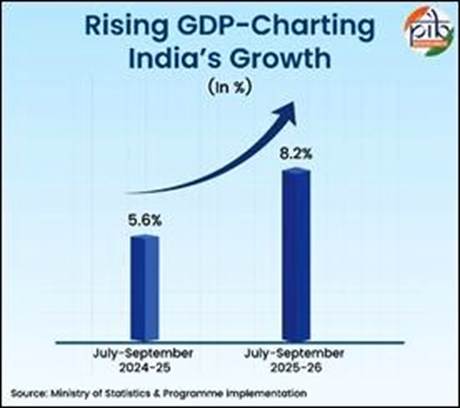
- PIB released Q2 FY26 macroeconomic data showing 8.2% real GDP growth, reaffirming India as the fastest-growing major economy.
- Headline CPI dropped to 0.25% (record low in current series), raising debate on disinflation, deflation risks, and policy stance.
- IIP, exports, labour participation, and GST collections showed broad-based improvement, signalling strong domestic momentum despite global slowdown.
Relevance:
GS 3 – Economy
- Macro indicators: GDP, GVA, CPI, WPI, IIP → core macroeconomic fundamentals.
- Sector-wise performance: primary vs secondary vs tertiary.
- Disinflation, deflation risk, monetary policy trade-offs (RBI 2–6% band).
- Labour market dynamics: LFPR, WPR, unemployment, EPFO data.
- Export performance: services dominance, electronics exports → value-chain upgrading.
- PLI scheme impact on manufacturing revival.
- Fiscal indicators: GST revenues, structural reforms.
- Global agencies’ growth projections → investor confidence.
What Is GDP and Why It Matters
- GDP = market value of all final goods and services produced within a country.
- Real GDP adjusts for inflation → reflects true output growth.
- GVA = GDP + taxes – subsidies; shows sectoral strength.
- GDP growth indicates economic momentum, investment cycles, employment generation.
Headline Findings (Q2 FY26 + Apr–Sep H1)
GDP
- Real GDP: 8.2% in Q2 vs 5.6% last year.
- Real GDP H1 FY26: 8% vs 6.1% in FY25.
- Nominal GDP Q2: 8.7%.
Sectoral GVA
- Primary: 3.1% (weather-linked, structural stagnation).
- Secondary: 8.1% (manufacturing-heavy recovery).
- Tertiary: 9.2% (services remain the growth engine).
Inflation Trajectory (CPI + WPI)
CPI (Retail Inflation)
- October 2025 CPI: 0.25%, lowest in current CPI series.
- Food inflation (CFPI): –5.02% → major driver of disinflation.
- Rural CPI: –0.25%; Urban CPI: 0.88%.
WPI (Wholesale Inflation)
- October 2025 WPI: –1.21%.
- WPI food inflation: –5.04%.
- Driven by lower crude, metals, food prices.
Policy Interpretation
- Inflation well within RBI’s 2–6% band.
- Supports neutral–accommodative monetary stance.
- Raises medium-term questions: disinflation vs demand softening.
Industry & Manufacturing: IIP Signals
IIP (September 2025)
- Overall IIP: 4% YoY.
- Manufacturing: 4.8% → main driver.
Top Sub-sectors
- Basic metals: 12.3%.
- Electrical equipment: 28.7%.
- Motor vehicles: 14.6%.
Use-Based Classification
- Infrastructure/Construction Goods: 10.5%.
- Consumer Durables: 10.2%.
- Intermediate Goods: 5.3%.
Interpretation
- Strong investment cycle revival.
- Healthy demand for consumer durables.
- Manufacturing expansion aligns with PLI impact.
Employment Trends: Labour Market Strength
Macro Labour Indicators
- LFPR: 55.4%, highest in 6 months.
- WPR: 52.5%.
- Unemployment: 5.2% (stable).
- Female LFPR: 34.2% (improving but structurally low).
EPFO Data
- Net additions: 21.04 lakh in July 2025.
White-Collar Hiring (Naukri JobSpeak)
- Hiring up 10.1%.
- AI-ML jobs: +61%.
- Fresher hiring: +15%.
Interpretation
- Labour market broadening across sectors.
- Services + technology driving job growth.
- Need for continued skilling to align workforce.
Trade & External Sector
Exports (Apr–Oct 2025)
- Combined exports: +4.84% (USD 491.8 bn).
- Merchandise exports: +0.63%.
- Services exports: +9.75% (USD 237.5 bn) → India’s stronghold.
Top Merchandise Growth Areas
- Electronics: +37.8%.
- Cashew: +28.32%.
- Other cereals: +25.52%.
- Marine products: +16.18%.
Export Market Growth
- Spain: +40.7%.
- China: +24.8%.
- Hong Kong: +20.7%.
- USA: +10.1%.
Interpretation
- India moving up value chains.
- Services cushion global goods-market slowdown.
- PLI boosting electronics export capability.
Government Policy Push: Structural Drivers
Manufacturing
- PLI: ₹1.97 lakh crore; investment attracted: ₹1.76 lakh crore.
- Skill India, Make in India → ecosystem building.
Labour Market
- PMKVY → 27 lakh trained.
- NAVYA → skilling adolescent girls.
- PMMY: ₹4.91 lakh crore sanctioned.
- 17th Rozgar Mela → 51,000 appointment letters.
Trade
- Export realization window extended → 15 months.
- Credit Guarantee Scheme → ₹20,000 crore credit facility to exporters.
- Export Promotion Mission → outlay of ₹25,060 crore.
GST 2.0
- Two-slab structure: 5% & 18%.
- GST collection (Oct 2025): ₹1.96 lakh crore (+4.6%).
Growth Projections (Global Agencies)
| Agency | Projection |
| RBI | 6.8% FY26 |
| World Bank | 6.5% (2026) |
| Moody’s | 6.4% (2026), 6.5% (2027) |
| IMF | 6.6% (2025), 6.2% (2026) |
| OECD | 6.7% (2025), 6.2% (2026) |
| S&P | 6.5% (FY26), 6.7% (FY27) |
High convergence across agencies → confidence in India’s fundamentals.
Big-Picture Takeaways
Strengths
- Broad-based GDP growth.
- Manufacturing revival → PLI impact visible.
- Services remain globally competitive.
- Inflation sharply moderated.
- Export ecosystems improving.
- Labour participation improving.
Emerging Concerns
- Excessively low CPI could indicate:
- demand softening in rural economy,
- agricultural stress.
- Primary sector growth modest (2.9%).
- Women’s LFPR still low compared to peers.
- WPI deflation may pressure MSME margins.
Strategic Implications
- India entering investment-led growth cycle.
- Strong macro stability enables fiscal room before 2029.
- Disinflation offers policy bandwidth for growth-supporting reforms.
- Need to improve:
- rural incomes,
- agricultural productivity,
- skilling for AI-driven jobs,
- export diversification.