
Published on Oct 29, 2025
Daily PIB Summaries
PIB Summaries 29 October 2025
Content
- Elderly in India
- Farmer’s Welfare: Integrated Cold Chain and Value Addition Infrastructure (ICCVAI)
Elderly in India
Definition and Demographic Overview
- Definition: As per National Policy on Older Persons (1999), “elderly” = persons aged 60 years and above.
- 2011 Census: ~104 million elderly (8.6% of total population).
- 2036 Projection (TGPP 2020): ~230 million (≈15% of total population).
- 2050 Projection (LASI 2021): ~319 million (≈20% of population).
- Growth Rate: Annual increase of ~3%.
- Sex Ratio: 1,065 females per 1,000 males (elderly women = 58% of total elderly).
- Dependency Ratio: 62 dependents per 100 working-age persons.
Relevance
- GS-1 (Society & Population): Demographic transition, ageing trends, regional disparities, and gendered ageing patterns.
- GS-2 (Governance & Welfare): Legal protection (Maintenance & Welfare Act, 2007), constitutional duties (Art. 41), and welfare schemes (AVYAY, IGNOAPS, NPHCE).
- GS-3 (Economy): “Silver economy” as an emerging growth sector; pension sustainability and fiscal implications of ageing.
Regional Demographic Patterns
- High elderly concentration: Southern States (Kerala, Tamil Nadu, Andhra Pradesh) + Himachal Pradesh + Punjab.
- Kerala: Elderly share to rise from 13% (2011) → 23% (2036) (highest in India).
- Uttar Pradesh: From 7% (2011) → 12% (2036) (younger demographic).
- Implication: Regional disparities in aging to widen, mirroring developed-country trends in the South.
Drivers of Ageing
- Declining fertility rate (below replacement in several states).
- Rising life expectancy due to better nutrition, healthcare, and sanitation.
- Declining mortality and urbanisation leading to longer lifespans.
Key Challenges Faced by the Elderly
Health
- Non-communicable diseases, dementia, Alzheimer’s, disabilities.
- Lack of geriatric infrastructure and rural health services.
- Mental health stigma and limited long-term care facilities.
Economic
- Low pension coverage (unorganised sector ~90% workforce).
- Inflation and medical costs exceeding savings.
- Inadequate old-age income security mechanisms.
Social
- Erosion of joint families; rising neglect and isolation.
- Increase in single and widowed elderly women (54% widows among elderly women).
Digital Divide
- Barriers to accessing e-services, healthcare, and entitlements.
- Need for digital literacy programs for older citizens.
Infrastructure
- Public spaces and transport not elderly-friendly.
- Absence of ramps, railings, accessible washrooms in urban design.
Legal and Policy Framework
Constitutional Basis
- Article 41: Duty of State to provide assistance to the aged.
- Directive under Article 46: Protection of weaker sections.
Key Legislations
- Maintenance and Welfare of Parents and Senior Citizens Act, 2007
- Legally binds children/heirs to provide maintenance to parents.
- Establishes maintenance tribunals and old-age homes.
- Maintenance and Welfare of Parents and Senior Citizens (Amendment) Bill, 2019
- Broadens “children” (includes step/adoptive/in-law).
- Removes ₹10,000 ceiling on maintenance.
- Mandates “life of dignity” standard.
- Ensures geriatric care, hospital priority, homecare, police nodal officers.
Institutional Framework
- Nodal Ministry: Ministry of Social Justice & Empowerment (MoSJE).
- Collaborating Ministries: Health & Family Welfare, Finance, AYUSH, Rural Development, etc.
- Support Mechanisms: Panchayati Raj Institutions, NGOs, CSOs, private sector.
Major Government Schemes for Elderly
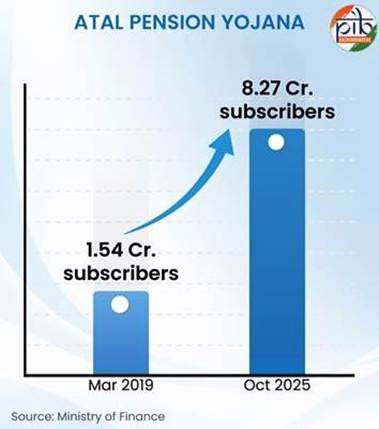
Atal Pension Yojana (APY)
- Launch: 2015; age 18–40 yrs; guaranteed pension ₹1,000–₹5,000/month after 60.
- Subscribers: 8.27 crore (as of Oct 2025).
- AUM: ₹49,000 crore+.
- Government guarantees shortfall if returns fall below assured pension.
Atal Vayo Abhyuday Yojana (AVYAY)
- Umbrella scheme for elderly welfare and empowerment.
- Components: IPSrC, RVY, SAGE, SACRED, Elderline, Geriatric Care Training.
Integrated Programme for Senior Citizens (IPSrC)
- Financial aid to NGOs/States for old age homes, mobile medicare units, physiotherapy clinics.
- 696 homes operational; 84 new homes (2025–26) sanctioned.
Rashtriya Vayoshri Yojana (RVY)
- Free assistive devices for BPL elderly or income ≤₹15,000/month.
- Devices via ALIMCO; doorstep delivery for 80+ seniors.
Elderline (Helpline 14567)
- Toll-free national helpline for grievances, emotional support, and guidance.
- Operational since 1 October 2021.
Senior Care Ageing Growth Engine (SAGE) Portal
- Encourages start-ups in elderly care sector.
- Equity support: up to ₹1 crore/project via IFCI (Govt stake ≤49%).
- Promotes “silver economy” innovation.
SACRED Portal
- Launched: 1 October 2021.
- Job-matching portal for senior citizens (60+).
- Facilitates re-employment with dignity.
Geriatric Caregivers Training
- Trains professionals for elderly care (clinical + non-clinical).
- 32 institutes empanelled (2023–24); 36,785 trained.
Ayushman Bharat – PMJAY
- ₹5 lakh annual coverage for secondary/tertiary healthcare.
- Expansion (2024): Free treatment for 6 crore senior citizens (70+).
- 40 lakh elderly enrolled (as of Jan 2025).
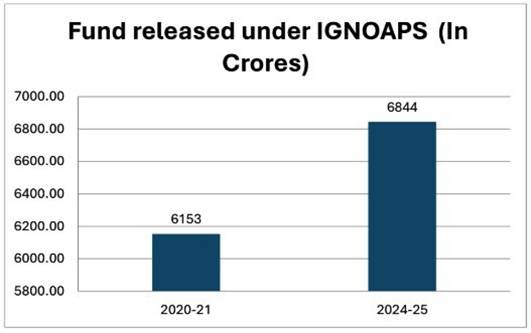
Indira Gandhi National Old Age Pension Scheme (IGNOAPS)
- Under NSAP; ₹200/month (60–79 yrs), ₹500/month (80+ yrs).
- 2.21 crore beneficiaries (Oct 2025).
National Programme for Health Care of the Elderly (NPHCE)
- Since 2010–11; comprehensive healthcare at all levels.
- Covers all 713 districts; geriatric wards, OPDs, physiotherapy.
Senior Citizens Welfare Fund (SCWF)
- Formed under Finance Act, 2015.
- Financed by unclaimed EPF, PPF, insurance, small savings.
- Managed by MoSJE for elderly welfare schemes.
Role of Technology
- Telemedicine (NPHCE, e-Sanjeevani): Remote consultations for homebound/rural elderly.
- Wearables: Health monitoring, fall detection, emergency alerts.
- Online Pharmacies & Smart Homes: Medication access, remote safety monitoring.
- Senior Citizens Welfare Portal: Single-window access to schemes and services.
Social and Community Support
- Family support: Primary care system; eroding due to migration & nuclearisation.
- Intergenerational initiatives: NAITIK PATAM (2025) game to foster family bonding and moral education.
- Community models: Senior clubs, volunteer networks, and PRIs-led outreach.
Housing and Urban Design
- Model Guidelines for Development and Regulation of Retirement Homes, 2019:
- Promotes age-friendly, accessible housing.
- Encourages private participation in elder housing.
Emerging Concept: “Silver Economy”
- Definition: Economic ecosystem catering to goods and services for the 50+ demographic.
- Market size: ₹73,000 crore (2024); rapid growth expected.
- Opportunity: Elderly = wealthiest global age cohort; promotes entrepreneurship and employment in eldercare, wellness, and technology.
Policy Priorities and Way Forward
- Recognise Senior Care as a specialised regulated sector.
- Enhance public-private collaboration for service delivery.
- Integrate geriatric health, social protection, housing, and digital access.
- Strengthen inter-ministerial convergence and state-level monitoring.
- Develop evaluation frameworks for policy effectiveness.
- Leverage PRIs, ULBs, NGOs, and start-ups for localised elderly welfare.
Summary
- Demographic Dividend → Dependency Challenge: India’s ageing curve demands a shift from youth-centric welfare to lifelong welfare.
- Gendered Ageing: Feminisation of old age calls for gender-sensitive pension, health, and safety measures.
- Economic Repercussions: Labour force contraction, pension load, and healthcare demand intensification.
- Policy Imperative: Shift from welfare-based to rights-based, participatory ageing framework.
Conclusion
India’s ageing population presents both a challenge and an economic opportunity.
To harness the potential of the “Silver Generation”, India must ensure:
- Inclusive health and social security.
- Productive engagement and re-employment opportunities.
- Technology-enabled independence and dignity.
A robust ecosystem driven by policy convergence, innovation, and compassion will ensure that ageing in India remains not a burden—but a dividend.
Farmer’s Welfare: Integrated Cold Chain and Value Addition Infrastructure (ICCVAI)
Context & Background
- Post-harvest losses: Estimated 4.6–15.9% for major crops (ICAR-NCCD, 2020), especially perishables.
- Objective: Build a seamless cold chain from farm gate to consumer to reduce losses, raise farmer incomes, and stabilize food supply.
- Implementing Ministry: Ministry of Food Processing Industries (MoFPI).
- Umbrella Scheme: Pradhan Mantri Kisan Sampada Yojana (PMKSY).
- Restructured: 2016–17; earlier existed as standalone Cold Chain Scheme.
Relevance
- GS-2 (Governance & Welfare): Farmer welfare, institutional mechanisms, convergence under PMKSY.
- GS-3 (Economy, Agriculture & Infrastructure): Agri-logistics, post-harvest management, cold chain technology, food processing industry.
- GS-3 (Science & Tech): Food irradiation, IoT, AI, and renewable energy in agriculture.
- GS-3 (Employment): Rural job creation through processing and logistics sectors.
Objectives
- Create integrated cold chain and preservation infrastructure.
- Link farm-level units to distribution hubs and retail points.
- Reduce wastage and improve farmer price realization.
- Promote value addition and diversification in perishables.
- Enhance employment generation and export competitiveness.
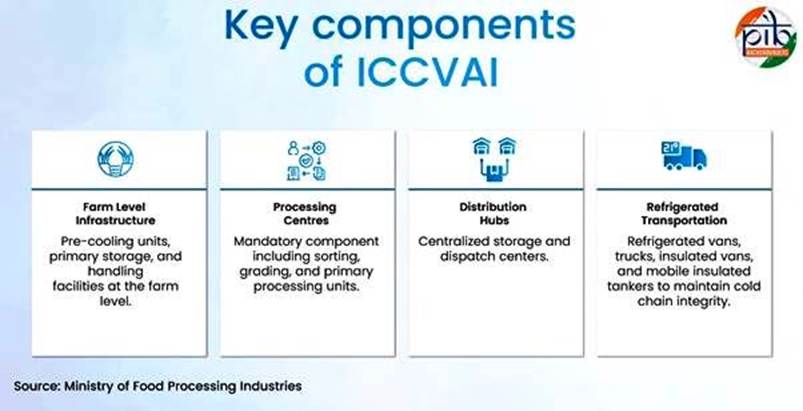
Key Components (as per 22 May 2025 guidelines)
- Farm Level Infrastructure (FLI): Pre-cooling, grading, primary processing.
- Distribution Hub (DH): Cold stores, ripening chambers, sorting/packing units.
- Refrigerated/Insulated Transport: Reefer trucks, milk tankers, fish containers.
- Technology Integration: Temperature & humidity control, traceability systems.
Eligible Project Implementing Agencies (PIAs)
- Individuals including farmers.
- FPOs/FPCs, SHGs, Cooperatives, NGOs.
- Private Companies, Firms, PSUs, Corporations.
- Applications invited through Expressions of Interest (EOIs).
- No State NOC required, but coordination encouraged.
Complementary Schemes
- Mission for Integrated Development of Horticulture (MIDH):
- Cold storage up to 5,000 MT; subsidy 35% (General), 50% (NE, Hilly, Scheduled Areas).
- Operation Greens (TOP to TOTAL):
- Stabilises Tomato, Onion, Potato (later expanded to other perishables and shrimp).
- Focuses on integrated value chains & price stabilization.
- National Horticulture Board (NHB):
- Subsidy 35–50% for cold storage (5,000–20,000 MT).
- Agriculture Infrastructure Fund (AIF):
- ₹1 lakh crore corpus, collateral-free loans up to ₹2 crore.
- 3% interest subvention on term loans.
Financial Assistance Structure
- Grant/Subsidy:
- 35% of eligible project cost (General areas).
- 50% for Difficult areas / SC-ST / FPO / SHG projects.
- Max assistance: ₹10 crore/project.
- Difficult Areas: NE States, J&K, Ladakh, Himachal, Uttarakhand, ITDP areas, Islands.
- Budget:
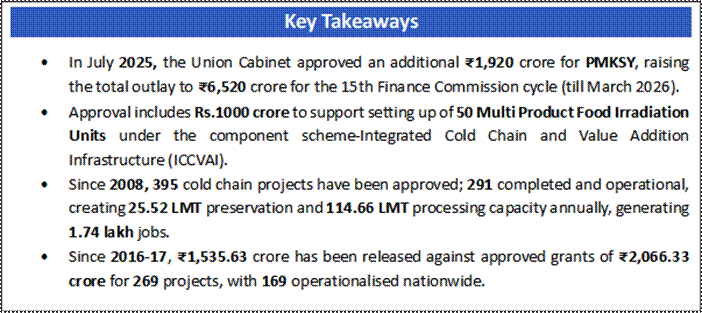
- PMKSY total outlay (2025): ₹6,520 crore (up from ₹4,600 crore).
- Includes ₹1,000 crore for 50 multi-product food irradiation units.
Achievements (as of June 2025)
- 395 projects approved since inception (2008).
- 291 operational →
- Preservation capacity: 25.52 LMT/year.
- Processing capacity: 114.66 LMT/year.
- Employment: 1.74 lakh jobs generated.
- Post-2016 acceleration: ₹1,535.63 crore released for 269 projects.
Key Policy Updates
- June 2022:
- Fruits & vegetables removed; shifted to Operation Greens for targeted intervention.
- August 2024:
- Added Food Irradiation Units (ionising radiation for shelf-life extension).
- May 2025:
- New operational guidelines → stronger farm-to-consumer linkages, emphasis on non-horticulture perishables.
Evaluation & Impact
- NABCONS 2020 Study:
- Significant reduction in wastage for Fruits, Vegetables, Dairy, Fisheries.
- Improved market access and farmgate prices.
- Promotes income diversification, price stabilization, and food security.
- Supports Make in India and Atmanirbhar Bharat by strengthening agri-logistics.
Technological Integration
- IoT-enabled cold storage monitoring.
- AI-based logistics optimization.
- Energy-efficient refrigeration systems.
- Blockchain traceability for supply chain transparency.
Challenges
- High capital & operating costs.
- Limited skilled manpower for cold chain maintenance.
- Power reliability issues in rural areas.
- Need for cluster-based approach to ensure viability.
Way Forward
- Develop PPP-based cold chain clusters near production belts.
- Integrate with e-NAM, FPO networks, and export corridors.
- Promote renewable-powered cold storage (solar-based).
- Encourage skill training in refrigeration & logistics.
- Establish national-level digital dashboard for real-time cold chain data.
Conclusion
- ICCVAI exemplifies adaptive and technology-driven agricultural governance.
- Transition from storage-centric to value-chain centric design ensures both farmer welfare and consumer stability.
- With policy convergence under PMKSY and funding expansion, India is moving toward a resilient, climate-smart, and value-added agri-economy.