
Published on Sep 30, 2025
Daily PIB Summaries
PIB Summaries 30 September 2025
Content
- India’s Dairy Sector
- Sacred Stages: Traditional Ritual Theatres of India
India’s Dairy Sector
Basics
- India’s global position: No. 1 in milk production; contributes ~25% of global supply.
- Economic weight: Dairy is India’s largest agri-product, ~5% of GDP; supports 8 crore+ farmers.
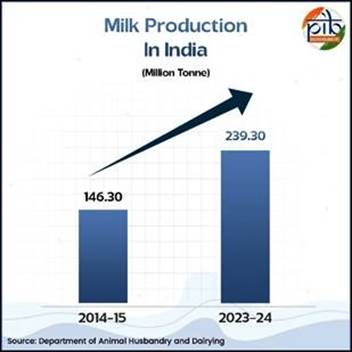
- Growth: Milk output rose 63.56% in a decade (146.3 MT in 2014–15 → 239.3 MT in 2023–24).
- Per capita supply: 471 g/day (2023–24), 48% rise in 10 years; global average = 322 g/day.
- Artificial insemination (AI): 565.55 lakh AIs done in 2024–25.
Relevance
- GS-3 (Economy, Agriculture & Food Security): Rural livelihoods, Agri-value chains, Livestock productivity, White Revolution 2.0, Nutritional security.
- GS-2 (Governance & Social Justice): Cooperative models, Women empowerment, Inclusive growth, Policy implementation (Rashtriya Gokul Mission, NDDB).
Nutrition Dimension
- Milk = near-complete food: proteins, vitamins, minerals, lactose, milk fat.
- Critical for children’s growth, bone health, and nutrition security.
- Contributes to reducing malnutrition and undernutrition across all age groups.
Socio-Economic Dimension
- Touches 8 crore+ rural households; majority are small & marginal farmers.
- Women’s participation: ~70% of dairy workforce; 35% active in cooperatives.
- 48,000+ women-led cooperatives; 16 fully women-run MPOs under NDDB Dairy Services.
- Income diversification: steady cash flow compared to seasonal agriculture.
Growth in Animal Resources
- Bovine population: 303.76 million (cattle, buffalo, mithun, yak).
- Productivity growth: +27.39% (2014–2022), highest globally (vs global avg. 13.97%).
- Supporting livestock: goats (148.88M), sheep (74.26M).
- Key schemes: Rashtriya Gokul Mission (RGM), Livestock Health Disease Control Programme (LHDCP), Mobile Veterinary Units (MVUs).
- Integration of Ayurveda & Ethno-Veterinary Medicine (EVM) for sustainable livestock health and tackling antibiotic resistance.
Cooperative Network
- 22 milk federations, 241 district unions, 28 marketing dairies, 25 MPOs.
- Coverage: 2.35 lakh villages; 1.72 crore members.
- Model: Farmer-owned, decentralized collection, assured market.
- Recognition: Shreeja MPO (women-led) won International Dairy Federation’s Dairy Innovation Award.
Historical Journey
- 1965: NDDB established at Anand, Gujarat.
- 1970: Operation Flood launched (Verghese Kurien’s leadership) → India turned from milk-deficient to world’s largest producer.
- 1987: NDDB declared Institution of National Importance by Parliament.
Key Initiatives
Rashtriya Gokul Mission (RGM)
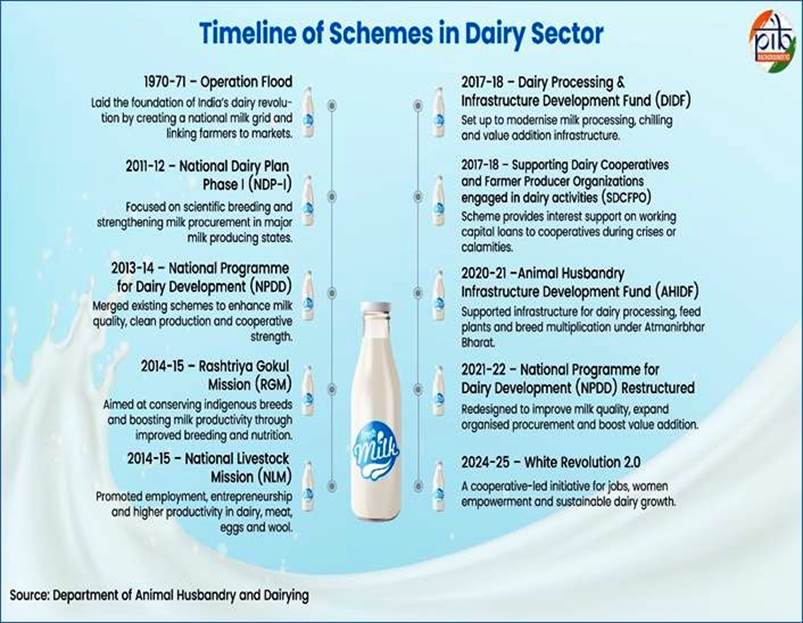
- Launched 2014, revised 2025 (allocation ₹3400 crore for 2021–26).
- Focus: indigenous breeds, semen stations, AI expansion, breed improvement (sex-sorted semen).
- Result: Milk production up 63.56% in 10 years; productivity up 26.34%.
Artificial Insemination & Breeding
- 33% bovines covered under AI (vs 70% still natural service).
- NAIP: 9.16 crore animals covered, 14.12 crore AIs, 5.54 crore farmers benefited.
- 22 IVF labs set up; 10.32 million sex-sorted semen doses produced.
- MAITRIs: 38,736 technicians trained, delivering AI at farmers’ doorsteps.
- Progeny testing: 3747 bulls tested (2021–24); 132 breed multiplication farms sanctioned.
Future Vision – White Revolution 2.0 (2024–29)
- Goal: Strengthen cooperatives, women empowerment, job creation, sustainability.
- Milk procurement target: 1007 lakh kg/day by 2028–29.
- 75,000 new Dairy Cooperative Societies to be formed; 46,422 existing societies to be strengthened.
- Sustainability push through 3 new Multi-State Cooperative Societies (MSCS):
- Cattle feed, mineral mixtures, technical inputs.
- Organic manure, biogas, circular economy (cow dung & agri-waste utilization).
- Management of hides, bones, horns of fallen animals.
Overview
- Nutrition Security: Dairy addresses protein-energy malnutrition, micronutrient deficiency, complements mid-day meals & ICDS.
- Income Security: Daily cash flow + women’s participation → stabilizes rural economy.
- Inclusivity: 70% women workforce makes it one of the most gender-inclusive sectors.
- Sustainability: Integration of Ayurveda, EVM, organic manure, biogas aligns with SDGs 2 (Zero Hunger), 5 (Gender Equality), 12 (Responsible Consumption), 13 (Climate Action).
- Challenges:
- Low AI coverage (only 33%).
- Climate vulnerability (fodder stress, water scarcity).
- Need for higher cold-chain and processing capacity.
- Market volatility & dominance of unorganized sector.
- Opportunities:
- Dairy exports (value-added products like cheese, whey, ghee).
- Agri-tech & digital solutions in dairy value chain.
- Rural employment multiplier effect (8 crore households).
- White Revolution 2.0 can replicate Operation Flood’s transformative scale with sustainability focus.
Conclusion
- India’s dairy sector has evolved from a subsistence activity to a global leader, ensuring both nutrition security and rural income stability.
- Women-led cooperatives, scientific breeding, and sustainability initiatives are shaping White Revolution 2.0 as a driver of inclusive rural transformation.
- With productivity gains, value addition, and climate-smart practices, India can consolidate its role as the dairy hub of the world.
Sacred Stages: Traditional Ritual Theatres of India
Basics
- Ritual Theatre: A form of performance combining sacred ritual and dramatic expression, rooted in temples, festivals, and collective memory.
- Core Features: Acting, singing, dance, music, narration, puppetry/pantomime. Beyond entertainment → cultural, ethical, spiritual functions.
- UNESCO Recognition: Classified as Intangible Cultural Heritage (ICH) for their role in identity, continuity, and social cohesion.
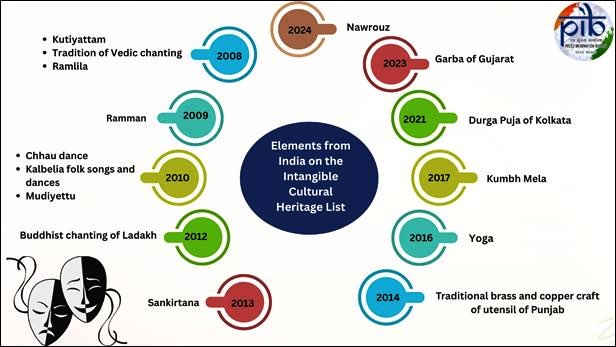
- ICH in India: 15 elements inscribed in UNESCO list; ritual theatres inscribed include Kutiyattam, Mudiyettu, Ramman, Ramlila.
Relevance
- GS-1 (Art & Culture): Indian theatre traditions, UNESCO’s Intangible Cultural Heritage, role of community in cultural preservation.
- GS-2 (Governance): Role of institutions (Sangeet Natak Akademi, UNESCO collaboration), cultural policy, safeguarding heritage.
- GS-3 (Economy, Tourism, Social Development): Cultural industries, heritage-based tourism, livelihood generation through traditional arts.
UNESCO’s Framework of ICH
Five domains under the Convention for Safeguarding ICH:
- Oral Traditions & Expressions (including language).
- Performing Arts.
- Social Practices, Rituals & Festive Events.
- Knowledge & Practices Concerning Nature & the Universe.
- Traditional Craftsmanship.
Key Ritual Theatres of India
1. Kutiyattam (Kerala)
- 2000-year-old Sanskrit theatre tradition blending classical + local elements.
- Features: Abhinaya (eye-hand expressions), long training (10–15 years), performances up to 40 days.
- Sacred space: Kuttampalams (temple theatres).
- Themes: Mythology, Sanskrit dramas.
- Community role: Patronage around temples, ritual audiences.
- UNESCO ICH: Inscribed in 2008.
2. Mudiyettu (Kerala)
- Ritual dance-drama depicting Kali vs Darika.
- Performed annually in Bhagavati Kavus post-harvest.
- Rituals: Purification, drawing of kalam (image of goddess).
- Entire village participation: cross-caste roles (mask-making, costumes, performers).
- Transmission: Oral apprenticeship.
- Fusion: Dance, music, visual arts, masks.
3. Ramman (Uttarakhand)
- Annual festival (April) in Saloor-Dungra villages for deity Bhumiyal Devta.
- Features: Ramayana recitations, masked dances, local legends, ritual theatre.
- Sacred space: Temple courtyard.
- Instruments: Dhol, Damau, Manjira, Jhanjhar, Bhankora.
- Strong caste/community-based role division; collective funding.
- Transmission: Oral, apprenticeship.
4. Ramlila (North India)
- Dramatic enactment of the Ramcharitmanas by Tulsidas.
- Major during Dussehra (Ayodhya, Ramnagar, Varanasi, Vrindavan, etc.).
- Duration: 10–12 days (Ramnagar version = 1 month).
- Performed in temple grounds/public squares.
- Amateur actors from community → values of dharma, bhakti, social cohesion.
Thematic Commonalities
- Divine Storytelling: Mythological epics (Ramayana, Kali legends, Sanskrit dramas).
- Sacred Space: Temple halls, courtyards, ritual precincts.
- Community Participation: Collective labour, caste-based roles, village patronage.
- Transmission of Knowledge: Oral, guru-shishya parampara, long apprenticeships.
- Fusion of Art Forms: Drama, music, dance, ritual, masks, puppetry, visual arts.
Institutional Role – Sangeet Natak Akademi
- Established: 1953; apex body for performing arts.
- Functions:
- Documentation & Archiving (audio-visuals, manuscripts, national archive).
- Training (guru-shishya programs, workshops, capacity building).
- Awards (SNA Awards, Fellowships, Ustad Bismillah Khan Yuva Puraskar).
- Research & Publications (books, journals, monographs).
- Festivals (National Theatre Festival, Dance Festivals).
- Collaboration with UNESCO & States (ICH nominations, state funding).
- Support to Artistes (stipends, grants, costume/training aid).
Overview
- Cultural Identity: Rooted in communities, reinforcing shared memory & ethics.
- Social Cohesion: Collective participation across caste, class, gender.
- Heritage Conservation: UNESCO + state efforts safeguard ICH against decline.
- Challenges: Declining patronage, urban migration, commercialization, high costs of costumes/training.
- Opportunities:
- Linking ICH with tourism (cultural circuits).
- Using digital platforms for wider archiving & outreach.
- Strengthening community-driven preservation.
- Expanding ICH education in schools/HEIs for intergenerational transfer.
Conclusion
- Ritual theatres like Kutiyattam, Mudiyettu, Ramman, and Ramlila are living embodiments of India’s sacred traditions, not static relics.
- They serve as bridges between the divine and the everyday, sustaining continuity through community effort and ritual practice.
- Preserving them ensures not only cultural pride but also India’s contribution to global heritage safeguarding.